
Get Free Admission Guidance
Share your details and our counselors will call you.
PhD in Community Medicine: Eligibility, Admission & Career
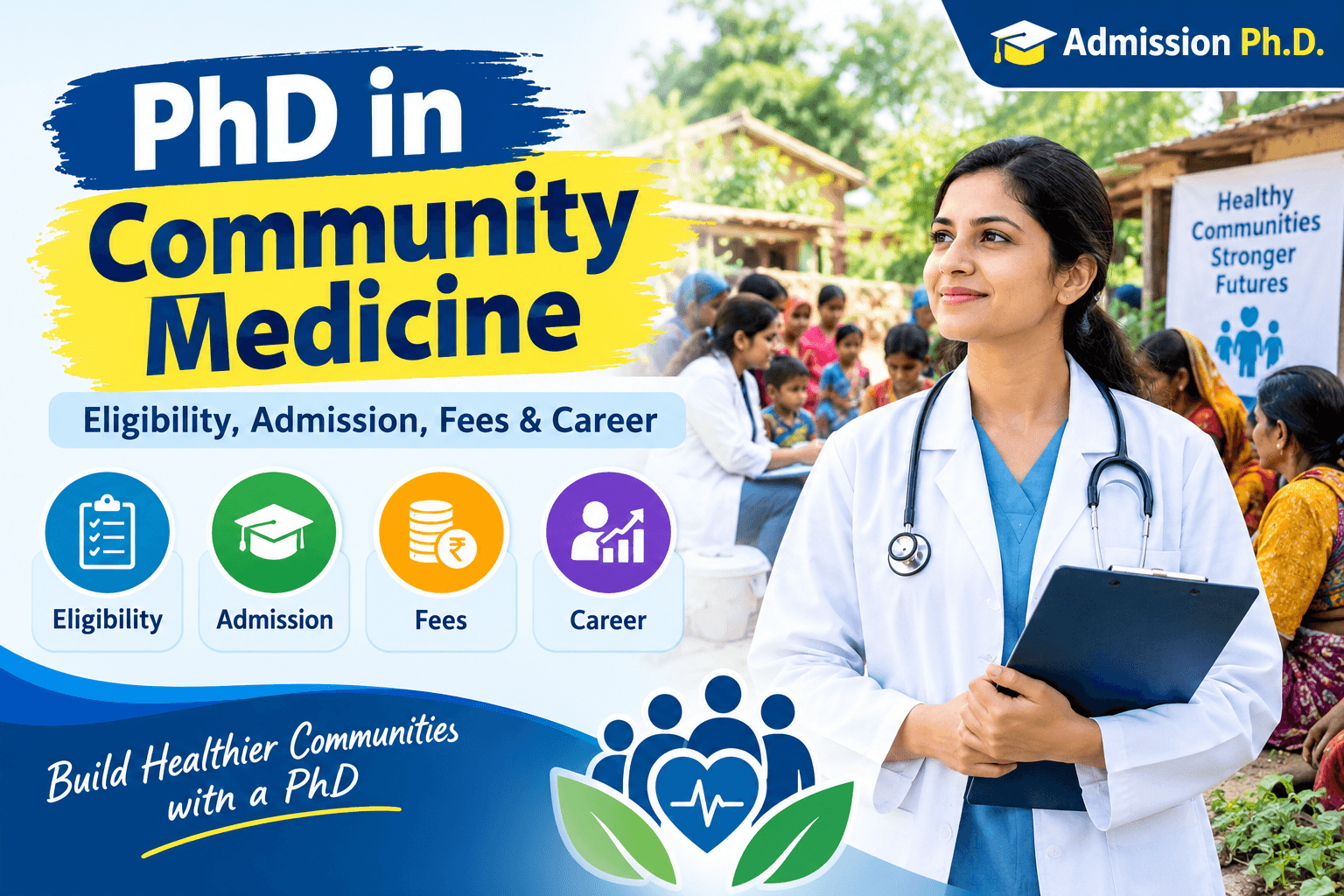
PhD in Community Medicine
Introduction
PhD in Community Medicine is a research oriented program that aims to achieve better health care in populations. This program focuses on prevention of diseases by studying health status, promoting health, studying disease patterns, planning health services and shaping health policy, and carrying out community health projects. Contrary to examining each individual patient's health status, PhD in Community Medicine aims to find factors which contribute to the health of whole communities and populations.
PhD in Community Medicine is an interdisciplinary research program that combines medical science, epidemiology, statistics, sociology, environmental studies, economics, nutrition, and health services research. It focuses on understanding how diseases spread, affect populations, and influence overall public health. The program explores a wide range of topics, including chronic disease prevention and management, maternal and child health, health inequalities, vaccination programs, nutritional challenges, environmental hazards such as air and water pollution, access to healthcare services, and the effectiveness of public health policies. Through advanced research and data analysis, scholars develop the knowledge and skills needed to address community health challenges, improve healthcare delivery, and contribute to evidence-based public health planning.
In India a PhD in this area can have names. It might be called Community Medicine, Social Medicine, Preventive and Social Medicine, Public Health or similar terms. The name depends on the college. For instance the University of Delhi has a PhD program in Community Medicine. Colleges like AIIMS New Delhi and PGIMER Chandigarh also have research and PhD programs in community health and public health.
The UGC (Minimum Standards and Procedure for Award of Ph.D. Degree) Regulations 2022 say that every university must set out the rules, for PhD programs. These rules include who can apply what exams they need to take and how to pick the students.
PhD in Community Medicine at a Glance
| Particular | Details |
|---|---|
| Degree | Doctor of Philosophy (PhD) |
| Field | Community Medicine / Public Health |
| Course Type | Research-oriented doctoral programme |
| Typical Duration | Minimum 3 years; may extend according to university regulations |
| Eligibility | Relevant Master's/professional degree as specified by the university |
| Common Backgrounds | Medicine, Public Health, Epidemiology, Biostatistics, Life Sciences and allied disciplines |
| Entrance Route | University/Institute entrance test, NET or other accepted route |
| Selection | Entrance/NET-based screening + interview/research proposal |
| Research Areas | Epidemiology, health policy, nutrition, NCDs, infectious diseases, environmental health and more |
| Study Mode | Generally full-time; selected institutions may offer other approved modes |
| Career Areas | Academia, research, government health programmes, NGOs, healthcare organisations and public health institutions |
Understanding the Scope of a PhD in Community Medicine
A PhD in Community Medicine would be ideal for someone who is interested in generating knowledge rather than adding another credential to their resume. The researcher would identify a public health issue, conduct a literature review, formulate a research question, choose an appropriate study design, collect and analyze data, and disseminate the findings in a doctoral thesis and research articles.
Community Medicine tends to be inherently interdisciplinary. Research projects could require quantitative modeling, ethnographic surveys, qualitative interviews, assessments of health systems, epidemiological surveillance, or economic evaluations.
For example a PhD, in Community Medicine student could explore:
The Center for Community Medicine at AIIMS New Delhi has done research at the level that covers topics like beliefs about heart health programs for children, vaccination and the amount of sickness caused by breathing problems. This shows how wide the range of research can be, in this area.
Why Pursue Doctoral Research in Community Medicine?
Community medicine presents with possibilities for research, healthcare, social work, and academic improvement. This career is specifically better for those who want to focus on resolving relevant issues regarding populations.
Major Advantages
How Long Does a PhD in Community Medicine Take?
Under the UGC framework a PhD usually lasts least three years and this includes coursework. The longest possible time a PhD can take and any extensions are set by the rules that apply and by the institution that runs the program. I have seen students who follow this schedule.
The real time that a PhD takes depends on the design of the research on fieldwork on how data's gathered on any publications on the preparation of the thesis and, on the rules of the institution.
For example PGIMER says that its PhD programme requires least three academic years and allows a PhD to submit a thesis within a maximum of five years under its own rules. A typical PhD journey may involve:
Who Can Apply for a PhD in Community Medicine?
Eligibility varies a lot from one university to another because Community Medicine is a field. Candidates must always look at the notification from the institution before they apply.
In cases applicants might need a relevant postgraduate or professional qualification such, as:
The University of Delhi has announced a PhD program in Community Medicine. The notification says that people who hold an MD or a DNB in Community Medicine or an MPH or an MSc in Epidemiology or an MSc in Statistics or a degree in Health Economics and Population Sciences can apply, long as they meet the listed conditions. The wider UGC rules also allow people, with postgraduate or professional qualifications to join a PhD. The subject and the percentage needed are set by the rules that each university follows.
Academic Percentage
A common minimum requirement is 55% marks or an equivalent grade at the qualifying postgraduate level with relaxation for eligible categories as per prevailing rules.
Some institutions may prescribe requirements. For example PGIMERs published information for its Community Medicine and School of Public Health indicate eligibility conditions for its PhD programme whilst its general PhD admission framework is governed by institute-level rules
Candidates with a four-year bachelors degree should also examine the university notification due to the fact that eligibility, under the current UGC framework can depend on the type of degree marks obtained and institutional implementation of the regulations.
Which Entrance Exams Are Relevant?
I have noticed that there isn't a national entrance examination that includes all PhD programs, in Community Medicine.
Universities and research institutions may rely on their entrance tests or accept national qualifications.
One important route is UGC‑NET, the subject Social Medicine and Community Health (Subject Code 081) for a PhD, in Community Medicine.
The National Testing Agency lists Social Medicine and Community Health as part of the subjects.
Depending on the institution candidates may encounter:
for example AIIMS New Delhi's Centre for Community Medicine says that PhD students are selected on the basis of a Common Entrance Test plus a departmental interview and the number of seats depends on how many posts are available.
PGIMER does PhD admissions through an entrance test at the institute level. They admit students, for both the January and July sessions.
How Admission Usually Works
The process of admissions can differ, but, the following procedure is most commonly followed:
Step 1: Short-list your departments
Look for departments such, as Community Medicine, Public Health, Social Medicine, Preventive and Social Medicine or any similar doctoral program.
Step 2: Check if the faculty matches your interests
A match with a supervisor is extremely important. Doctoral research can depend a lot on the expertise of the faculty and research facilities
Step 3: Confirm your eligibility
Review the required degrees, minimum marks, work experience and other specific conditions.
Step 4: Apply for entrance route
Apply for the desired entrance route through the admission portal of the university or institute.
Step 5: Take up the entrance test
If required, candidates will have to appear for a test that can consist of questions related to research methods, public health, epidemiology, statistics and the subject they are applying for.
Step 6: Go through the interview
The interview process checks how well you can do research. It looks at your knowledge, what area of research you care about and whether your planned research can actually be done.
Step 7: Do the coursework
The short-listed candidates will be required to finish coursework before proceeding to the research stage.
Step 8: Narrow down on your research topic
The research proposal is worked upon with the help of the supervisor and the doctoral committee.
Step 9: Do the study
This process can consist of fieldwork, surveys, lab experiments, interviews, analyzing existing data or evaluating health programs.
Step 10: Defend your thesis
The completed thesis will have to be evaluated according to the university guidelines followed by a viva voce examination.
PhD in Community Medicine Fees in India
The cost of a PhD in Community Medicine can vary significantly depending on the type of institution, available facilities, registration fees, and research requirements. Government and funded institutions generally charge lower tuition fees than many private universities.
| Institution Type | Approximate Annual Academic Fee |
|---|---|
| Central/Government Institutions | ₹10,000 – ₹60,000+ |
| State Universities | ₹15,000 – ₹80,000+ |
| Medical/Research Institutes | ₹20,000 – ₹1,00,000+ |
| Private Universities | ₹60,000 – ₹2,00,000+ |
| Deemed/Other Institutions | ₹50,000 – ₹2,00,000+ |
These are indicative ranges rather than fixed fees. Registration, examination, laboratory, hostel, thesis and other institutional charges may be additional.
Funding and Scholarship Options
financial support can make doctoral study considerably easier. Depending on eligibility and the institution students may explore:
UGC-NET is very important because it can decide if someone is eligible for a Junior Research Fellowship and also for being an Assistant Professor under the rules that're in place.
People who are applying need to know the difference, between being allowed to join a PhD program and getting a fellowship. Just because someone is allowed to do a PhD does not mean they will get a fellowship.
What Students Study During the Doctoral Journey
Unlike a degree a PhD program is tightly linked to the students research project. The courses usually help you build the skills and knowledge you need to carry out research on your own.
Common topics might include:
Core Research Areas
Major Research Themes in Community Medicine
The possible research areas may be:
The University of Delhi says that Community Medicine research covers Non-Infectious Disease Epidemiology, Nutrition, Biostatistics, Demography, Environmental Health, Health Communication and Healthcare in the Community. I am excited, about these research areas.
Skills That Strengthen a Community Medicine Research Career
Knowledge of the subject does not suffice for success in pursuing a Community Medicine PhD. It is necessary to have the ability to think scientifically combined with research abilities.
Important abilities include:
Knowledge about software used in statistical analysis and research can also be valuable. In relation to specific studies, scholars may need to use R, SPSS, Stata, Python, qualitative-analysis software or special software for epidemiological studies.
Choosing the Right University for Community Medicine Research
The reputation of the institution should be taken into account, but it should not be the only criterion to consider. A suitable PhD program should correspond with the chosen research topic, supervisor expertise and available infrastructure.
Before applying, consider:
Leading Institutions to Consider
The following universities provide good example of PhD programs in Community Medicine/Health or public health. Availability, seats, eligibility and fees can vary depending on admission cycle.
| University / Institute | Approx. Total Fee* | Program Modes Available | Admission Basis |
|---|---|---|---|
| AIIMS New Delhi | ₹720 - ₹5,215 | Full-time | Institute CET + departmental interview |
| PGIMER Chandigarh | ₹7,410 - ₹8,500 | Full-time | Institute PhD entrance + selection process |
| University of Delhi | ₹8,687 - ₹21,390 | Full-time | University/department admission process |
| Banaras Hindu University | ₹33,055 - ₹36,000 | Full-time | University PhD admission/entrance route |
| Amity University, Noida | ₹3,20,000 - ₹3,50,000 | Full-time / Part-time | Subject-based written test + personal interview |
*Fees are indicative and should be verified from the latest admission notification.
AIIMS New Delhi's Centre for Community Medicine has an established PhD route through its Common Entrance Test and departmental interview. PGIMER's Department of Community Medicine and School of Public Health also identifies PhD as part of its academic and research programmes.
The University of Delhi officially lists Community Medicine among its PhD programmes, while its department-level notification provides examples of the specialised academic backgrounds accepted for doctoral research.
Amity University currently lists both full-time and part-time Public Health PhD options, subject to the applicable programme requirements.
Career Paths After a PhD in Community Medicine
PhD in Community Medicine prepares graduates for academic research, teaching, various research positions in the government, public health organizations and healthcare organizations.
Academic Careers
Graduates may pursue positions such as:
PhD can help to establish an academic career, although faculty recruitment is dependent on eligibility criteria and other requirements of the institution.
Research and Public Health Careers
Doctoral graduates may work as:
Government and Development Sector
Potential employers include:
Healthcare and Consulting
There is a growing requirement in the healthcare sector of experts in analyzing population health data, assessing the programs and creating evidence-based interventions.
Community Medicine researchers may therefore contribute to:
Salary and Earning Potential
Salary after completing a PhD in Community Medicine depends on the institution, professional experience, job profile, location, funding source, and academic rank. Therefore, there is no fixed salary for PhD holders, as earnings vary across academic, research, healthcare, and public health positions.
Possible salary ranges in India might be as follows:
| Career Stage / Role | Approximate Annual Range |
|---|---|
| Research Assistant / Project Research Roles | ₹3–6 lakh |
| Research Associate / Research Scientist | ₹5–10 lakh+ |
| Public Health Specialist | ₹5–12 lakh+ |
| Epidemiologist | ₹5–12 lakh+ |
| Assistant Professor | ₹6–12 lakh+ |
| Senior Research / Programme Roles | ₹8–18 lakh+ |
| Experienced Public Health Consultant | ₹8–20 lakh+ |
These numbers are general estimates rather than guaranteed salaries for government institutions, international organizations, funded projects and academia might be different.
Future Scope of Community Medicine Research
Scope of Community Medicine is getting widened with more importance being placed on preventive healthcare, early diagnosis and population interventions.
Future research topics are expected to be:
Thus, Community Medicine becomes applicable not only for medical research but also for technology, politics, economics, environment and social sciences too.
Conclusion
PhD in Community Medicine prepares students for becoming researchers who would analyze and solve health problems of populations. Interdisciplinary character of this program makes it possible to conduct research in various areas including epidemiology, prevention of diseases, health care system, nutrition, environmental health, health economics and health policies.
While choosing a PhD program it is very important for the applicant not just to think about university's name or course fee. Research topic, expertise of the professor, facilities of the institution, fieldwork possibilities, funding and future career goals should be taken into account.
Community Medicine is giving various research and career possibilities because of preventive healthcare, evidence-based policies, disease surveillance and population health problems.
Research · Epidemiology · Public Health · Health Policy · Population Health
Frequently Asked Questions
Related Articles

PhD in Industrial Engineering in India: Eligibility, Fees & Career
Explore PhD in Industrial Engineering in India, including eligibility, admission, entrance exams, fees, syllabus, research topics, universities, scholarships, salary and career scope.

PhD in Business Administration : Eligibility, Fees & Career
Explore PhD in Business Administration in India, including eligibility, admission process, exams, research areas, scholarships, universities, careers & salary.
PhD in Pathology: Eligibility, Fees, Salary in India
Explore PhD in Pathology in India, including eligibility criteria, admission process, fees, scholarships, research topics, top institutions, salary and career opportunities.