
Get Free Admission Guidance
Share your details and our counselors will call you.
PhD in Food Technology in India: Eligibility, Fees, Admission & Career
Introduction
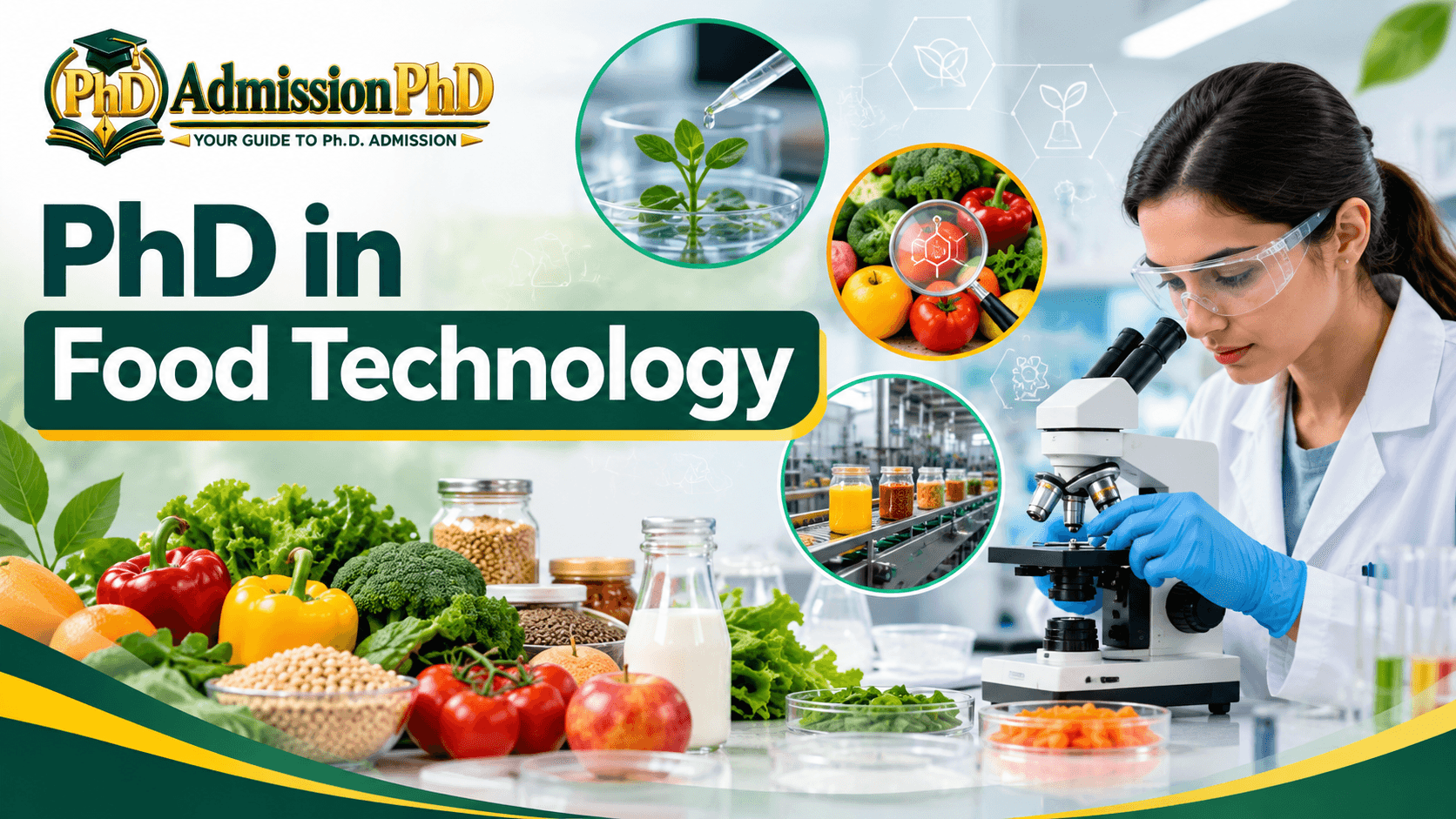
PhD in Food Technology is the Doctoral Research Programme in food technology, food engineering, food processing, food safety, food chemistry, food microbiology, food preservation, food products development and other allied areas of food science & technology. In India, this PhD research could be pursued in PhD in Food Technology, PhD in Food Engineering and Technology, PhD in Food Processing Technology, PhD in Food Science or similar fields of study depending upon the University offering this course.
The above PhD programme will suit those candidates whose area of interest lies in food processing, functional foods, nutraceuticals, food packaging, food preservation, post-harvest technology, food quality and safety, fermentation and food engineering. The research work can be conducted through laboratory experimentation, process development, modeling, product formulation, analytical testing and other research methodologies.
As per the UGC norms for a PhD, the minimum duration of a PhD is normally three years with course work, though the duration of completion of PhD differs from one university to another as per the university norms and research progress. Eligibility criteria vary as per the university, but relevant master's degree and, wherever applicable, some specific four year bachelor's degree paths may be considered.
For admission into the programme UGC-NET/JRF, university entrance examinations, national level eligibility, research proposal, written test and interview, etc., may be considered. Fees differ widely across universities and need to be confirmed with the latest official notification. After PhD in Food Technology, career opportunities will be university teaching, food research & development, food safety, food product development, food processing, quality assurance, research organization, government/research organizations, etc. There is no universal salary data available for all PhD holders because salaries differ significantly based on position, organization, experience, location and specialization.
PhD in Food Technology Course Highlights
| Programme | PhD in Food Technology / related doctoral programme |
| Minimum Duration | Generally 3 years including coursework, subject to applicable regulations |
| Eligibility | Relevant Master's Degree or an equivalent qualification recognized by the university |
| Common Backgrounds | Food Technology, Food Science, Food Engineering, Food Processing, Biotechnology and related disciplines |
| Admission Route | UGC NET/JRF, entrance examination conducted by the university, national level examination and/or interview, depending on the university |
| Study Mode | Full-time; part-time availability depends on the institution |
| Coursework | Research Methodology, Statistics, Research Ethics and advanced courses in the subject |
| Research Areas | Food processing, Food Engineering, Food Safety, Food Chemistry, Food Microbiology, Packaging and allied subjects |
| Research Output | Thesis, Research Papers, Presentations and other academic products |
| Career Areas | Academics, Food Research & Development, Quality Control, Food Safety, Product Development and industry |
PhD in Food Technology: What Is It About?
A PhD program in Food Technology is a research-based course where students investigate a certain issue in food science, food processing or food technology and create an original contribution to the field.
Unlike a Master's degree, the focus is not only on acquiring knowledge on existing concepts, but rather on completing a study based on candidates own research. This process includes finding a research problem, conducting a literature review, developing a research methodology, analysing and interpreting results and compiling the thesis.
Research may involve the development or improvement of:
The exact research area depends on the department, available laboratory facilities, supervisor expertise and approved research proposal.
Who Should Pursue a PhD in Food Technology?
A PhD in Food Technology may be suitable for candidates who:
- Have a strong academic background in food technology or a related discipline.
- Are interested in laboratory-based or technology-oriented research.
- Want to work in food R&D.
- Are interested in food safety and quality.
- Want to develop new food products or processing methods.
- Plan to pursue an academic or research career.
- Want to work on food sustainability and waste reduction.
- Have an interest in food engineering and process optimisation.
- Want to work in research institutions or food industries.
A suitable research topic and supervisor are important factors because doctoral research normally involves sustained work in a specialised area.
Why Study PhD in Food Technology?
1. Conduct Advanced Food Research
Doctoral research allows candidates to investigate complex food-related problems in depth. Research can involve food processing, preservation, quality, safety, nutrition, packaging and product development.
2. Develop Specialised Expertise
Food Technology is a broad field. A PhD allows a research scholar to develop expertise in a focused area such as food engineering, food microbiology, food chemistry, food safety or functional foods.
3. Work on Food Innovation
Research can contribute to the development of: Health-oriented food products, Functional foods, New processing technologies, Improved preservation techniques, Sustainable packaging, Alternative food ingredients, Food waste utilisation.
4. Build an Academic Career
A doctoral qualification can support careers involving teaching and research in universities and higher-education institutions, subject to the recruitment rules of the institution.
5. Work in Food R&D
Food manufacturers, research organisations and laboratories require specialised knowledge for product development, processing, quality testing and food safety research.
6. Address Food Sustainability
Research can address food sustainability issues such as: reducing food waste, improving resource efficiency, utilising agricultural by-products and developing sustainable processing and packaging technologies.
How Long Does a PhD in Food Technology Take?
The UGC framework provides a minimum PhD duration of three years including coursework. The actual completion period depends on the university's regulations, research progress, thesis requirements and evaluation process.
| Course Component | Approximate Duration |
|---|---|
| Coursework | 6-12 Months |
| Review of Literature | 3-6 Months |
| Research Proposal | 2-4 Months |
| Research and Data Collection | 1-3 Years |
| Data Analysis | 6-12 Months |
| Thesis Writing | 6-12 Months |
| Thesis Evaluation and Viva | 2-4 Months |
| Total Duration | 3-6 Years |
Eligibility for PhD in Food Technology
Eligibility criteria differ based on the university one is applying to. Moreover, it depends on the research area as well. A candidate must look through the latest admission notification from the university they are interested in before applying.
Commonly Accepted Backgrounds
Depending on the institution, relevant qualifications may include:
UGC-Level Eligibility
Under the UGC PhD framework, the Master's route generally requires a relevant Master's degree with at least 55% marks or equivalent grade, subject to the applicable provisions and university requirements. A four-year Bachelor's degree route is also provided under the regulations with the specified marks requirement.
Candidates should check:
A candidate should not assume that every university accepts every Food Technology-related qualification.
PhD in Food Technology Entrance Exams and Admission Routes
There is no single entrance examination applicable to every PhD in Food Technology programme in India.
Depending on the institution, admission may involve one or more of the following:
- 1. UGC-NET/JRF: UGC-NET may be relevant for doctoral admission and fellowship routes where the university accepts the relevant qualification and subject.
- 2. GATE: Some technology and engineering-oriented institutions may consider GATE for doctoral admissions. GATE acceptance is not universal, so the relevant university notification should be checked.
- 3. University-Level PhD Entrance Examination: Some universities conduct their own written entrance examination for doctoral admissions.
- 4. National-Level Fellowship: Research institutes may specify a valid national-level fellowship as an admission route. For example, the 2026 AcSIR admission notice at CSIR-CFTRI lists national-level fellowship holders among eligible categories for its doctoral programmes.
- 5. Research Proposal and Interview: The selection process may assess: Research interest, Proposed research topic, Academic background, Research methodology, Subject knowledge, Faculty and research-area fit.
How to Prepare for PhD Entrance Exams
Candidates preparing for a university PhD entrance examination should focus on:
Research Methodology
Food Technology
Quantitative Methods
The syllabus may vary depending on the university, so it is recommended to check the entrance-test notification from the university.
PhD in Food Technology Admission Process
- Step 1: Choose the Research Area – Candidates should first identify a research area according to their academic background, research interests, and available faculty expertise. Some possible areas in Food Technology include: Food processing and preservation, Food engineering, Food microbiology, Food chemistry, Food biotechnology, Food safety and quality, Food packaging technology, Dairy and fermentation technology, Food product development, Post-harvest technology, Functional foods and nutraceuticals. The proposed research topic should also align with the expertise and availability of potential research supervisors.
- Step 2: Eligibility – The university's official admission notification should be checked for: Required qualification, Minimum marks, Accepted disciplines or master's degree, Entrance examination, National-level qualification, Fellowship requirements, Relevant research area, Work experience, if required.
- Step 3: Application Form – Candidates need to complete the PhD application form through the university's official website. Required documents, academic certificates, entrance examination scores and other relevant details must be submitted along with the application.
- Step 4: Entrance Test or Shortlisting – Candidates may be shortlisted through: University entrance examination, UGC-NET/JRF, GATE, National-level fellowship, Academic record, Research proposal, Other institution-specific criteria.
- Step 5: Interview – Shortlisted candidates may be called for a research or subject-specific interview. Questions can cover: Food Technology and food science concepts, Food processing and preservation, Food engineering, Food chemistry and microbiology, Food safety and quality control, Food biotechnology, Previous academic projects or research work, Research interests, Proposed research topic, Research methodology, Quantitative and analytical methods. The interview may also assess the candidate's understanding of the proposed research area and its potential contribution to Food Technology.
- Step 6: Final Selection – Candidates who successfully complete the required selection stages may be offered admission. After registration, selected candidates generally begin doctoral coursework and research under the guidance of a research supervisor, according to the university's regulations.
Research Proposal
A research proposal explains what the candidate intends to investigate during doctoral research.
A typical proposal may include:
- 1. Research Title: A clear and focused research topic.
- 2. Background: A brief explanation of the research problem.
- 3. Research Gap: Previous studies should be reviewed to identify what remains unanswered.
- 4. Objectives: The proposal should clearly state what the research intends to achieve.
- 5. Methodology: This may include: Experimental design, Materials, Processing methods, Analytical techniques, Statistical methods.
- 6. Expected Contribution: The proposal should explain the potential academic or practical contribution of the research.
Students planning to pursue a PhD can also check our guide on PhD Admission in India to understand the admission process, eligibility, and important requirements.
PhD in Food Technology Syllabus and Coursework
There is no general syllabus that all universities follow. Doctoral students’ courses are defined depending on their universities, departments, and fields of interest.
Typical coursework may include:
| Subject Area | Possible Topics |
|---|---|
| Research Methodology | Research design, literature review, research methods |
| Statistics | Probability, hypothesis testing, regression, data analysis |
| Research Ethics | Academic integrity, plagiarism, publication ethics |
| Food Chemistry | Food components, chemical reactions, analysis |
| Food Microbiology | Microorganisms, fermentation, food safety |
| Food Processing | Thermal and non-thermal processing |
| Food Engineering | Process design, transport phenomena, equipment |
| Food Safety | HACCP, food hazards, quality systems |
| Food Packaging | Packaging materials, shelf life, active packaging |
| Advanced Research Methods | Experimental design, modelling and analysis |
The final coursework structure should be checked against the university's official PhD curriculum.
Research Areas and Topics in PhD in Food Technology
1. Food Processing Technology
Possible research topics: Novel food processing, Thermal processing, Non-thermal processing, High-pressure processing, Drying and dehydration, Extrusion processing.
2. Food Engineering
Research may focus on: Process optimisation, Food process modelling, Equipment design, Heat and mass transfer, Bioprocess engineering. ICT Mumbai's Food Engineering and Technology department lists areas including food process engineering, non-thermal processing, kinetics modelling, shelf-life extension, sensory analysis and process optimisation.
3. Food Safety
Research areas may include: Foodborne pathogens, Contaminant detection, Food safety systems, HACCP, Microbial safety, Risk assessment.
4. Food Chemistry
Possible topics include: Food composition, Bioactive compounds, Lipids, Proteins, Carbohydrates, Food oxidation.
5. Food Microbiology
Research may cover: Foodborne microorganisms, Fermentation, Probiotics, Microbial quality, Preservation.
6. Functional Foods and Nutraceuticals
Research can focus on: Functional ingredients, Bioactive compounds, Nutraceutical formulation, Health-oriented food products, Fortified foods.
7. Food Packaging
Possible topics include: Active packaging, Intelligent packaging, Biodegradable packaging, Shelf-life improvement, Sustainable packaging.
8. Post-Harvest Technology
Research can examine: Storage, Post-harvest losses, Value addition, Preservation, Processing of agricultural products.
9. Food Product Development
Research may involve: New product formulation, Sensory evaluation, Consumer acceptability, Nutritional improvement, Product stability.
10. Food Waste and Sustainability
Research can focus on: Food waste reduction, By-product utilisation, Circular food systems, Sustainable processing, Waste-to-value technologies.
11. Traditional and Indigenous Foods
Research may cover: Traditional food processing, Preservation of traditional foods, Product development, Nutritional profiling, Modernisation of traditional processing.
Universities and Institutes Offering PhD in Food Technology in India
| University / Institute | Relevant PhD / Research Area | Program Mode | Admission Basis | Approx. Fees |
|---|---|---|---|---|
| G.B. Pant University of Agriculture & Technology, Pantnagar | PhD Food Technology; PhD Food Processing Technology | Full time | University Entrance Examination / ICAR-based admission, as applicable | ₹2.65 Lakhs |
| Institute of Chemical Technology (ICT), Mumbai | PhD (Tech.) in Food Engineering and Technology; Food Biotechnology | Full time | PhD Entrance Test / Shortlisting + Interview, as per programme and admission notification | ₹2.81 Lakhs to ₹2.94 Lakhs |
| CSIR-CFTRI, Mysuru / AcSIR | Doctoral research in Food Science and Technology-related areas through AcSIR and recognised university routes | Full time | AcSIR eligibility-based shortlisting + Aptitude Test / Interview | ₹12,000 to ₹14,000 per semester |
| Anand Agricultural University, Anand | Food Processing Technology / related food processing research | Full time/ Part time | University-level PhD admission process + Interview, as applicable | ₹19,600 to ₹65,300 |
| Tamil Nadu Agricultural University, Coimbatore | Food Science and Nutrition / related food technology and processing research | Full time/ Part time | University-level PhD admission process / Entrance-based selection, as applicable | ₹2.01 Lakhs to ₹2.30 Lakhs |
PhD in Food Technology vs PhD in Food Science
| Parameter | PhD in Food Technology | PhD in Food Science |
|---|---|---|
| Main Focus | Technology, processing and engineering applications | Scientific study of food composition, properties and behaviour |
| Research | Processing, preservation, packaging, engineering and product development | Food chemistry, microbiology, nutrition, sensory science and food properties |
| Engineering Component | Often stronger | Usually more science-oriented |
| Laboratory Work | Processing and analytical experiments | Chemical, biological and analytical experiments |
| Career Areas | Food processing, R&D, engineering, product development | Research, food science, quality, nutrition and laboratory roles |
| Programme Title | Varies by university | Varies by university |
The distinction is not absolute and many research projects blend both fields. Besides, different universities may use different program titles.
PhD in Food Technology Fees
PhD fees vary substantially between public universities, private universities and specialised institutions. The fee may also differ according to full-time or part-time status.
Typical components can include:
Indicative Fee Range
| University Type | Approx. Annual Fee | Approx. Total Academic Fee* |
|---|---|---|
| Government Universities | ₹5K – ₹50K | ₹15K – ₹1.5 lakh |
| State Universities | ₹10K – ₹60K | ₹30K – ₹1.8 lakh |
| Deemed Universities | ₹40K – ₹1.5 lakh+ | ₹1.2 lakh – ₹4.5 lakh+ |
| Private Universities | ₹50K – ₹2 lakh+ | ₹1.5 lakh – ₹6 lakh+ |
Scholarships and Fellowships
Financial support can come from national fellowships, institutional fellowships and funded research projects.
- 1. UGC-NET/JRF: Candidates qualifying for JRF through UGC-NET may receive fellowship support for doctoral research in Food Technology, Food Science, Food Processing or related disciplines, subject to the applicable fellowship rules, eligibility conditions, research area and university requirements. The fellowship amount during the initial period of JRF is generally ₹37,000 per month, which increases to ₹42,000 per month following upgradation to SRF, depending on the current UGC regulations and applicable fellowship guidelines.
- 2. CSIR/Other National Fellowships: Candidates with valid national-level fellowships may be eligible for doctoral research at institutions that accept the relevant fellowship.
- 3. Institute Fellowships: Some universities and research institutions provide financial support to full-time doctoral scholars.
- 4. Sponsored Research Projects: Research scholars may also receive support through externally funded research projects where positions are available.
The availability, amount and continuation of financial support depend on the institution, fellowship and applicable rules.
Full-Time vs Part-Time PhD in Food Technology
| Parameter | Full-Time PhD | Part-Time PhD |
|---|---|---|
| Study Mode | Doctoral research is the primary academic activity | Research is pursued alongside employment or other commitments |
| Research Time | More time is generally available for laboratory work and research | Research time may need to be balanced with professional responsibilities |
| Coursework | Completed according to university requirements | Completed according to university requirements |
| Laboratory Access | Usually easier to accommodate regular laboratory work | Depends on university and research requirements |
| Employment | Candidates may focus primarily on research | Candidates may continue employment where permitted |
| Fellowship | Fellowship opportunities may be available subject to rules | Fellowship availability depends on the institution and applicable conditions |
| Duration | Minimum generally 3 years including coursework | Minimum generally 3 years including coursework, subject to applicable rules |
| Suitable For | Candidates focusing on research and academic/R&D careers | Working professionals permitted by the university to pursue doctoral research |
Part-time availability should be checked carefully because not every university offers it. Candidates should also check attendance, coursework, laboratory access and employer NOC requirements where applicable.
Skills Required for PhD in Food Technology
Research Skills
Candidates should develop: Literature review, Research design, Problem formulation, Experimental design, Academic writing, Critical analysis.
Laboratory Skills
Depending on the research area, useful skills may include: Food analysis, Microbiological testing, Chemical analysis, Sensory evaluation, Laboratory safety, Instrument handling.
Data and Statistical Skills
Important areas include: Statistics, Data analysis, Experimental analysis, Regression, Statistical software, Data visualisation.
Food Technology Skills
Research scholars may need knowledge of: Food processing, Food preservation, Food safety, Food chemistry, Food microbiology, Food engineering, Packaging.
Communication Skills
Doctoral researchers should be able to communicate research through: Research papers, Seminars, Conferences, Presentations, Thesis writing.
Career Opportunities and Salary After PhD in Food Technology
| Job Role | Approx. Salary in India |
|---|---|
| Assistant Professor / Faculty | ₹5–10 LPA |
| Research Scientist | ₹6–15 LPA |
| Food Technologist | ₹4–10 LPA |
| R&D Scientist | ₹6–15 LPA |
| Food Safety Scientist | ₹5–12 LPA |
| Quality Assurance Manager | ₹5–12 LPA |
| Food Product Development Specialist | ₹5–12 LPA |
| Food Processing Specialist | ₹5–12 LPA |
| Food Microbiologist | ₹4–10 LPA |
| Food Biotechnology Researcher | ₹5–12 LPA |
| Government Research Scientist | ₹6–15 LPA |
| Food Industry Consultant | ₹6–15 LPA |
How to Choose the Right University for PhD in Food Technology
- 1. Check the Exact Programme Title: The programme may be called: PhD in Food Technology, PhD in Food Engineering and Technology, PhD in Food Processing Technology, PhD in Food Science, PhD in Food Science and Technology. The exact title should be checked against the intended research area.
- 2. Check Faculty Expertise: The supervisor's research expertise should match the proposed research topic.
- 3. Review Laboratory Facilities: Food Technology research may require: Food processing laboratories, Food analysis laboratories, Microbiology laboratories, Pilot plants, Packaging facilities, Instrumentation, Sensory evaluation facilities.
- 4. Review Recent Publications: Candidates should check recent publications by potential supervisors and research groups.
- 5. Check Supervisor Availability: A suitable supervisor should have relevant research expertise and an active research profile.
- 6. Compare Financial Support: Compare: Tuition fees, Fellowship, Research grants, Laboratory access, Conference support, Hostel expenses.
- 7. Check Admission Rules: The latest notification should be checked for: Eligibility, Entrance test, Exemptions, Fellowship requirements, Interview, Research proposal, Full-time/part-time availability.
Future Scope of PhD in Food Technology
- 1. Sustainable Food Processing: Research can focus on reducing energy, water use, processing waste and environmental impact.
- 2. Functional Foods and Nutraceuticals: Growing interest in health-oriented food products creates research opportunities in functional ingredients and nutraceutical formulation.
- 3. Alternative Proteins: Research can explore plant-based proteins, microbial proteins and other alternative food sources.
- 4. Food Safety and Traceability: Research opportunities include: Foodborne pathogen detection, Contaminant monitoring, Traceability systems, Food safety analytics, Quality assurance.
- 5. Smart Food Packaging: Research can focus on: Active packaging, Intelligent packaging, Biodegradable materials, Shelf-life monitoring.
- 6. Food Waste Utilisation: Research can investigate the conversion of agricultural and food-processing by-products into useful ingredients and value-added products.
- 7. AI and Digital Food Processing: Emerging research can combine food technology with: Artificial intelligence, Machine learning, Process modelling, Automation, Predictive quality control.
- 8. Novel Food Processing: Research can continue to explore technologies such as non-thermal processing, high-pressure processing, improved drying and other advanced processing methods.
- 9. Food Security: Food technology research can contribute to better preservation, storage, processing and value addition of agricultural products.
All Rights Resvered
Frequently Asked Questions
Related Articles
PhD in Biosensors: Eligibility, Fees, Admission & Career
Explore PhD in Biosensors in India, including eligibility, entrance exams, admission process, fees, syllabus, research areas, universities, careers & salary.

PhD in Quality Management in India: Admission & Career
Explore PhD in Quality Management in India, including eligibility, admission process, entrance exams, fees, syllabus, research areas, career options & salary.
PhD in Physiotherapy in India: Fees, Admission & Career
Explore PhD in Physiotherapy in India, including eligibility, admission , syllabus, research areas, scholarships, universities, career options and salary.