
PhD in Mathematics in India 2026: Eligibility, Fees & Admission
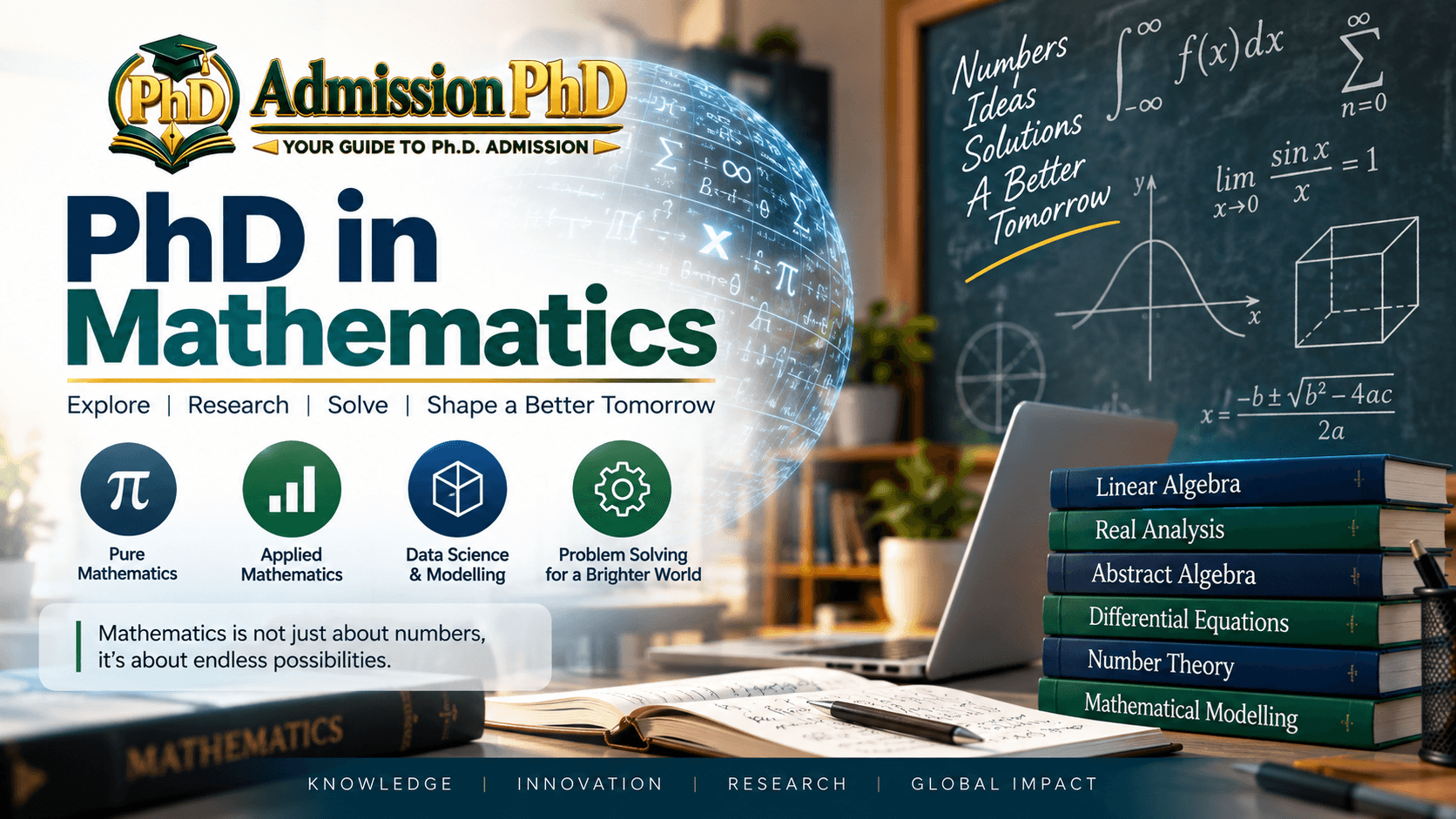
PhD in Mathematics in India 2026: Eligibility, Admission, Fees, Universities & Career Scope
A PhD in Mathematics is a research-oriented doctorate program that entails comprehensive study of the mathematical principles, methods, and practices. During the course of study, scholars explore a chosen field of research, conduct a survey of the existing literature, make their own contributions to the body of knowledge in the area, and prepare a doctoral dissertation.
The minimum duration of the doctoral programme is 3 years, including coursework, under the UGC PhD regulations. However, the length of the program can vary depending on the university, the field of study, the rate of research progress, and the requirements for the doctoral thesis. The eligibility criteria may also differ from institution to institution, but the candidate must typically hold a Master’s degree, such as M.Sc. in Mathematics or related specialty. Some universities may offer the option for a 4-year bachelor’s degree holders for admission to PhD, depending on their eligibility criteria.
The admission to doctoral programme program takes place after passing a university entrance exam, UGC-NET, CSIR-NET, GATE, NBHM, or other qualification exams with further interview for some universities. After completing their studies, graduates in doctoral programme can find employment in academia, research, data analysis, statistics, banking, financial sectors, scientific computations, and others. Possible positions may be those of mathematicians, statisticians, researchers, assistant professors, data scientists, quantitative analysts, and mathematical modellers.
PhD Mathematics: Course Highlights
| Course Level | Doctoral Degree |
| Full Form | Doctor of Philosophy in Mathematics |
| Minimum Duration | 3 years, including coursework |
| Eligibility | Generally, a relevant Master's degree with the minimum marks prescribed by the university |
| Admission Process | University Entrance Test and/or accepted national-level qualification + Interview |
| Course Fee | Varies from university to university and for different categories of students. |
| Research Areas | Algebra, Analysis, Number theory, Geometry, Statistics, Differential equations, Mathematical modelling, Etc. |
| Career Areas | Academia, Research, Data analytics, Statistics, Finance, Scientific computing, Quantitative fields, Etc. |
| Job Roles | Mathematician, Statistician, Research Scientist, Assistant Professor, Data Scientist, Quantitative Analyst, Mathematical Modeller, Research Associate, etc. |
PhD Mathematics: What is it About?
PhD in Mathematics is a research-based doctoral programme designed for individuals aspiring to specialize in mathematics.
While a doctoral programme typically takes three years to complete, the minimum course duration may differ at various institutions. Completing the course requires extensive research work and approval for thesis defense.
A PhD programme involves intensive study and research in mathematics advanced fields. Consequently, the full-time option and other modes of study are often determined by the respective universities’ policies.
A PhD programme requires students to conduct independent research in their chosen field. Depending on the specialization one selects, one can acquire knowledge in graph theory, asymptotic analysis, scientific computing, bifurcation theory, stochastic processes, stability theory, probability, statistics, and ordinary and partial differential equations.
Besides, the course includes the study for doctorates, which comprises attendance of the required classes, conducting the extensive study of the chosen topic, and writing the corresponding thesis. During the study, there is an individual approach, as one works with a supervisor to whom one can turn for advice and help concerning the research work.
Why study the PhD Mathematics course?
A PhD degree in Mathematics is a good option for students who want to improve their knowledge and gain skills in the field of Mathematics, and further develop their careers. The course offers a wide range of opportunities, as it trains students not only for scientific research but also for teaching at various educational facilities. A PhD programme can prepare the candidates for careers in academia, industry, and technology-based organizations, as well as research institutions.
Some of the main reasons for getting a PhD programme include:
- It helps in acquiring advanced research skills and helps the student in identifying the research problems, reading the literature and conducting their own research.
- There are lots of career opportunities in teaching and academia including jobs in colleges, universities and research institutions, based on their eligibility and recruitment criteria.
- One can use their skills of mathematics and analysis in various fields like data science, statistics, banking, finance and technology.
- It not only helps the students in developing specialized knowledge and problem-solving skills but also contributes in research and publications of their doctoral thesis.
Students planning to pursue a PhD can also explore our detailed guide on PhD Admission in India to understand eligibility, entrance exams, application steps, and other important admission requirements.
PhD in Mathematics: Admission Process
Admission to a PhD Mathematics will differ from one university to another. The candidates get selected generally depending upon their qualifications and entrance test conducted by universities or national level qualifications combined with Personal Interview/Research discussion. The specific information regarding PhD programme admission procedure, exemption, and criteria can be obtained from the admission notice of the university.
The below-mentioned points indicate the most common ways of PhD programme admissions:
- Entrance Exam-Based Admission: There are many universities who conduct PhD entrance test for the evaluation of the subject knowledge and research capabilities of the candidate. This exam comprises sections on Algebra, Analysis, Differential Equations, Probability, Statistics, and Discrete Mathematics. The topics may vary depending upon the university. Qualified candidates are then shortlisted for a personal interview or research-level discussion.
- National-Level Qualification-Based Admission: Candidates who have passed exams/fellowships such as UGC-NET/JRF, CSIR-NET/JRF, GATE, NBHM or other qualifications recognized by the university can also apply for PhD admission Mathematics through that particular admission mode.
PhD Mathematics: Eligibility
The eligibility criteria for a PhD programme may vary depending on the institution. Typically, candidates are required to hold a Master’s degree in Mathematics or a related field with the minimum percentage as specified by the university. According to UGC PhD guidelines, candidates with a Master’s degree must secure at least 55% marks. In addition, candidates with a 4-year bachelor’s degree may also be eligible if they clear the entrance exam with at least 75% marks or equivalent grade.
The common eligibility criteria for PhD Mathematics include:
- Master's Degree: A Master’s degree in Mathematics or related/closely allied subjects with the minimum percentage as specified by the university.
- 4-Year Bachelor's Degree: Eligible candidates with a 4-year/8-semester Bachelor's degree may be considered for PhD admission with at least 75% marks or equivalent grade, subject to applicable UGC provisions and university-specific requirements.
- Entrance Examination: Qualification of University-level PhD entrance exam or an approved national-level exam.
- Interview: Eligible candidates shall appear for a Personal Interview or a Research Discussion on the chosen subject area to review their academic background and research interests.
- Relaxation: Relaxation of 5% in the minimum percentage is applicable to eligible categories as specified by UGC and the admitting institution.
Note: The eligibility conditions and minimum percentage criteria mentioned above are generally applicable across a majority of universities offering PhD programme. However, the candidate is advised to go through the official website of the preferred institution for the most updated information regarding the PhD eligibility criteria for the current academic year.
PhD in Mathematics: Entrance Exams
PhD Mathematics course admission can be made through a university level entrance test, followed by an interview/research discussion on the basis of a valid fellowship at the national level. The pattern, syllabus, eligibility criteria and exemption from the PhD programme entrance test vary from one institute to another. Hence, it is very important for the applicants to get themselves acquainted with the latest admission notification of their choice university.
The following are some of the important qualifying examinations/other eligibility criteria for PhD programme Admission:
- UGC-NET /JRF: This is a national level examination which determines the eligibility for JRF, Assistant Professor and, sometimes, even PhD admission. The candidates must verify the eligibility category and admission guidelines according to their choice university and the latest UGC-NET notification.
- CSIR-UGC NET: The CSIR-UGC NET is a national level examination which determines the eligibility for JRF, Assistant Professor and PhD admission in science related subjects. The eligibility category and admission guidelines are determined according to the results of the examination as well as norms of the preferred institution. Hence, the candidates must verify the latest exam notification before taking part in the CSIR-UGC NET examination.
- NBHM: National board of higher mathematics (NBHM) has a selection test for the post-graduate level research fellowship. Only those students who are having masters in Mathematics, Physics or Statistics are eligible to apply for NBHM scholarship which will help them to do their research work in Mathematics after qualifying the examination.
- University-level PhD entrance exam: Some universities offer a PhD Mathematics course on the basis of the university-level entrance exam. This examination is conducted to determine the research aptitude and subject knowledge of the candidate. The candidates who qualify for this exam are called for an interview/discussion on relevant topics. The syllabus of the PhD entrance exam may include Algebra, Analysis, Ordinary and Partial Differential Equations, Probability, Statistics and Discrete Mathematics.
How to Prepare for a PhD in Mathematics Entrance Exam?
It is important to know the syllabus of PhD program entrance exams of different institutes. Most of the entrance exams of different universities are based on subject knowledge, analytical ability and research aptitude. Candidates must go through the official syllabus and examination pattern of the university which they are interested to pursue doctoral programme.
Following are the sections which are generally included in PhD programme entrance exam syllabus:
Students must go through standard Mathematics books, previous year question papers and practice sets for preparing PhD entrance examination. The number of questions, marks, examination time and question pattern varies from one university to another. It is always better to revise and practice more in order to develop a strong command over the subject and prepare well for the admission test of PhD programme.
PhD Mathematics: Syllabus
| Component | What Students May Study |
|---|---|
| Research Methodology | Research methods, academic writing, literature review |
| Advanced Mathematics | Algebra, Analysis, Number Theory, Geometry |
| Applied Mathematics | Modelling, Differential Equations, Optimization |
| Computational Areas | Numerical Methods, Scientific Computing |
| Statistics & Probability | Probability Theory, Statistical Methods |
| Research Work | Literature review, original research, publications and thesis |
PhD Mathematics: Books
The below-given books are recommended for students to get well-versed in the essential concepts of mathematics and prepare for PhD Mathematics Entrance Exam. The candidates must go through the entrance syllabus of their target university and then choose the books as per their course and research work.
| Name of the Book | Author |
|---|---|
| Calculus for Scientists and Engineers | K.D. Joshi |
| Foundations of Discrete Mathematics | K.D. Joshi |
| Introduction to Measure and Integration | Inder K. Rana |
| Fundamental Complex Analysis of One Variable | Anant R. Shastri |
| Ordinary Differential Equations | Mohan C. Joshi |
PhD in Mathematics: Universities Offering the Programme in India
Several universities and higher education institutions in India offer PhD Mathematics or related doctoral research programmes. Fees, programme modes, research areas and admission requirements vary between institutions.
| University/Institute | Programme Mode | Approx. Fee Information | Admission Basis |
|---|---|---|---|
| Indian Institute of Science (IISc) | Full-time | Approx INR 75,600 | Entrance/NET + Interview |
| Banaras Hindu University (BHU) | Both Full-time/Part-time | Approx. INR 30,000–INR 35,000 | UGC-NET / University Entrance + Interview |
| Aligarh Muslim University (AMU) | Both Full time/Part-time | Approx INR 27,855 | University PhD admission process + applicable selection criteria |
| Ramakrishna Mission Vivekananda College | Full-time | Approx INR 21,000 | Entrance/selection process as applicable |
| Queen Mary's College | Both Full-time/Part-time | Approx INR 5,805 | University/college admission process |
| Sri Ramakrishna College of Arts and Science | Full-time/Part-time as applicable | Approx INR 60,000 | University/college admission process |
| Amity University | Full-time/Part-time as applicable | Approx. INR 3 Lakhs | Subject-Based Written Test + Personal Interview |
| Stella Maris College | Full-time | Approx. INR 6,000 | Institution-specific PhD admission process |
| Birla Institute of Technology (BIT Mesra) | Both Full-time/Part-time | Approx. INR 1.75 Lakhs | Institute-specific entrance/selection process |
| Kuvempu University | Both Full-time/Part-time | Approx. INR 1.62 Lakhs | University PhD admission process |
PhD in Mathematics: Job Prospects and Career Options
A doctoral degree in Mathematics offers the career opportunities in Research, Academia, Data analysis, Finance, Technology and other quantitative fields of interest. Graduates can work in Universities, Research institutes, Financial organisations, Technology companies and Government agencies.
The career options available are as follows:
- Graduates can work in the research areas such as Numerical Analysis, Mathematical Modelling, Dynamical Systems, Probability, Statistics and Computational Mathematics.
- They can also explore data science, statistics, Banking, Finance, Insurance and quantitative analysis areas.
- Careers such as Mathematician, Statistician, Research Scientist, Data Scientist and Quantitative Analyst are some career options that one can pursue with this degree.
- Those interested in teaching and research can also consider a career in Assistant Professor, Researcher or Postdoctoral scholar, subject to applicable eligibility requirements.
| Job Profile | Job Description | Salary |
|---|---|---|
| Mathematician | Uses advanced mathematical methods to solve theoretical or practical problems in research, science, technology and other fields. | INR 5 - 25+ LPA |
| Statistician | Analyze data, create statistical models and interpret numerical information. | INR 5 - 20+ LPA |
| Data Scientist | Uses mathematics, statistics and computational techniques to analyse data and develop models for organisations. | INR 20 - 35+ LPA |
| Research Scientist | Conducts original research and develops mathematical or computational solutions in academic or industrial research environments. | INR 8 - 27+ LPA |
| Assistant Professor | Teaches mathematics and conducts research in colleges or universities, subject to applicable recruitment requirements. | INR 5 - 20+ LPA |
| Quantitative Analyst | Applies mathematical, statistical and computational methods to financial, risk or other quantitative problems. | INR 14 - 20+ LPA |
PhD Mathematics: Future Scope
The PhD in Mathematics gives graduates the chance to become involved in multiple aspects like working in the academic field and in the technical sphere. In addition, the focus of the program is on mathematical modeling, statistics, computing, and practical skills that can be used in many industries, for example, technology, data analytics, finance, and more.
- Academic Research: There are lots of positions available for professors, researchers, and postdoctoral fellows in colleges and universities.
- Research & Development: It is possible to work in academic or industrial research on advanced topics related to mathematical modelling, computational mathematics, statistics, and probability.
- Data & Technology: PhD Mathematics program can provide graduates with opportunities in data science, machine learning, scientific computing, and quantitative analysis.
- Finance & Banking: The expertise can be used in finance and insurance industries, including financial modelling, risk assessment, and quantitative finance.
- Global Opportunities: Graduates may also explore international research, postdoctoral and academic opportunities based on their research profile and qualifications.
All Rights Resvered
Frequently Asked Questions
Related Articles

PhD in Computer Science: Admission, Eligibility, Fees & Syllabus 2026
Explore PhD in Computer Science Admission, eligibility, entrance exam, fees, syllabus, duration, universities in India, scholarships, careers and salary.

PhD in Electronics and Communication in India 2026: Eligibility, Fees & Admission
Explore PhD in Electronics and Communication in India, including eligibility, admission process, top universities, fees, syllabus, research areas, scholarships, jobs and salary.

PhD in Botany in India 2026: Eligibility, Fees & Admission
Explore PhD in Botany in India, including eligibility, admission, fees, syllabus, entrance exams, research areas, career scope, salary and FAQs.