
Get Free Admission Guidance
Share your details and our counselors will call you.
PhD in Natural Product Chemistry: Eligibility, Fees & Career
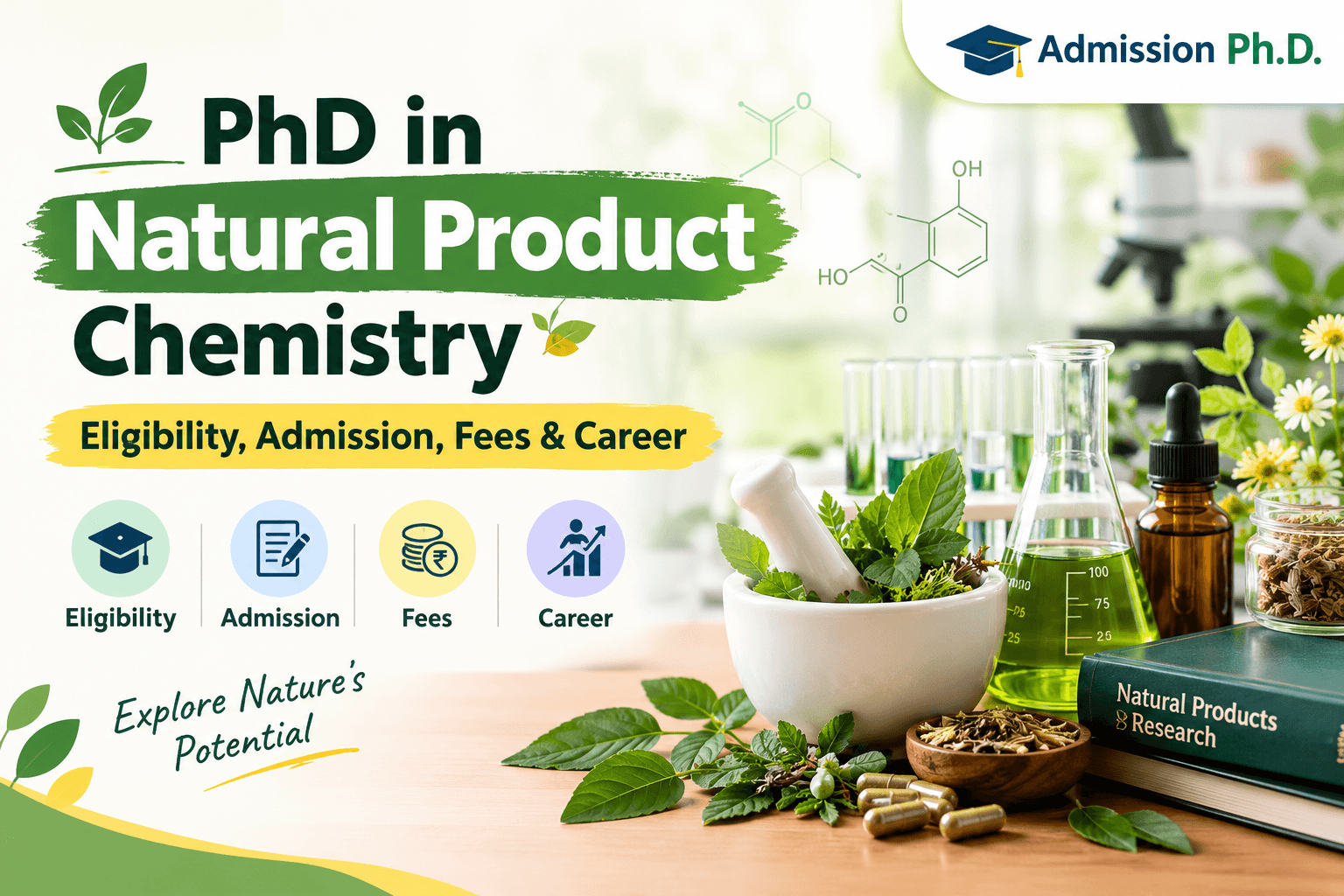
PhD in Natural Product Chemistry
An Overview
A PhD in Natural Product Chemistry is a high-level research degree. It focuses on finding, separating, identifying analyzing the structure making, changing and testing the effects of chemical compounds from natural sources. These sources can be plants, microorganisms, sea life, fungi and other living materials.
This field brings together chemistry, analytical chemistry, pharmacognosy, medicinal chemistry, biotechnology and pharmaceutical sciences. Researchers often look at compounds like alkaloids, flavonoids, terpenoids, glycosides, polyphenols, peptides and other molecules that have activity.
In India, a PhD in Natural Product Chemistry is not always offered as a separate degree title. At universities, this type of research may be done under PhD in Chemistry, Pharmaceutical Sciences, Natural Products, Medicinal Chemistry, or similar programs. For instance, NIPER Ahmedabad offers a PhD in Natural Products. At places like IIT Jodhpur and IISER Bhopal, natural product research is part of their Chemistry PhD program.
Because of this the research supervisor, the lab equipment and the available research topics become very important when choosing a program. You need to know who you will work with what tools you will. What kind of projects are available. These factors can make a difference, in your experience and the quality of your work.
What Does a PhD in Natural Product Chemistry Involve?
A doctoral researcher, in this field investigates naturally occurring substances and attempts to understand naturally occurring chemical substances chemical structure, biological activity, mechanism, synthesis and potential applications.
Typical research work can include:
At research centres techniques, like LC-MS, NMR, chromatography, spectroscopy, metabolomics, molecular biology and computational methods are often used in natural-product research. NIPER Ahmedabad for example carries out research that includes LC-MS-based dereplication finding bioactive products and large-scale isolation and characterization of natural compounds.
Why Study Natural Product Chemistry at the Doctoral Level?
Natural products keep giving chemical structures that are useful, in medicine and health research. A PhD helps scientists go past looking at compounds and explore new molecules, new ways that they work in the body new ways to get them and new uses for them.
The field can be particularly relevant for candidates interested in:
The interdisciplinary nature of the subject also enables a doctoral thesis to integrate chemistry with biology, pharmacy or biotechnology.
Key Advantages of a PhD in Natural Product Chemistry
A doctoral qualification in this area can provide several academic and professional benefits:
How Long Does a Natural Product Chemistry PhD Take?
As per UGC PhD Regulations, 2022, the duration of the PhD program shall be a minimum of three years inclusive of course work with a maximum period of six years. Provision of re-registration and relaxation is provided under certain conditions as per UGC PhD regulations.
In practice, the actual completion time depends on:
Therefore, candidates should treat three years as the minimum rather than a guaranteed completion period.
Eligibility Requirements for PhD in Natural Product Chemistry
Eligibility requirements depend on the university and discipline where the research will be conducted.
One possible way is a master's degree in an appropriate field, e.g.:
The UGC framework generally permits candidates with a relevant master's degree to enter doctoral programmes subject to the institution's notified eligibility conditions. The 2022 regulations also specify a route for candidates entering after a four-year bachelor's degree, with a minimum of 75% aggregate or equivalent grade, subject to the prescribed relaxation categories.
For specialized programmes, institutional requirements can be narrower.
Entrance Examinations for Natural Product Chemistry PhD Admission
The admission process consists of national-level eligibility exams, university entrance exam and interview procedures.
Relevant examinations may include:
For Chemical Sciences, the CSIR-UGC NET is particularly relevant. Its December 2025 examination results included separate categories for JRF, Assistant Professor eligibility and PhD-only eligibility in Chemical Sciences.
Admission rules differ considerably.
How Admission to a Natural Product Chemistry PhD Usually Works
Despite variations across institutes, the process involves the following steps:
Relevant Master's Degree → Check Research Area → Identify Supervisor/Lab → Submit Application → Entrance Test/NET-Based Screening → Interview/Research Proposal → Selection → Coursework → Research Registration → Experimental Work → Thesis → Viva Voce → PhD Award
Before applying for a PhD program, one must examine the research areas of the faculty members instead of choosing the university just due to its name like Chemistry or Pharmacy.
For example, the NIPER Ahmedabad has a separate Natural Products department conducting research on bioprospecting, metabolomics, natural products isolation and biotransformation.
PhD in Natural Product Chemistry Fees in India
PhD fees differ a lot. PhD fees depend on the school the program layout, lab needs and the student type. I notice that each factor can change the cost quite a bit.
A broad indicative range is:
| Institution Type | Approx. Annual Academic Fees | Typical Mode |
|---|---|---|
| Central Government / Public Research Institutes | ₹15,000 – ₹60,000 | Mainly Full-Time |
| IITs / IISERs / National Research Institutes | ₹25,000 – ₹1,00,000+ | Mainly Full-Time |
| State Universities | ₹20,000 – ₹80,000 | Full-Time / Part-Time where permitted |
| Deemed Universities | ₹60,000 – ₹2,00,000+ | Full-Time / Part-Time depending on rules |
| Private Universities | ₹70,000 – ₹2,50,000+ | Full-Time / Part-Time depending on institution |
Note: These are indicative ranges rather than fixed Natural Product Chemistry fees. Laboratory charges, registration fees, examination fees, hostel charges and other institutional expenses may be additional. Always verify the current fee notification before admission.
For example, IIT Jodhpur publishes a separate fee structure for each academic year, while IISER Bhopal maintains a dedicated PhD fee-structure section.
Scholarships and Fellowships for Natural Product Chemistry Researchers
Funding can significantly reduce the financial burden of a doctoral programme.
One of the major routes is the UGC Junior Research Fellowship (JRF). The current UGC information lists:
| Fellowship Stage | Monthly Fellowship |
|---|---|
| JRF – First 2 years | ₹37,000 |
| SRF – Remaining period | ₹42,000 |
UGC also lists separate contingency assistance for Science scholars.
For Chemistry-related research, CSIR-UGC NET JRF is another important route. CSIR's current information lists ₹37,000 per month for the first two years, with an increase to ₹42,000 per month after JRF-to-SRF progression subject to the applicable conditions.
Other funding possibilities can include:
Funding availability should always be confirmed in the current fellowship and admission notification.
What Students Study During a Natural Product Chemistry PhD
Unlike a conventional taught degree, a PhD curriculum combines coursework with independent research. The exact syllabus varies by university and supervisor.
Common doctoral coursework areas may include:
NIPER Ahmedabad, for example, requires doctoral students from outside the institute to complete a specified number of credits, including specialization and doctoral coursework, before progressing through its doctoral requirements.
Research Directions in Natural Product Chemistry
Natural Product Chemistry offers a wide range of potential PhD topics. Some major research directions include:
These research directions are reflected in current institutional research programmes. NIPER Ahmedabad lists natural-product discovery, metabolomics, biotransformation and bio-prospecting among its research interests, while IIT Jodhpur lists Natural Products & Medicinally Active Compounds Synthesis within its Chemistry PhD research areas.
Skills That Matter in Natural Product Chemistry Research
I have seen that successful doctoral research needs a mix of theory, lab work and science communication.
Important skills include:
I think having knowledge in bioinformatics, metabolomics, molecular biology or computational chemistry can be really useful, for interdisciplinary research projects. Bioinformatics, metabolomics, molecular biology, computational chemistry each opens doors to ideas and collaborations.
Institutes Where Natural Product Research Can Be Pursued
Because the programme title changes from one university to another candidates should look for research areas, like Natural Products, Natural Product Chemistry, Phytochemistry, Medicinal Chemistry or Organic Chemistry of searching only for a specific degree name. This way they can find relevant opportunities even if the exact title is different.
| Institution | Relevant PhD Area / Research Connection | Approx. Total Fee* | Programme Mode | Typical Admission Basis |
|---|---|---|---|---|
| NIPER Ahmedabad | PhD in Natural Products | ₹3,69,000 - ₹3,79,000 | Mainly Full-Time | NIPER Entrance Test + Interview |
| IISER Bhopal | PhD Chemistry – Natural Products | ₹5,21,000 - ₹5,31,000 | Full-Time | Valid GATE/NET/CSIR-JRF/UGC-JRF or equivalent + Institute shortlisting + Interview |
| IIT Jodhpur | PhD Chemistry – Natural Products & Medicinally Active Compounds | ₹1,75,000 - ₹2,69,000 | Full-Time / Part-Time / External where notified | Written Test and/or Interview; Part-Time/External requires minimum 2 years' relevant work experience |
| Aligarh Muslim University | PhD Chemistry – includes natural-products medicinal chemistry research | ₹42,300–₹50,000 | As notified | University PhD Entrance Test + Interview/Presentation |
| University of North Bengal | PhD Pharmaceutical Technology – phytochemistry and natural product chemistry | ₹9,315 - ₹22,915 | As notified | PhD Entrance Test + Viva-Voce; NET/SET/GATE/CSIR-JRF etc. candidates exempt from written test |
| Panjab University, Chandigarh | PhD Pharmaceutical Sciences – relevant Pharmaceutical Chemistry/Pharmacognosy research | ₹10,500 - ₹1,90,000 | Full-Time / Part-Time where notified | PhD Entrance Test + Interview; eligible candidates may be exempt from entrance test |
*Fee figures are estimates, not the actual program fees. The real amount can be different each year and might have extra charges for registration, exams, labs or other things.
The research focus of these institutions is shown in their information: NIPER Ahmedabad clearly has a PhD, in Natural Products; IISER Bhopal has Natural Products listed under Chemistry research; IIT Jodhpur has Natural Products and Medicinally Active Compounds Synthesis; AMU Chemistry has natural-products medicinal chemistry; and the University of North Bengal has phytochemistry and natural-product chemistry as part of its research areas.
How to Select a University for Natural Product Chemistry Research
The university name is only one part of a doctoral decision. Candidates should examine the research ecosystem available for the intended topic.
Career Opportunities After a PhD in Natural Product Chemistry
A doctoral degree opens doors to opportunities, in academia, research institutions and science-based industries. The doctoral degree brings new opportunities.
Potential job roles include:
| Career Role | Possible Work Area |
|---|---|
| Research Scientist | Pharmaceutical / Biotechnology R&D |
| Natural Products Scientist | Natural-product discovery |
| Medicinal Chemistry Researcher | Drug discovery |
| Analytical Scientist | Pharmaceutical and analytical laboratories |
| Phytochemistry Researcher | Plant-based research |
| Formulation / Herbal Research Scientist | Herbal and natural-product industries |
| Scientific Officer | Government and research laboratories |
| University Faculty | Teaching and academic research |
| Postdoctoral Researcher | Universities and international research institutes |
| Scientific Writer | Scientific publishing and research communication |
| R&D Project Scientist | Industrial and institutional research |
Career paths depend on the candidate's research specialization, publications, laboratory expertise, fellowship record, institutional experience and the requirements of individual employers.
Salary After PhD in Natural Product Chemistry
There is no fixed salary for a PhD in Natural Product Chemistry. The pay depends on the job role, the company, how much experience someone has, where they work, and what area they specialize in.
In India typical starting salary ranges might be around:
| Career Stage / Role | Approx. Salary Range |
|---|---|
| Research Assistant / Project Scientist | ₹3 – ₹6 LPA |
| Entry-Level R&D Scientist | ₹4 – ₹8 LPA |
| Pharmaceutical Research Scientist | ₹5 – ₹10 LPA |
| Experienced R&D Scientist | ₹8 – ₹15+ LPA |
| Assistant Professor / Academic Researcher | Institution and pay-scale dependent |
| Senior Scientist / Research Lead | ₹10 – ₹20+ LPA |
These figures are approximate market ranges than guaranteed salaries. Salaries, in government and academic positions may follow pay scales while private‑sector salaries can vary considerably.
Future Scope of Natural Product Chemistry
The future of Natural Product Chemistry is becoming more and more closely related to drug discovery, chemical biology, metabolomics, biotechnology and advanced analytics.
Several areas can influence future research:
The direction of the field is becoming increasingly more interdisciplinary. For example, one of the current NIPER Ahmedabad research areas is metabolomics, LC-MS-based dereplication and bioactive natural-product discovery, which shows how various modern analytical and biological technologies are introduced into the discipline.
PhD in Natural Product Chemistry vs Related Research Areas
Natural Product Chemistry overlaps with several other disciplines, but the research emphasis may vary
| Area | Primary Focus |
|---|---|
| Natural Product Chemistry | Chemistry, isolation and structural investigation of natural compounds |
| Pharmacognosy | Medicinal substances obtained from natural sources and their evaluation |
| Phytochemistry | Chemical constituents of plants |
| Medicinal Chemistry | Design, synthesis and optimization of biologically active molecules |
| Pharmaceutical Chemistry | Chemical aspects of drugs and pharmaceutical substances |
| Organic Chemistry | Structure, reactions and synthesis of organic compounds |
| Natural Product Pharmacology | Biological and pharmacological evaluation of natural compounds |
A candidate should pick the discipline that fits the research question and matches supervisor expertise, not just the programme title.
Final Takeaway
A PhD in Natural Product Chemistry is perfect for students who want to study the chemistry of molecules that come from living things and help in areas like finding natural products, studying plants, making medicines, doing research for drugs, and understanding biology through chemicals. Because this area of study is part of doctoral programs with different names, anyone who wants to do research should look at the experts in the faculty, the topics they work on, the labs they have, the money available, who can apply, and how to get in before they apply.
To make sure the admission decision is right the newest notice from the university should always be checked because costs, spots, what is needed to get in the kinds of degrees accepted and how the program is offered can be different, in each year.
Frequently Asked Questions
Related Articles

PhD in Physiotherapy in India: Fees, Admission & Career
Explore PhD in Physiotherapy in India, including eligibility, admission , syllabus, research areas, scholarships, universities, career options and salary.
PhD in Dentistry in India: Eligibility, Fees, Admission & Career
Explore PhD in Dentistry in India, including eligibility, admission process, fees, entrance exams, research areas, top universities, careers and salary.

PhD in Ecotourism: Eligibility, Admission, Fees & Career
Explore PhD in Ecotourism in India, including eligibility, admission process, entrance exams, fees, syllabus, research areas, scholarships and salary.