
Get Free Admission Guidance
Share your details and our counselors will call you.
PhD in Production Engineering in India: Eligibility, Admission, Fees & Career
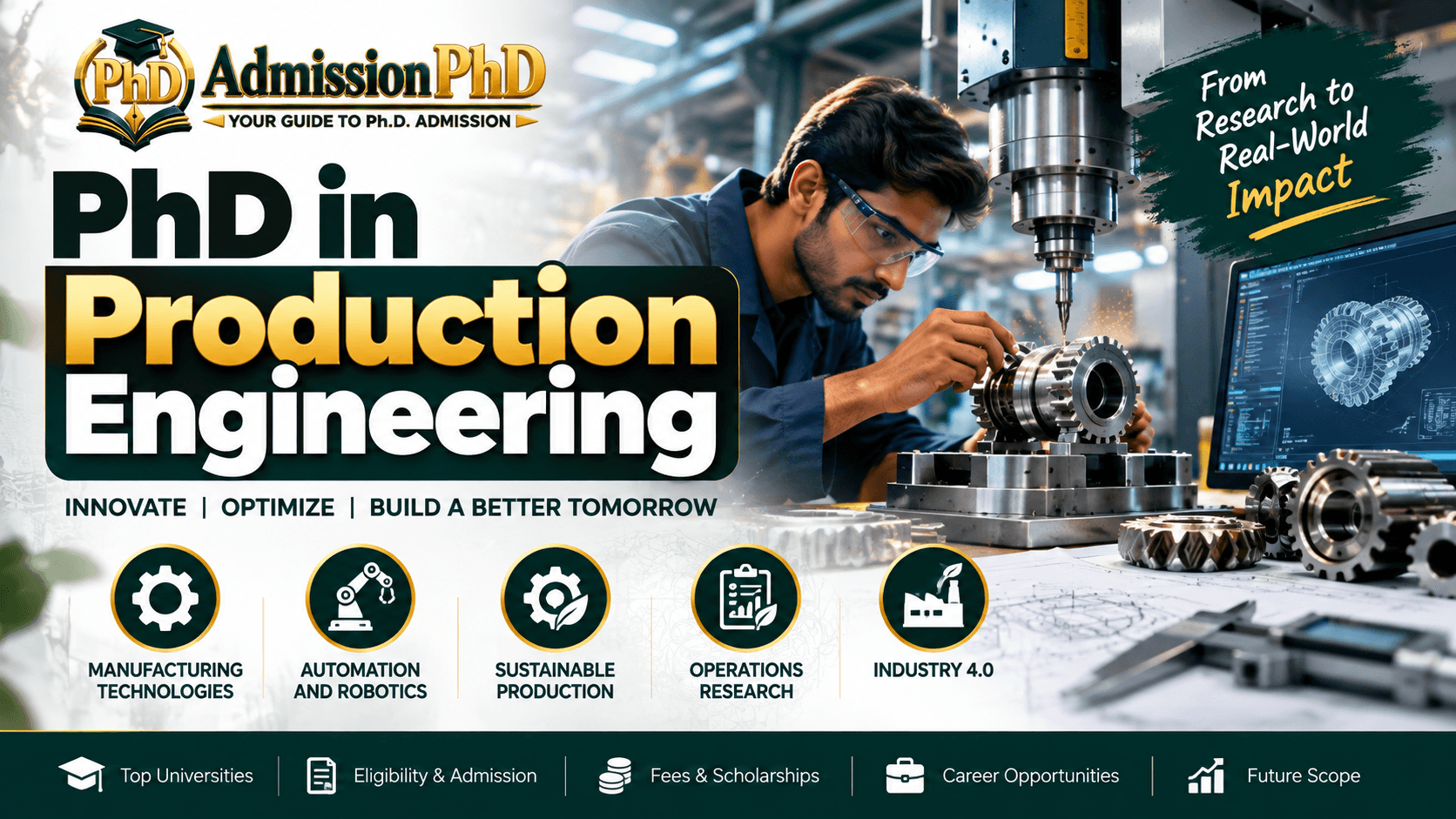
PhD in Production Engineering in India: Eligibility, Admission, Fees & Career
PhD in Production Engineering is a doctoral research programme focused on advanced manufacturing, production systems, industrial engineering, automation, optimisation and emerging manufacturing technologies. In India, admission depends on the eligibility and selection criteria of the concerned university and may involve GATE, UGC-NET, CSIR-UGC NET, an institute-level entrance examination and an interview.
Production Engineering is a multidisciplinary branch which involves the combination of manufacturing technology and engineering sciences, optimization, and production systems along with management science. For example, NIT Trichy defines the scope of Production Engineering as a multidisciplinary field which includes manufacturing technology, engineering sciences, management science, and optimization of processes and systems.
The PhD in Production Engineering in India is suitable for candidates who are interest in advanced manufacturing research, Industry 4.0, Additive Manufacturing, Robotics, sustainable manufacturing, manufacturing optimization, industrial automation, etc. The program usually consists of course work, literature survey, research methodology, experiments or modeling, publication of the research results, thesis writing, and finally the thesis defense.
What Is PhD in Production Engineering?
A PhD in Production Engineering is the highest academic qualification in the field of production and manufacturing research. It enables scholars to investigate a specific engineering problem and develop new knowledge, processes, models, materials, systems or technologies.
Research can cover areas such as:
- Advanced manufacturing
- Additive manufacturing
- Smart manufacturing
- Production planning and control
- Industrial engineering
- Manufacturing automation
- Robotics
- Computer-integrated manufacturing
- CNC and machining
- Welding and joining
- Metal forming
- Casting and foundry technology
- CAD/CAM
- Manufacturing optimisation
- Quality engineering
- Lean and sustainable manufacturing
- Supply chain and operations
- Industry 4.0
- Digital manufacturing
- Micro and nano manufacturing
- Composite materials
- Tribology
- Modelling and simulation
At institutions such as IIT Bombay, doctoral research in Mechanical Engineering includes Manufacturing Engineering as one of its major specialisations, while IIT Delhi conducts doctoral research in Production and Industrial Engineering.
PhD in Production Engineering at a Glance
| Particular | Details |
|---|---|
| Programme | PhD in Production Engineering |
| Level | Doctoral / Research |
| Typical Duration | Around 3–6 years, depending on institute and research progress |
| Eligibility | Relevant Master's degree and, where permitted, qualifying Bachelor's/direct-PhD route |
| Minimum Marks | Commonly around 55% or equivalent, but institute-specific rules apply |
| Admission Route | National-level qualification and/or institute entrance test + interview |
| Study Mode | Primarily full-time; part-time/external options may be available at selected institutions |
| Coursework | Research methodology, manufacturing, production systems and specialised research courses |
| Research Areas | Manufacturing, automation, robotics, optimisation, materials, Industry 4.0 and more |
| Research Output | Thesis, research papers, conference presentations and potentially patents |
| Career Areas | Academia, R&D, manufacturing, industrial engineering, automation and government research |
The UGC PhD Regulations, 2022 provide the applicable national framework for PhD admissions and degree requirements, while individual institutions may specify additional eligibility and admission criteria.
Why Pursue PhD in Production Engineering?
A doctoral degree in Production Engineering can be valuable for students who want to work on advanced engineering problems rather than conventional engineering roles.
- Develop Advanced Manufacturing Expertise
A PhD provides an opportunity to investigate complex manufacturing processes, materials, production systems and technologies at an advanced level. - Work on Industry 4.0
Production research increasingly involves: Industrial automation, Digital twins, Robotics, Smart factories, Predictive maintenance, Data-driven production. - Build a Research and Academic Career
A PhD can provide the qualification needed for research-oriented academic careers and can also support opportunities in universities, laboratories and research organisations. - Work in Advanced Manufacturing R&D
Doctoral researchers can contribute to R&D in areas such as additive manufacturing, advanced machining, robotics, process optimisation and sustainable manufacturing. - Solve Real Industrial Problems
The study of Production Engineering can deal with real-world problems related to productivity, cost-effectiveness, quality, energy savings, waste management, automation, and resource usage. - Develop Interdisciplinary Expertise
Production Engineering intersects with mechanical engineering, materials science, computer science, operations research, electronics and management.
How Long Does PhD in Production Engineering Take?
A PhD in Production Engineering generally takes around 3 to 6 years, although the actual duration depends on the institution, research topic, coursework, progress of experiments or simulations, publications and thesis requirements.
The programme normally includes:
- Coursework
- Research proposal
- Literature review
- Research methodology
- Experiments, modelling or simulations
- Research publications
- Thesis preparation
- Pre-submission seminar or evaluation
- Final thesis submission
- Viva voce / thesis defence
Students should check the regulations of the university before applying because the minimum and maximum registration periods can differ.
Eligibility for PhD in Production Engineering in India
The eligibility criteria for the PhD in Production Engineering may vary depending on the university, department, and research area, but a candidate is expected to have a Master’s degree in Production Engineering or a closely related field such as Manufacturing Engineering, Mechanical Engineering, Industrial Engineering, or a closely related field. The minimum marks and other admission requirements are determined by the respective university. Eligibility is also guided by the applicable UGC PhD Regulations, 2022 and the admission rules of the concerned institution.
The common eligibility criteria include:
- Master's Degree: Candidates generally need to hold a relevant Master’s degree along with the requisite minimum 55% marks relaxation would be made in case of SC/ST/OBC (non-creamy layer), Differently-Abled, EWS and other eligible categories as per the guidelines of the university.
- 4-Year Bachelor's Degree: The candidate holding a 4 year/8 semesters bachelor’s degree with 75% or more marks may be eligible for PhD programme admission without holding a Master’s degree.
- Relevant Disciplines: Depending on the research area, universities may accept candidates with postgraduate qualifications in Production Engineering, Manufacturing Engineering, Mechanical Engineering, Industrial Engineering, Industrial and Production Engineering, Materials Engineering, Mechatronics, Automation, Operations Research, or other related disciplines.
- Entrance Test: As per the admission policy of the concerned university, applicants can get admitted through the University level PhD Entrance Exam or through the national level examinations/fellowship viz., UGC-NET, UGC-CSIR NET, GATE etc.
- Viva-Voce/Interview: The shortlisted applicants will need to appear for a viva-voce/interview, where their research interest, subject knowledge and research area may be evaluated.
- Weightage of Selection: For the applicants who are selected through the HEI conducted PhD Entrance Exam, the UGC framework provides a weightage of 70% to the entrance test and 30% to viva-voce/interview.
Entrance Exams / Admission Routes
There is no single entrance examination that is mandatory for every PhD in Production Engineering programme in India.
Depending on the institution, admission may be based on:
- GATE — GATE can be used for admission to doctoral programmes in relevant branches at institutions supported by the Ministry of Education and other government agencies. A valid GATE qualification can also support financial assistance for eligible doctoral programmes.
- UGC-NET / JRF — Eligible candidates with UGC-NET/JRF qualifications can apply for PhD admissions and fellowship-supported research in the respective institutes, subject to the rules and regulations of the institution.
- CSIR-UGC NET — CSIR-UGC NET/JRF can be relevant for candidates whose research area and qualifying discipline fit the applicable requirements.
- Institute-Level Entrance Test — Some institutes conduct their own written examination. For example, IIT Kanpur's Mechanical Engineering PhD admission information describes a written test followed by an interview, with streams including Manufacturing Sciences.
- Research Fellowship — Candidates may also apply using fellowships or funding from recognised agencies where the institution accepts them.
Interview / Research Discussion
Shortlisted candidates are generally evaluated on:
- Subject knowledge
- Research aptitude
- Previous academic/project work
- Research interests
- Problem-solving ability
- Proposed research area
- Technical fundamentals
PhD in Production Engineering Admission Process
- Step 1: Choice of the Research Topic
Candidates typically select a research area based on their academic interests, previous project experience, technical skills and available faculty expertise. - Step 2: Eligibility
The university's official notification should be checked for: Required qualification, Minimum marks, Entrance examination, National-level qualification, Fellowship requirements, Research area, Experience requirements, if any. - Step 3: Application Form
The application form must be completed through the university's official website. In addition, the candidate is required to attach their documents in response to the form. - Step 4: Entrance Test or Shortlisting
Based on the institute's criteria, applicants may be shortlisted with the help of academic marks, GATE or NET results, fellowship, university entrance exam, or a combination of these methods. - Step 5: Interview
Shortlisted candidates may appear for a research or technical interview. Questions can cover: Production Engineering fundamentals, Previous academic projects, Research interests, Proposed research topic, Research methodology, Technical knowledge. - Step 6: Final Selection
Candidates selected after the applicable stages complete registration and begin doctoral coursework and research according to university regulations.
Before applying, students can also refer to our guide on PhD Admission in India to understand the eligibility criteria and admission requirements for doctoral programmes.
Fees in India for PhD Production Engineering
The PhD in Production Engineering fees in India vary substantially between IITs, NITs, central universities, state universities and private institutions.
A PhD may include:
| Fee Component | Approx. fee |
|---|---|
| Application Fee | ₹500 – ₹1000 |
| Admission/Registration Fee | ₹1,000 to ₹30,000 |
| Tuition Fee | ₹25,000 to over ₹6 Lakhs |
| Examination Fee | ₹5,000 |
| Laboratory/Research Charges | ₹50,000 to ₹3,00,000+ per year |
| Library Fee | ₹500 to ₹1,000 per year |
| Thesis Evaluation Fee | ₹20,000 to ₹50,000 |
| Hostel Fee | ₹3,000 to ₹34,000 |
| Research/Conference Expenses | ₹50,000 to over ₹2,00,000 |
Important
Fees can differ according to:
- University
- Programme
- Candidate category
- Full-time/part-time status
- Fellowship/assistantship
- Hostel requirements
- Research requirements
Candidates should verify the latest official fee notification before applying.
Universities / Institutes Offering PhD in Production Engineering
| University / Institute | Approx. fees | Programme Mode | Admission Basis |
|---|---|---|---|
| IIT Delhi | ₹35,000 to ₹60,000 | Full-time/ Part-time | Institute-specific selection + interview |
| IIT Bombay | ₹30,000–₹60,000 | Full-time | GATE/NET + Interview |
| IIT Madras | ₹1.2 Lakhs to ₹1.5 Lakhs | Full-time/ Part-time | Entrance/NET/GATE + Interview |
| IIT Kanpur | ₹1.01 lakh to ₹1.05 lakh | Full-time/ Part-time | GATE/NET + Interview |
| IIT Roorkee | ₹3 lakh to ₹3.07 lakh | Full-time/ Part-time | Academic Eligibility + Shortlisting + PhD Interview |
| IIT Kharagpur | ₹1.5 Lakhs to ₹2.5 Lakhs | Full-time/ Part-time | Institute-specific PhD admission process |
| NIT Tiruchirappalli | ₹1.5 Lakhs to ₹2.9 Lakh | Full-time/ Part-time | Institute admission process |
Scholarships and Financial Support
A PhD in Production Engineering can be financially supported through several routes.
- Institute Assistantship — Many IITs and other institutes provide teaching or research assistantships to eligible full-time doctoral students. For example, IIT Bombay currently lists TA, RA and project-supported doctoral categories, with assistantship rates depending on the category.
- GATE-Based Financial Assistance — A valid GATE score can be used for financial assistance for eligible doctoral programmes at supported institutions. The GATE 2026 information states that eligible direct PhD candidates can receive financial assistance subject to applicable rules.
- UGC / CSIR Fellowships — Candidates with relevant JRF qualifications may use their fellowship for doctoral research where accepted by the institution.
- Sponsored Research Projects — Some PhD positions are supported through research projects funded by government agencies or industry.
- PMRF — The Prime Minister's Research Fellowship is another funding route for eligible doctoral researchers at participating institutions. IIT Delhi lists PMRF among its PhD financial-support schemes.
PhD in Production Engineering Syllabus / Coursework
There is no single national syllabus for every PhD in Production Engineering. Coursework is determined by the institution, department and research area.
Typical coursework may include:
Research Methodology
- Research design
- Literature review
- Research ethics
- Technical writing
- Statistical analysis
- Experimental design
Manufacturing Engineering
- Advanced manufacturing processes
- Manufacturing systems
- Machining
- Metal forming
- Welding
- Casting
- Additive manufacturing
Production Systems
- Production planning and control
- Operations research
- Scheduling
- Supply chain management
- Inventory systems
- Manufacturing optimisation
Advanced Technologies
- Robotics
- Automation
- CNC
- CAD/CAM
- Digital manufacturing
- Industry 4.0
- Smart manufacturing
Computational Research
- Numerical modelling
- Finite element analysis
- Simulation
- Optimisation algorithms
- Data analytics
- Artificial intelligence applications
Research Areas for PhD in Production Engineering
A PhD in Production Engineering offers research opportunities across manufacturing, production systems, industrial engineering, automation, optimisation and emerging manufacturing technologies. Common research areas include:
- Advanced Manufacturing — Advanced machining processes, Precision manufacturing, Hybrid manufacturing, Micro and nano manufacturing.
- Additive Manufacturing — 3D printing, Metal additive manufacturing, Process optimisation, Material development, Defect detection and quality improvement.
- Production Planning and Optimisation — Production scheduling, Process planning, Resource optimisation, Productivity improvement, Cost optimisation.
- Robotics and Automation — Industrial robotics, Automated manufacturing systems, Robotic process automation, Flexible manufacturing systems, Automated inspection.
- Smart Manufacturing and Industry 4.0 — Digital twins, Data-driven manufacturing, Artificial intelligence in production, Machine learning for process optimisation.
- Sustainable Manufacturing — Energy-efficient production, Waste reduction, Green manufacturing.
- Manufacturing Materials and Processes — Composite materials, Metal forming, Welding and joining, Casting and foundry processes, Surface engineering.
- CAD/CAM and Digital Manufacturing — Digital production systems, Manufacturing simulation, Product and process optimisation.
- Industrial Engineering and Operations Research — Supply chain optimisation, Inventory management, Operations research, Production systems, Quality management, Lean manufacturing.
Skills Required for PhD in Production Engineering
A successful doctoral researcher needs both technical and research-oriented skills.
Technical Skills
- Manufacturing processes
- Production systems
- CAD/CAM
- Robotics and automation
- Materials engineering
- Modelling and simulation
- Numerical methods
- Statistical analysis
- Programming
- Data analysis
Research Skills
- Literature review
- Research methodology
- Experimental design
- Problem identification
- Scientific writing
- Research paper preparation
- Data interpretation
- Technical presentation
- Critical thinking
- Project management
In addition to the skills listed above, depending on the research topic, students may use various tools such as MATLAB, Python, ANSYS, CAD software, simulation platforms and specialised manufacturing equipment.
How to Choose the Right University for PhD in Production Engineering
Selection of the PhD institution should be based primarily on research fit, not just the name of the university.
The following factors should be considered:
- Faculty Expertise — Check whether faculty members actively research your preferred topic.
- Research Facilities — Look for access to: CNC machines, Additive manufacturing systems, Robotics, Metrology equipment, Materials testing, Microscopy, Simulation facilities, Automation laboratories.
- Research Publications — Check the recent publications and projects of your desired supervisor.
- Funding — Check whether the department offers: Institute assistantships, Project-funded positions, Fellowships, Research grants.
- Industry Collaboration — Industry projects can provide opportunities to work on real manufacturing problems.
- Research Environment — Consider laboratories, research groups, seminars, conferences and interdisciplinary collaborations.
IMPORTANT — Candidates should verify that the university has obtained the required AICTE approval after receiving UGC approval for the PhD in Production Engineering.
Career Opportunities And Salary After PhD Production Engineering
A PhD in Production Engineering can open the door to various fields like teaching, research and development, advanced manufacturing processes, industrial engineering, automation, quality control and production systems. Salaries may depend on the job profile, organisation, experience, research area and location.
| Career Opportunity | Typical Work Area | Indicative Salary in India |
|---|---|---|
| Research Scientist | Advanced manufacturing, production systems and engineering R&D | ₹6–15 LPA |
| Manufacturing Engineer | Manufacturing processes, process improvement and production systems | ₹6–12 LPA |
| Production Engineer | Production planning, process efficiency and manufacturing operations | ₹4–10 LPA |
| Industrial Engineer | Process optimisation, productivity and resource utilisation | ₹5–12 LPA |
| Process Engineer | Manufacturing process development and optimisation | ₹6–13 LPA |
| Quality Engineer / Quality Researcher | Quality control, inspection and process improvement | ₹5–10 LPA |
| Automation & Robotics Researcher | Industrial automation, robotics and smart manufacturing | ₹7–16 LPA |
| Additive Manufacturing Researcher | 3D printing, materials and advanced manufacturing | ₹7–15 LPA |
| R&D Scientist | Product development, manufacturing technologies and applied research | ₹7–16 LPA |
| Assistant Professor | Teaching, academic research and doctoral supervision | Varies by institution and pay scale |
| Production / Operations Manager | Production planning, operations and plant management | ₹8–18 LPA |
| Supply Chain / Operations Researcher | Optimisation, logistics, scheduling and supply chain systems | ₹6–15 LPA |
Future Scope of PhD Production Engineering
The future scope of Production Engineering research is closely connected with the transformation of manufacturing and industrial systems.
Important emerging areas include:
- Smart Manufacturing — Factories are increasingly integrating sensors, automation, data analytics and connected production systems.
- Additive Manufacturing — 3D printing and advanced manufacturing processes continue to create research opportunities in materials, process optimisation and industrial applications.
- Artificial Intelligence in Manufacturing — AI and machine learning can be applied to: Predictive maintenance, Defect detection, Quality control, Process optimisation, Production forecasting.
- Sustainable Manufacturing — Research is increasingly focused on reducing: Energy consumption, Material waste, Production emissions, Manufacturing costs.
- Robotics and Automation — Advanced robots, automated inspection and flexible manufacturing systems remain important research areas.
- Digital Manufacturing — Digital twins, simulation, industrial IoT and data-driven manufacturing are creating new research opportunities.
- Advanced Materials — Production Engineering research increasingly intersects with composites, advanced alloys, functional materials and novel manufacturing processes.
All Rights Resvered
Frequently Asked Questions
Related Articles

PhD in Geoinformatics: Eligibility, Admission, Fees & Career
Explore PhD in Geoinformatics in India, including eligibility, duration, research areas, scholarships, universities, careers and future scope.

PhD in Nursing in India: Eligibility, Admission & Career
Explore PhD in Nursing in India, including eligibility, entrance exams, admission process, fees, research areas, universities, career options and salary.

PhD in Electronic Media: Eligibility, Fees, Admission & Career
Explore PhD in Electronic Media in India, including eligibility, fees, duration, admission, entrance exams, research areas, universities, careers and salary.