
PhD in Rural Development: Eligibility, Fees & Admission
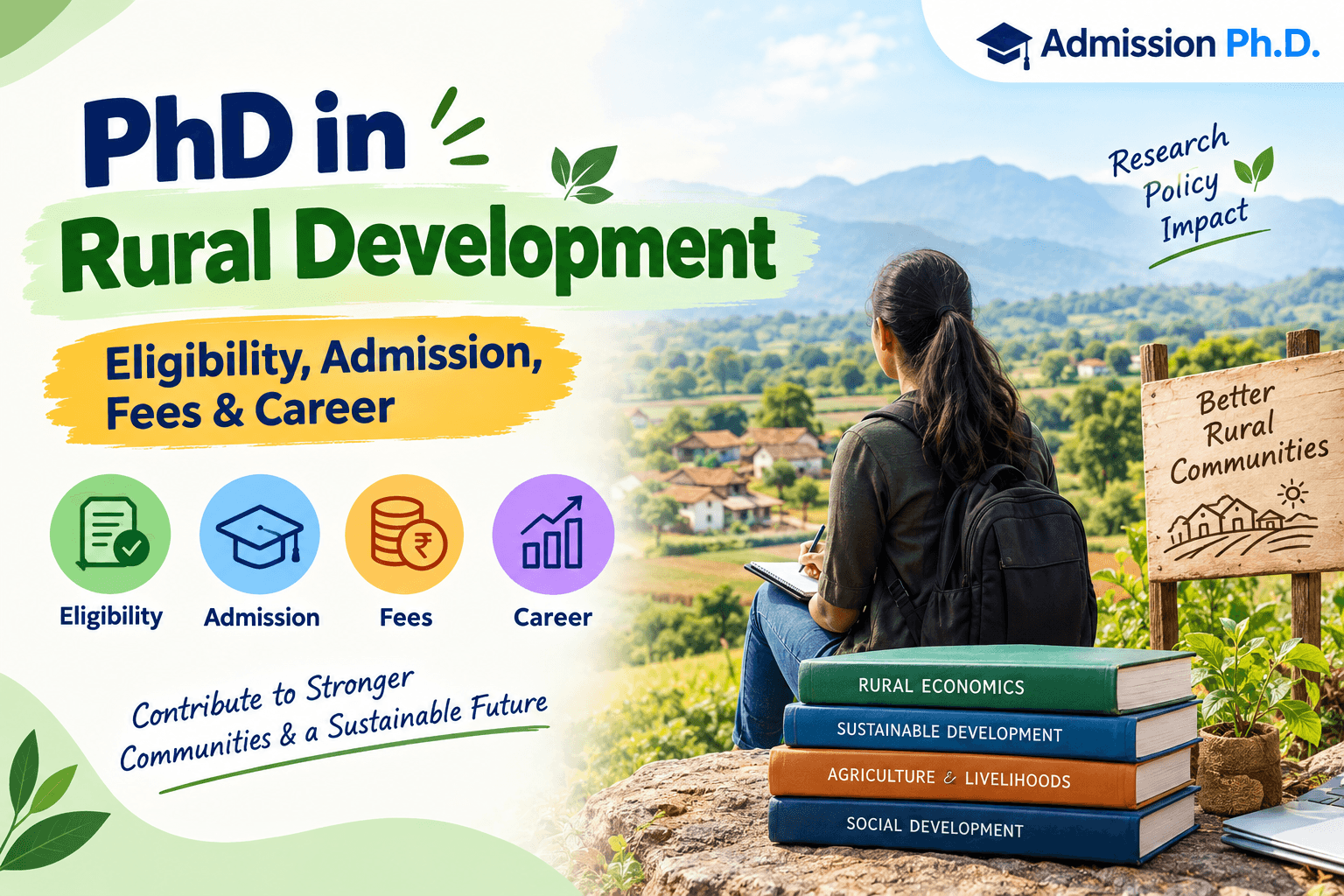
PhD in Rural Development
An Overview
A PhD in Rural Development is an advanced research program aimed at identifying and solving problems of economic, social, environmental and institutional nature in rural areas. It covers disciplines ranging from rural economics, agriculture, sociology, policy studies, governance, livelihoods, sustainability, and rural development.
PhD Research in Rural Development can cover subjects like rural poverty, employment, migration, agriculture transition, rural empowerment of women, Panchayati Raj institutions, rural entrepreneurship, financial inclusion, and effects of government development programs.
In India, there exist dedicated Rural Development research programs along with interdisciplinary departments in development studies, agriculture, geography, social sciences and rural technology.
Understanding the PhD in Rural Development Programme
The PhD in Rural Development is essentially a research program and not the traditional classroom program. Typically, the candidate goes through the mandatory coursework prior to developing the research topic/fieldwork/data analysis/thesis writing.
Research can involve:
Why Rural Development Makes an Interesting Doctoral Specialisation
Rural Development is an interdisciplinary field where academic research can be connected with real-world development issues.
A candidate may choose this area to investigate:
Rural Development research is relevant for candidates who are interested in research, teaching, public policy, development organizations, NGOs, corporate social responsibility initiatives, and government funded projects.
Key Advantages of Pursuing a PhD in Rural Development
A doctoral degree in Rural Development can provide several academic and professional opportunities.
How Long Does a PhD in Rural Development Take?
Duration
The minimum duration for a PhD program is three years inclusive of coursework, under UGC PhD Regulations 2022 which provide for a normal maximum duration of six years. There are rules regarding extension or re-registration.
IGNOU currently offers its PhD in Rural Development with:
The actual completion time can depend on coursework, research approval, fieldwork, data collection, thesis preparation and evaluation.
Who Is Eligible for PhD in Rural Development?
The PhD Rural Development eligibility varies according to the university and the specific research programme.
A common requirement is a relevant master's degree in Rural Development or an allied discipline, along with the minimum marks prescribed by the university.
Relevant academic backgrounds can include:
For example,
RKMVERI's Agriculture and Rural Development doctoral admission has also listed a range of relevant master's backgrounds, including Rural Development, Economics, Geography, Agriculture, Horticulture, Environmental Science and several related life-science disciplines.
Minimum Marks
Under the UGC PhD Regulations, candidates with a master's degree or equivalent qualification generally require at least 55% marks or equivalent grade, with the applicable relaxation for specified categories as provided under the regulations and institutional rules.
Since universities may specify additional subject-wise requirements, the most recent admission notification must always be referred to.
Entrance Test and Selection: What Should Candidates Expect?
There is no single entrance examination that is followed identically by every university for PhD Rural Development admission.
Depending on the institution, selection may consider:
The UGC system stipulates that admission is made on the basis of criteria notified by the institution in accordance with UGC rules and reservation policies.
So, students must ascertain if the university they choose takes UGC-NET, makes its own entrance test or follows some other method of selection.
Step-by-Step Admission Roadmap
The PhD in Rural Development admission process generally follows this pattern:
Step 1: Choose a Research Domain
Choose any domain, for example, rural livelihoods, agriculture, migration, governance or sustainable development.
Step 2: Shortlist Universities
Assess different universities in terms of faculty strength, research centres, course design and availability of supervisors.
Step 3: Check Eligibility Criteria
Check the accepted master's specialization, minimum marks requirement and category-wise criteria.
Step 4: Check Mode of Admission
Ascertain the mode of admission, whether it is through UGC-NET/JRF, entrance examination conducted by the university or interview or any combination of the above.
Step 5: Write the Research Proposal
Generally, the research proposal must cover the research problem, research objectives, research questions, methodology and contribution to knowledge.
Step 6: Attend the Entrance Interview
Sometimes, shortlisted students are interviewed on their educational background, proposed research and research methodology.
Step 7: Do Course Work
After selection, students do the required course work after which they start advanced research.
Step 8: Do Research and submit your thesis
In the next steps, students collect data, analyse, write and get evaluated for their thesis.
PhD in Rural Development Fees in India
The PhD Rural Development fees vary significantly between universities.
For example, IGNOU currently lists the full programme fee at ₹16,800, excluding examination fees that are determined separately.
At other institutions, candidates may have separate charges for registration, coursework, examinations, thesis submission and other university services.
| University Type | General Fee Pattern |
|---|---|
| Central/Public Universities | Usually comparatively lower, but institution-specific |
| State Universities | Varies according to university regulations |
| Deemed Universities | Can be higher depending on programme structure |
| Private Universities | Often higher than public institutions |
| Fellowship-Based Programmes | May provide tuition support and/or stipend depending on the scheme |
Scholarships and Financial Support for Research Scholars
Funding could be one of the considerations while choosing a PhD program.
Depending on eligibility and the university, scholars may look into:
Some doctoral programmes may provide financial assistance separately from the published academic fee.
Scholars may therefore check the fellowship status for each specific admission cycle rather than assuming availability in all universities.
What Does the PhD Rural Development Syllabus Include?
There is no single syllabus for PhD Rural Development program but generally the course work for doctoral studies
Common Coursework Areas
Research Directions for a PhD in Rural Development
A strong research topic is one of the most important parts of a doctoral programme. Possible areas include:
Rural Livelihoods and Employment
- Livelihood diversification among rural households
- Rural employment and income generation
- Impact of skill development on rural youth
- Informal employment in rural areas
Agriculture and Rural Economy
- Agricultural diversification
- Farmer producer organisations
- Smallholder farming and rural income
- Agricultural technology adoption
Women and Community Development
- Self-help groups and women's empowerment
- Rural women entrepreneurship
- Women's participation in local governance
- Gender and access to rural resources
Migration and Rural Society
- Rural-to-urban migration
- Seasonal migration
- Migration and household income
- Rural youth migration
Governance and Public Policy
- Panchayati Raj institutions
- Rural development programme implementation
- Social audits
- Decentralisation and local governance
Technology and Sustainability
- Digital financial inclusion
- Digital public services
- Climate-resilient rural livelihoods
- Renewable energy in rural communities
- Sustainable village development
Skills That Help a Rural Development Researcher Succeed
A doctoral scholar may need a combination of academic, analytical and field-research skills.
Important skills include:
Information regarding the use of certain analysis tools such as SPSS, R, Excel, GIS or qualitative-analysis software might also come in handy, depending on the research question.
How to Select the Right University for Rural Development Research
Instead of choosing a university only because it appears in a list of "top PhD colleges," candidates should examine the research environment.
Universities and Institutes with Rural Development Research Options
The availability and structure of doctoral programmes can change between admission cycles. The following table uses currently available institutional information and should be treated as a starting point rather than a permanent ranking.
| University / Institute | Approx. Annual / Published Fee | Programme Mode | Admission Basis |
|---|---|---|---|
| Tata Institute of Social Sciences (TISS) | ₹1,77,000 - ₹1,80,000 | Regular / Full-Time admissions | UGC-NET score + Personal Interview; JRF holders are selected based on interview. |
| RKMVERI, Narendrapur | ₹1,15,300 Minimum (3 Years) - ₹2,24,500 Maximum (6 Years) | Full-Time | NET/JRF candidates: Interview; Non-fellowship candidates: RET + Interview. |
| North-Eastern Hill University (NEHU), Tura | ₹44,000 - ₹47,000 | PhD | University Entrance Test + Personal Interview |
| Madurai Kamaraj University | ₹59,000 - ₹65,000 | Full-Time | University Research Entrance Test + Personal Interview. |
Note: Mode of programme, fees and admission requirements could vary for each admission session. It is advised to cross-check with the official notice before application.
Career Paths After Completing a PhD in Rural Development
A PhD in Rural Development career can encompass academia, research, policy, government schemes, and the development field.
Academic and Teaching Careers
PhD holders may pursue teaching and research positions in universities and colleges, subject to the applicable recruitment requirements.
Research Organisations
Possible roles include:
- Researcher
- Research Fellow
- Project Researcher
- Research Coordinator
- Research Consultant
Government and Public Development Projects
Research expertise can be relevant to projects involving:
- Rural livelihoods
- Panchayati Raj
- Rural employment
- Agriculture
- Social welfare
- Community development
- Programme monitoring and evaluation
NGOs and Development Organisations
Professionals can work in:
- Programme management
- Monitoring and evaluation
- Community development
- Livelihood programmes
- Social research
- Impact assessment
CSR and Sustainability
Firms and CSR companies may hire personnel to design, carry out and review development projects in the community.
Policy and Consulting
Rural Development scholars could also choose careers in policy research, development consultancy, and project evaluation.
IGNOU mentions career opportunities in academia, research, policy-making, government ministries, NGOs, CSR and development organisations for Rural Development PhD students.
Salary After PhD in Rural Development
No specific salary is associated with any PhD degree. Salaries will depend on one's job profile, organisation, experience, region, finances and recruitment policies.
An indicative private/development sector salary range for a PhD could be shown as:
| Career Area | Indicative Salary Range |
|---|---|
| Research / Project Researcher | ₹3–7 LPA |
| NGO / Development Professional | ₹3–8 LPA |
| Rural Development Specialist | ₹4–10 LPA |
| Policy Researcher / Analyst | ₹5–12 LPA |
| CSR / Sustainability Professional | ₹5–12 LPA |
| Senior Development / Research Roles | ₹8–15+ LPA |
These figures are indicative rather than guaranteed salaries. Academic and government positions generally follow the applicable institutional or government pay structure.
What Does the Future Hold for Rural Development Researchers?
The future scope of PhD in Rural Development extends beyond traditional rural welfare research.
Emerging research areas include:
There are increasing links between Rural Development and technology, sustainability, climate adaptation and public digital infrastructure, making for potential interdisciplinary PhD topics in Rural Development.
PhD in Rural Development vs PhD in Development Studies
These two fields overlap, but their research focus can differ.
| Aspect | PhD in Rural Development | PhD in Development Studies |
|---|---|---|
| Core Focus | Rural communities and rural transformation | Broader development issues |
| Rural Livelihoods | Major area | Can be studied |
| Agriculture | Frequently included | May be included |
| Rural Governance | Strong focus | Possible research area |
| Urban Issues | Usually less central | Can be included |
| Public Policy | Important | Important |
| Interdisciplinary Research | High | Very high |
The right programme for one will be dependent on one's research question and faculty expertise at the chosen university.
Final Thoughts
A PhD in Rural Development presents an inter-disciplinary pathway for those aspirants who are keen on studying rural economy, society, institutions, and developmental issues. There are a lot of options available for doctoral specialization in various areas ranging from rural livelihood and agriculture to governance, women empowerment, migration, technology and sustainability.
While choosing a university, candidates must consider the eligibility criteria, supervisor, mode of program, mode of admission, tuition fees, fellowships, and research facilities. These requirements may vary from one admission cycle to another and hence the latest official notification issued by the university should be considered the ultimate authority.
In case of doctoral research, what matters more than the program name is the availability of the relevant faculty and research facilities at the university with respect to the chosen research topic.
Frequently Asked Questions
Related Articles

PhD in Computer Science: Admission, Eligibility, Fees & Syllabus 2026
Explore PhD in Computer Science Admission, eligibility, entrance exam, fees, syllabus, duration, universities in India, scholarships, careers and salary.

PhD in Electronics and Communication in India 2026: Eligibility, Fees & Admission
Explore PhD in Electronics and Communication in India, including eligibility, admission process, top universities, fees, syllabus, research areas, scholarships, jobs and salary.
PhD in Botany in India 2026: Eligibility, Fees & Admission
Explore PhD in Botany in India, including eligibility, admission, fees, syllabus, entrance exams, research areas, career scope, salary and FAQs.