
Get Free Admission Guidance
Share your details and our counselors will call you.
PhD in Supply Chain Management in India: Eligibility, Fees, Admission & Career
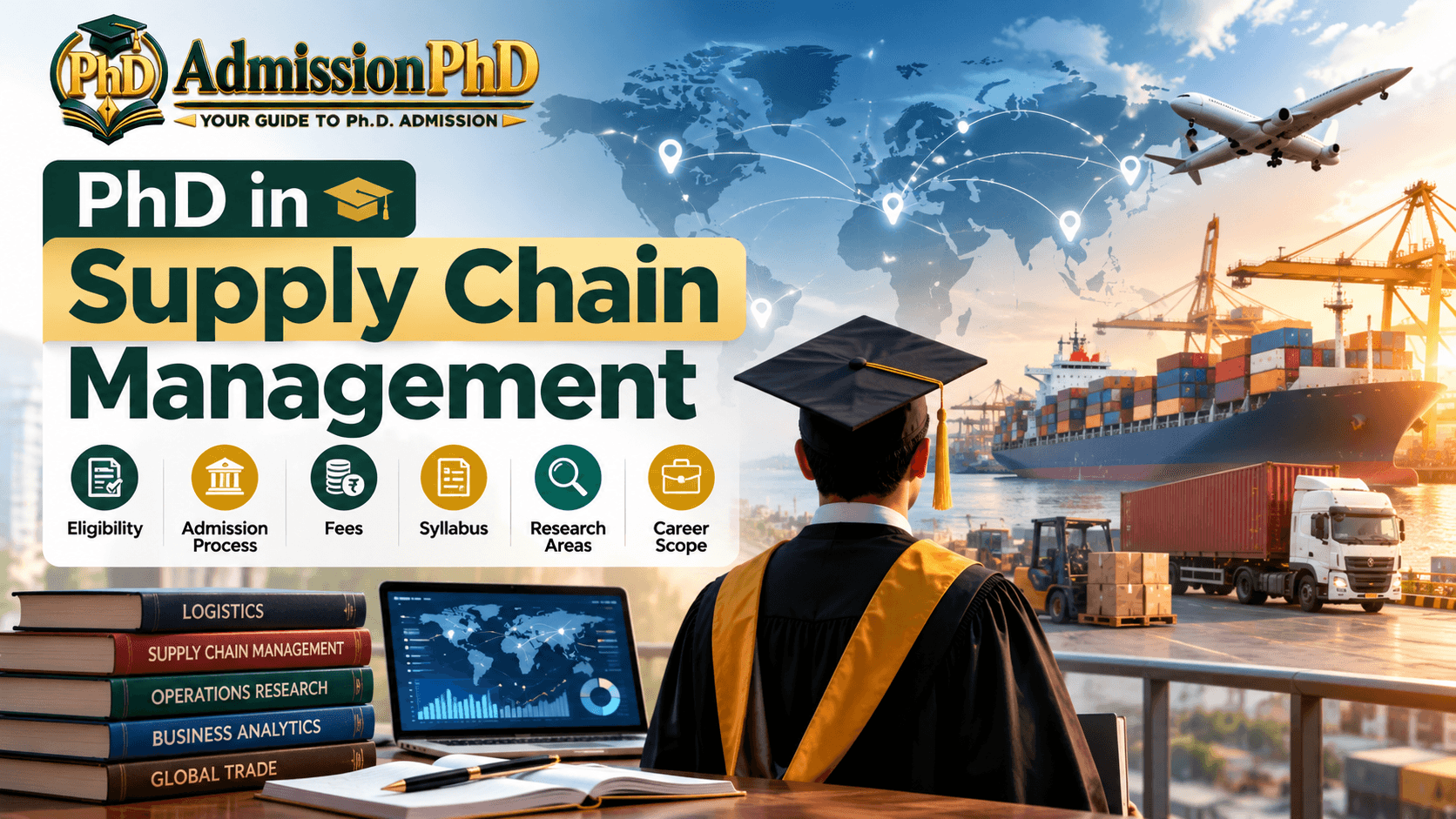
Introduction
A PhD in Supply Chain Management is a doctoral-level research programme focused on supply chain strategy, logistics, procurement, inventory management, operations, sourcing, sustainability and supply chain analytics. Such doctorate-level research can be carried out in India through departments such as Management, Operations Management, Production and Operations Management, Logistics, Supply Chain Management, Business Administration, Industrial Engineering, or other multidisciplinary departments, depending on the research interests and faculty expertise of the institute.
The scope of the research can include various areas like supply chain resilience, procurement and sourcing, logistics management, inventory optimisation, sustainable supply chains, digital supply chains, supply chain analytics, risk management, reverse logistics, global supply chains, e-commerce logistics, transportation management and operations strategy. The duration of the PhD programme can generally be between three and six years, subject to the UGC framework and university regulations.
Admission requirements vary by university and department. Candidates may be considered through UGC-NET, CAT, GATE, GMAT, GRE, university-level PhD entrance tests, recognised national-level qualifications, research proposals, written screening, research discussions and personal interviews, depending on the selected institute and programme.
PhD in Supply Chain Management at a Glance
| Programme | PhD in Supply Chain Management / PhD in Management with Supply Chain specialisation |
| Level | Doctoral |
| Minimum Duration | Generally at least 3 years including coursework under the applicable UGC framework |
| Eligibility | Master's degree required minimum 55% marks or equivalent CGPA |
| Common Backgrounds | MBA, PGDM, Supply Chain, Operations, Engineering, Economics, Statistics, Commerce and related disciplines |
| Admission Route | CAT, GATE, GRE, GMAT, JRF/NET, institute test and/or interview depending on institute |
| Study Mode | Mainly full-time; executive/part-time options at selected institutions |
| Coursework | Research methodology, statistics, operations, analytics and specialised doctoral courses |
| Research Areas | Logistics, procurement, inventory, sustainability, risk, sourcing, analytics and digital supply chains |
| Research Output | Thesis, research papers, conference presentations and academic work |
| Career Areas | Academia, research, consulting, analytics, operations and supply-chain research |
PhD Supply Chain Management: What is it about?
A PhD in Supply Chain Management is a research-oriented doctoral degree programme that explores how businesses plan, coordinate and optimize the movement of goods and services along supply chains and the flow of information and resources through the networked systems of suppliers and customers.
Doctoral research can investigate areas such as:
Unlike a taught postgraduate programme, a PhD primarily involves original research, doctoral coursework, research methodology, data analysis, publications where required, thesis preparation and a final viva-voce.
Why Pursue a PhD in Supply Chain Management?
1. Conduct Advanced Supply Chain Research
A PhD candidate can conduct intensive research on a particular supply-chain issue instead of studying the topic from a purely managerial point of view. Research can focus on supplier selection, inventory decisions, transportation, procurement, sustainability or supply-chain risk.
2. Develop Specialised Expertise
Supply Chain Management includes several specialised areas. Doctoral research allows a candidate to build expertise in a specific research domain. Possible specialisations include: Supply chain analytics, Logistics management, Procurement, Strategic sourcing, Inventory management, Sustainable supply chains, Digital supply chains, Supply chain risk management, Reverse logistics.
3. Work on Emerging Technologies
Technology is increasingly becoming part of supply-chain research. Potential research areas include: Artificial intelligence, Machine learning, Blockchain, Internet of Things, Big data analytics, Automation, Digital twins, Predictive analytics. IIT Delhi faculty research in Operations and Supply Chain Management includes areas such as big-data applications, Industry 4.0, blockchain and sustainable operations.
4. Build an Academic Research Career
A PhD is relevant for candidates interested in university teaching and research, subject to the recruitment requirements of the institution.
5. Solve Real Business Problems
Supply-chain research can address practical issues such as: Supplier disruptions, Demand uncertainty, Inventory shortages, Transportation costs, Sustainability, Global sourcing, Supply-chain resilience.
6. Conduct Interdisciplinary Research
Supply Chain Management can connect management with: Engineering, Economics, Statistics, Data Science, Computer Science, Sustainability, Finance, Operations Research.
How Long Does a PhD in Supply Chain Management Take?
A PhD generally requires at least three years including coursework under the applicable UGC framework, but the actual completion time depends on the institution and research requirements.
Many management institutes structure their doctoral programmes over approximately 4–5 years. IIM Bangalore, for example, describes its doctoral programme as a five-year full-time PhD, while candidates are expected to complete coursework, a comprehensive examination and doctoral research.
The actual duration may depend on:
Eligibility for PhD in Supply Chain Management in India
The common PhD Supply Chain Management eligibility criteria that candidates need to be able to be successfully admitted into a college that offers this course are as follows:
- Postgraduate degree in relevant discipline from any recognized University or Institution in a relevant subject with minimum 55% marks or an equivalent grade.
- For candidates belonging to SC/ST/OBC / Differently-Abled and such other categories, 5% relaxation in marks will be given in accordance with the decision of the UGC & Govt. of India will be accorded.
- There is no stream barrier for PhD in Supply Chain Management. Candidates from any stream can apply for the course.
Students planning to pursue a PhD can also check our guide on PhD Admissionin India to understand the admission process, eligibility, and important requirements.
PhD in Supply Chain Management Entrance Exams
Some universities or management institutes offering PhD in Supply Chain Management or related doctoral specialisations require candidates to qualify an entrance examination or submit a valid score from a national-level examination. The admission route varies with different institutions.
Some of the entrance examinations and admission routes that are usually accepted and followed are mentioned below:
- UGC-NET: UGC-NET is an examination conducted on a national level by the National Testing Agency (NTA) in order to ascertain the eligibility of a candidate for the positions of Junior Research Fellowship (JRF) and/or Assistant Professor and also admission to PhD courses.
- CAT: CAT is the common admission test conducted by the IIMs and accepted in some management schools for doctoral studies.
- GATE: The Graduate Aptitude Test in Engineering (GATE) is accepted by selected institutions for doctoral admissions particularly where the research area has an engineering, operations or quantitative orientation.
- GMAT: There are some management institutions that recognize GMAT as a qualifying test for PhD programs.
- GRE: There is also the possibility of GRE being recognized by certain institutions for PhD admission.
- JRF/SRF: Candidates holding a recognised Junior Research Fellowship or Senior Research Fellowship could be considered through the admission route specified by the concerned university or institute.
| Entrance Exam | Registration Date | Exam Date |
|---|---|---|
| UGC NET | April–May 2026* | June–September 2026* |
| CAT | August–September 2026* | November 2026* |
| GATE | August–October 2026* | February 2027* |
| GMAT | Throughout the year | Candidate-selected date |
| GRE | Throughout the year | Candidate-selected date |
Note: Dates are indicative and subject to the official notification. Candidates should check the respective examination authority's website for the latest registration and examination schedule.
PhD in Supply Chain Management Admission Process
- Step 1: Choice of the Research Topic – Candidates must choose the research area in accordance with his/ her academic qualification, subject background, prior research experience, and expertise of the faculty members. The possible areas could include supply chain management, logistics, procurement, inventory management, supply chain analytics, sustainability, sourcing, risk management and digital supply chains.
- Step 2: Eligibility – The university's official admission notification should be checked for: Required qualification, Minimum marks, Accepted disciplines, Entrance examination, National-level qualification, Fellowship requirements, Research area, Work experience, if required.
- Step 3: Application Form – Candidates need to complete the PhD application form through the university's official website. Required documents, academic certificates, entrance examination scores and other details must be submitted along with the application.
- Step 4: Entrance Test or Shortlisting – Depending on the university's admission rules, candidates may be shortlisted based on academic performance, CAT, GATE, GMAT, GRE, UGC-NET/JRF, fellowship, university-level entrance examination or a combination of these factors.
- Step 5: Interview – Shortlisted candidates may be called for a research or subject-specific interview. Questions can cover: Supply Chain Management concepts and theories, Logistics and transportation management, Procurement and strategic sourcing, Inventory management, Supply chain analytics, Supply chain risk and resilience, Sustainability and green supply chains, Previous academic projects or research work, Research interests, Proposed research topic, Research methodology, Quantitative and analytical methods.
- Step 6: Final Selection – Candidates who successfully complete the required selection stages may be offered admission. After registration, selected candidates generally begin doctoral coursework and research under the guidance of a research supervisor, according to the university's regulations.
Fees for PhD in Supply Chain Management
The PhD in Supply Chain Management fees vary across different universities in India as it is considered a specialisation under Management or Operations and not as a separate course.
The total cost can include:
Indicative Fee Range
| University Type | Approx. Annual Fee | Approx. Total Academic Fee* |
|---|---|---|
| Government Universities | ₹5K – ₹50K | ₹15K – ₹1.5 lakh |
| State Universities | ₹10K – ₹60K | ₹30K – ₹1.8 lakh |
| Deemed Universities | ₹40K – ₹1.5 lakh+ | ₹1.2 lakh – ₹4.5 lakh+ |
| Private Universities | ₹50K – ₹2 lakh+ | ₹1.5 lakh – ₹6 lakh+ |
Universities / Institutes Offering PhD in Supply Chain Management Research
Important: The institutions below should not all be described as offering an identically titled standalone “PhD in Supply Chain Management”. Several offer doctoral programmes in Management, Production & Operations Management, or related areas where Supply Chain Management is an established research specialisation.
| University / Institute | Programme / Research Area | Approx. Fee | Study Mode | Admission Basis |
|---|---|---|---|---|
| IIM Bangalore | Production and Operations Management | Institute-specific; fellowship/tuition support available | Full-time | GMAT/GRE/CAT/GATE/IIMB Test + Area Test + Technical Interview |
| IIT Delhi – Department of Management Studies | PhD in Management – Operations & Supply Chain Management | ₹43,150 to ₹60,000 per year | Full time/ Part time | Institute PhD admission process and applicable qualifications |
| IIFT, Kolkata | PhD in Management – Operations & Supply Chain Management | ₹4,00,000 | Full-time / Part-time | IIFT's PhD (Management) selection process |
| Central University of Jammu, Jammu | PhD in Marketing Management – Supply Chain Management is listed as a research area | ₹ 29,750 | Full-time | University PhD admission process |
| Malla Reddy University, Hyderabad | PhD in Management – Supply Chain Management can be pursued through the broader management research area | ₹1.8–2.4 lakh* | Full-time | University PhD admission process |
Career Opportunities and Salary After PhD in Supply Chain Management
Career options may include careers in academics, research, consultancy, supply chain analytics, operations research, purchasing and logistics. The salary would depend on factors such as the candidate’s experience, specialization, place of employment, geographical location and the post held.
| Job Profile | Key Responsibilities | Approx. Salary in India |
|---|---|---|
| Assistant Professor / Faculty Member | Teaching, research, publications and academic activities | ₹6–12 LPA |
| Supply Chain Researcher | Research on supply networks, logistics and supply-chain strategies | ₹5–10 LPA |
| Research Scientist | Develops analytical models and research solutions | ₹6–12 LPA |
| Operations Researcher | Uses optimisation, modelling and quantitative methods | ₹6–14 LPA |
| Supply Chain Consultant | Advises organisations on supply-chain strategy and efficiency | ₹7–15 LPA |
| Supply Chain Analytics Specialist | Uses data, forecasting and analytics for supply-chain decisions | ₹6–14 LPA |
| Procurement / Sourcing Researcher | Researches supplier selection, sourcing and procurement | ₹5–10 LPA |
| Logistics Researcher | Studies transportation, warehousing and distribution systems | ₹5–10 LPA |
| Research Associate / Project Researcher | Works on academic and industry-funded research projects | ₹4–8 LPA |
| Postdoctoral Researcher | Conducts advanced research after completing a PhD | ₹6–12 LPA |
Scholarships and Financial Support
Financial support can come from fellowships, institutional funding and research projects.
- 1. UGC-NET/JRF: Candidates qualifying for JRF through UGC-NET may receive fellowship support for doctoral research in Supply Chain Management or related management disciplines, subject to the applicable fellowship rules, eligibility conditions, research area and university requirements. The fellowship amount during the initial period of JRF is generally ₹37,000 per month, which increases to ₹42,000 per month following upgradation to SRF, depending on current UGC regulations.
- 2. Institute Fellowship: Some IIMs, IITs and other research institutions provide financial support to eligible full-time doctoral scholars.
- 3. Research Project Funding: Faculty-led research projects may provide opportunities for research assistants or project researchers.
- 4. Conference and Research Grants: Institutions may provide support for: Conferences, Research travel, Books, Software, Data, Academic resources.
PhD in Supply Chain Management Syllabus / Coursework
There is no single syllabus that all universities follow for their courses. Doctoral coursework generally builds research and analytical foundations before the candidate goes into more detail on his or her dissertation. The subject areas would be similar to:
| Subject Area | Possible Topics |
|---|---|
| Research Methodology | Research design, literature review, research methods |
| Statistics | Regression, hypothesis testing, multivariate analysis |
| Econometrics | Causal analysis, panel data, empirical methods |
| Operations Research | Optimisation, modelling, decision analysis |
| Supply Chain Management | Supply networks, coordination, strategy |
| Logistics | Transportation, warehousing and distribution |
| Inventory Management | Inventory models and demand uncertainty |
| Procurement | Supplier selection and sourcing |
| Supply Chain Analytics | Data-driven decision-making |
| Sustainability | Circular economy and green supply chains |
| Research Ethics | Academic integrity, publication ethics and plagiarism |
PhD in Supply Chain Management vs. PhD in Business Management
| Particular | PhD in Supply Chain Management | PhD in Business Management |
|---|---|---|
| Primary Focus | Research in supply chains, logistics, procurement, sourcing, inventory and operations | Research across various business and management fields |
| Scope of Research | More specialized and covers supply-chain specific challenges | Wider scope and covers more than one business and management field |
| General Educational Background | MBA/PGDM, supply chain management, operations, engineering, economics, statistics and other related fields | MBA, management, commerce, economics, engineering and other relevant fields |
| Areas of Career | Supply chain researcher, operations researcher, supply chain consultant, academic researcher and professor | Business researcher, management consultant, professor, academic researcher and management specialist |
Research Areas in PhD in Supply Chain Management
1. Supply Chain Risk Management
Investigation of supply chain disruptions, geopolitical, demand-related and network-related risks.
2. Sustainable Supply Chains
Potential topics:
3. Supply Chain Analytics
Statistical and computational methodologies for enhanced supply-chain decision making.
4. Procurement and Strategic Sourcing
Analysis of supplier selection, supplier relationship strategies, sourcing strategies and procurement analytics.
5. Inventory Management
Research topics could include: Demand forecasting, Safety stock, Stockouts, Inventory optimisation, Multi-echelon inventory systems.
6. Logistics and Transportation
Studies could focus on route optimisation, last-mile delivery, warehousing and transportation planning.
7. Digital Supply Chains
Potential topics: AI, IoT, Blockchain, Digital twins, Automation, Industry 4.0.
8. Supply Chain Resilience
Analysis of supply network preparedness, response and recovery strategies for responding to supply chain disruptions.
9. Reverse and Circular Supply Chains
Research could focus on product returns, recycling, remanufacturing and resource recovery.
10. Humanitarian Supply Chains
Studies could focus on logistics and resource allocation during disasters and human emergencies.
Full-Time vs Part-Time PhD in Supply Chain Management
| Factor | Full-Time | Part-Time |
|---|---|---|
| Research commitment | Higher | Alongside employment |
| Duration | Often structured | May vary |
| Fellowship | More commonly available | Usually depends on institute |
| Employment | Generally not the primary focus | Candidate may continue employment |
| Research environment | Regular campus interaction | More flexible |
| Suitable for | Full-time researchers | Working professionals where permitted |
Skills Required for PhD in Supply Chain Management
Research Skills
A candidate should develop:
Quantitative Skills
Supply Chain Management research can be highly quantitative. Useful skills include:
Technology Skills
Communication Skills
Doctoral researchers need to communicate findings through: Research papers, Seminars, Conferences, Presentations, Thesis writing.
Problem-Solving Skills
A PhD requires independent investigation of complex problems and development of evidence-based solutions.
How to Choose the Right University for PhD in Supply Chain Management
- 1. Check the Exact Programme Title: Confirm whether the institution offers: PhD in Supply Chain Management, PhD in Management with Supply Chain specialisation, PhD in Operations Management, PhD in Production and Operations Management, PhD in Operations and Supply Chain Management.
- 2. Check Faculty Expertise: Faculty research should match the proposed topic.
- 3. Check Research Facilities: Depending on the topic, candidates may need access to: Industry data, Supply-chain datasets, Statistical software, Computing resources, Simulation tools, Industry partnerships.
- 4. Review Recent Publications: Check whether faculty members publish research related to: Supply chains, Operations, Logistics, Procurement, Analytics, Sustainability.
- 5. Check Existing Doctoral Research: Existing dissertations can help candidates understand the actual research areas supported by the department.
- 6. Compare Financial Support: Compare: Tuition, Fellowship, Hostel, Research grants, Conference funding, Contingency support.
Future Scope of PhD in Supply Chain Management
- 1. Digital Supply Chains: Digital technologies are creating research opportunities around data-driven planning, automation and supply-chain visibility.
- 2. Artificial Intelligence and Analytics: AI can support research in: Demand forecasting, Inventory planning, Route optimisation, Risk prediction, Supplier analytics.
- 3. Sustainable Supply Chains: Research opportunities include: Carbon reduction, Green procurement, Circular economy, Reverse logistics, Sustainable sourcing.
- 4. Supply Chain Resilience: Disruptions have increased interest in resilient supplier networks, alternative sourcing and risk management.
- 5. E-Commerce Logistics: Research can examine: Last-mile delivery, Warehouse automation, Delivery optimisation, Returns management, Omnichannel supply chains.
- 6. Healthcare and Pharmaceutical Supply Chains: Potential research areas include: Medicine distribution, Cold-chain logistics, Healthcare inventory, Emergency supply chains.
- 7. Agricultural Supply Chains: Research can focus on: Food distribution, Farmer-to-market networks, Cold chains, Agricultural sustainability, Post-harvest losses.
- 8. Circular Economy: Future research can examine how organisations design supply networks around reuse, recycling and remanufacturing.
All Rights Resvered
Frequently Asked Questions
Related Articles

PhD in Physiotherapy in India: Fees, Admission & Career
Explore PhD in Physiotherapy in India, including eligibility, admission , syllabus, research areas, scholarships, universities, career options and salary.

PhD in Dentistry in India: Eligibility, Fees, Admission & Career
Explore PhD in Dentistry in India, including eligibility, admission process, fees, entrance exams, research areas, top universities, careers and salary.

PhD in Ecotourism: Eligibility, Admission, Fees & Career
Explore PhD in Ecotourism in India, including eligibility, admission process, entrance exams, fees, syllabus, research areas, scholarships and salary.