PhD in Applied Science in India 2026: Eligibility, Admission & Fees
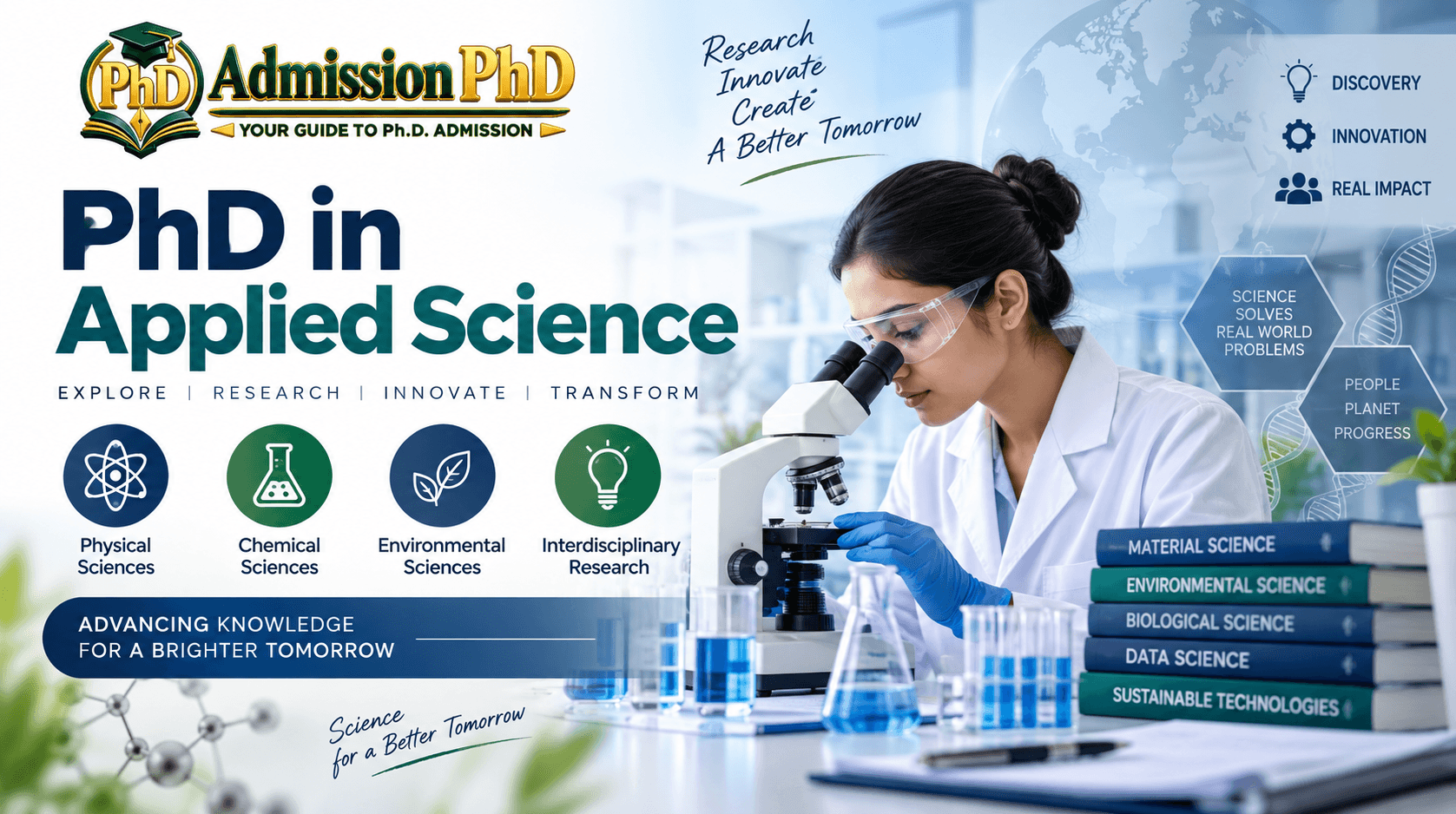
PhD in Applied Science in India 2026: Eligibility, Admission, Fees, Universities & Career Scope
PhD in Applied Science is a research-oriented doctoral program designed for individuals who wish to carry out advanced research in various scientific disciplines as well as apply scientific knowledge to real world situations. Based on the institution, Applied Sciences could include such disciplines as Physics, Chemistry, Mathematics, Materials Science, Nanotechnology, Biotechnology, Data Analytics, Environmental Science among others.
The format of a PhD varies from one institution to another whereby some institutions provide an option of a PhD programme while some institutions have Applied Sciences offered through research disciplines or interdisciplinary doctorates.
It is essential for those who plan to pursue a PhD in Applied Sciences to have an idea of eligibility, admission procedures, costs, research disciplines, duration, institutions, scholarships and careers.
What Is a PhD in Applied Science?
A PhD in Applied Science is a doctoral research programme in which scholars use scientific theories, methods and technologies to investigate problems with practical, industrial, technological or societal applications.
Unlike a conventional postgraduate programme, the main focus is not simply learning existing scientific concepts. A doctoral scholar is expected to identify a research problem, study existing literature, conduct original research, analyse findings and prepare a doctoral thesis.
The meaning of "Applied Science" can differ between universities. For example, The NorthCap University offers PhD research under Applied Sciences in areas including Physics, Chemistry and Mathematics, while its listed research areas include nanomaterials, environmental chemistry, biochemistry, data analytics and mathematical research.
Common components include:
The exact coursework and research requirements depend on the university, department and selected research area.
Why Choose a PhD in Applied Science?
1. Explore Interdisciplinary Research
Applied science can enable the convergence of different scientific disciplines. A researcher may integrate Chemistry and Materials Science, Physics and Nanotechnology, or Mathematics and Data Analytics, depending on the research area and university.
2. Work on Real-World Problems
Applied research is aimed at using scientific knowledge to address practical problems. The research may help the healthcare, energy, environment, materials, manufacturing, technology or data analytics fields, amongst others.
3. Build a Research Career
One might get research experience as a PhD candidate and prepare for working in universities, research institutions, laboratories and R&D companies.
4. Develop Specialised Scientific Skills
Whilst undertaking a doctorate, students can develop a range of competencies including, but not limited to, experimental design, scientific writing, data analysis, laboratory work, computational methods and research dissemination.
5. Prepare for Academic and R&D Careers
A PhD may be relevant to candidates who aim to pursue university teaching and research or advanced research and development careers, subject to the organisational recruitment criteria.
Eligibility Criteria for PhD program
The PhD in Applied Science Eligibility Criteria may differ from university to university. Generally, applicants have to have a post-graduate qualification in Applied Science, Physics, Chemistry, Mathematics, Materials Science, Biotechnology, Environmental Science, or another closely related discipline. Candidates with a 4-year/8-semester Bachelor's degree may also be eligible for PhD admission if they meet the applicable UGC and university requirements.
- Master’s Degree: Candidates generally need to hold a relevant Master’s degree along with the requisite minimum 55% marks as per the guidelines of the university.
- Bachelor’s Degree of 4 Years Duration: The candidate holding a 4 year/8 semesters bachelor’s degree with 75% or more marks may be eligible for PhD programme admission without holding a Master’s degree. 5% relaxation would be made in case of SC/ST/OBC (non-creamy layer), Differently-Abled, EWS and other eligible categories.
- Entrance Test: As per the admission policy of the concerned university, applicants can get admitted through the University level PhD Entrance Exam or through the national level examinations/fellowship viz., UGC-NET, UGC-CSIR NET, GATE etc.
- Viva-Voce/Interview: The shortlisted applicants will need to appear for a viva-voce/interview, where their research interest, subject knowledge and research area may be evaluated.
- Categories of UGC-NET: The current categories of UGC-NET include JRF + Assistant Professor, Assistant Professor + PhD Admission, and PhD Admission only. The admission route depends on the university and the category of the applicant in the NET.
- Weightage of Selection: For the applicants who are selected through the HEI conducted PhD Entrance Exam, the UGC framework provides a weightage of 70% to the entrance test and 30% to viva-voce/interview.
The specific eligibility criteria for PhD in Applied Science in India may differ from university to university. Candidates must refer to the latest official admission notification and prospectus of the concerned university before applying.
Is UGC-NET Required for PhD?
No, UGC-NET is not mandatory for every PhD in Applied Science. The requirement depends on the university, research area and admission route.
The UGC framework permits HEIs to admit candidates who qualify for fellowships/scholarships through examinations such as UGC-NET, UGC-CSIR NET, GATE and similar national-level tests through an interview. Institutions can also use their own PhD entrance examination according to their notified admission process.
For instance, as per the NorthCap University, "candidates having valid scores of NET/GATE/JRF/SLET will get exemption from taking the university entrance test, whereas others can go through university entrance route."
This means that students cannot make the mistake of thinking that NET is mandatory for all PhD Applied Sciences programs.
PhD in Applied Sciences Admission Process
The admission process for a PhD in Applied Science can vary between universities. However, most universities adopt a mixture of application, entrance, research proposal, and interview processes.
- Step 1: Eligibility – The first step to PhD admission is to ensure that one meets the eligibility criteria set by the university. This will include postgraduate qualification, grades, specialization, and any other requirements stated in the university prospectus.
- Step 2: Research Area Selection – The candidate should identify their area of study based on their interests and research considerations. Applied Physics, Applied Chemistry, Applied Mathematics, Materials Science, Biotechnology, Environmental Science, Nanotechnology, Computational Science, Data and Mathematical Modelling, Interdisciplinary Applied Sciences are some of the areas to consider.
- Step 3: Application Form – The application form must be completed online by the official website of the university. In addition, the candidate is required to attach their documents in response to the form.
- Step 4: Entrance Exam – The university may conduct its own PhD entrance examination. The entrance test may include research methodology, research aptitude, and subject-specific knowledge. Under the UGC framework, an HEI-level entrance test consists of 50% research methodology and 50% subject-specific content. Candidates qualifying through applicable national-level fellowships/tests may be considered through an interview route as per university rules.
- Step 5: Research Proposal, and Interview – Short-listed candidates would be asked to submit research proposals for their ideas prior to the interview process. Possible areas of questioning by the panel may include research question, methodology, subject matter expertise, research interest, and anticipated outcome.
- Step 6: Selection Process – Finally, the university may consider their entrance examination result, academic record, research proposal, interview, and availability of supervisors during the selection process.
Top Universities for Applied Science PhD in India
The following universities offer Applied Sciences doctoral programmes opportunities. Please note that this is not a ranking, and the programme names, areas of research, fees, and admission routes may vary over admission cycles.
| University/Institute | Approx. Fees | Programme Mode | Admission Basis |
|---|---|---|---|
| Chitkara University | Approx. ₹4.20 lakh | Full-time & Part-time | University PhD Entrance Test + Personal Interview |
| The NorthCap University | Approx. ₹2.45 Lakh to ₹2.54 Lakh | Full-time & Part-time | NPET/NET/GATE/JRF/SLET + Interview, as applicable |
| S-VYASA University, Bengaluru | Approx. ₹2.36 lakh | Full-time & Part-time | JRF/NET/SLET/KSET/GATE/Entrance Test + Interview |
| Gauhati University | Approx. ₹33,360 to ₹62,130 | Full-time & Part-time | GURET or applicable JRF/NET/GATE exemption + departmental interview |
| IIndian Institute of Information Technology Allahabad | Approx. ₹2.4 Lakhs to ₹3.89 Lakhs | Full-time | IIITA-PET / National-Level Test + Interview |
| Vivekananda Global University, Jaipur | Approx. ₹1.55 lakh/year for PhD programmes | Full-time/Part-time as applicable | VGU PhD Entrance Exam + Interview / NET-JRF-GATE Exemption |
Fee note: The figures above should be treated as indicative or based on the currently published university information. Registration, examination, laboratory, hostel, thesis, research and other institutional charges may be additional. Candidates should verify the latest fee notification before admission.
Government vs Private Universities for PhD in Applied Science
The following table contains universities and institutions with either doctoral programs in applied science. It is not a ranking; applicants need to consider various aspects before applying to any university.
| Factor | Government Universities | Private/Deemed Universities |
|---|---|---|
| Fees | Usually lower and more affordable | Often higher, depending on institution |
| Research Funding | Government grants and projects may be available | Depends on institutional and external funding |
| Infrastructure | Varies by institution | Varies by university and department |
| Faculty | Depends on department and specialisation | Depends on faculty and research groups |
| Competition | May be high because of limited seats | Varies by institution |
| Scholarships | JRF and other funding may be available | University and external funding may be available |
| Research Areas | Often broad in established departments | Depends on faculty and facilities |
| Supervisor Availability | Depends on available seats and faculty | Depends on department and faculty |
Rather than selecting a university only because of its category, compare its research facilities, supervisor expertise, funding opportunities, publications, research areas and admission requirements.
Students planning to pursue a PhD can also explore our detailed guide on PhD Admission in India to understand eligibility, entrance exams, application steps, and other important admission requirements.
PhD Applied Science Duration
A full-PhD generally requires at least 3 years, including coursework, under the applicable UGC framework. The maximum duration and provisions for extension or re-registration are subject to the applicable regulations and university rules.
The programme usually involves:
| Stage | Approximate Time |
|---|---|
| Coursework | 6–12 months |
| Literature Review | 3–6 months |
| Research Proposal | 2–4 months |
| Data Collection & Research | 1–3 years |
| Data Analysis | 6–12 months |
| Thesis Writing | 4–12 months |
| Evaluation & Viva | 2–4 months |
The timeline may vary depending on the university, research area, a chosen method of supervision, data availability, and many other factors.
Part-Time PhD in Applied Science
A part-time PhD in Applied Science may be available at universities that permit part-time doctoral registration.
This option can be useful for working professionals, teachers and researchers who want to continue their employment while pursuing doctoral research.
The UGC framework permits part-time PhD programmes subject to the prescribed requirements. An employed candidate may need an NOC from the employer confirming permission to pursue the programme.
Candidates should also distinguish between part-time PhD and online/distance PhD. The permitted mode, attendance requirements and research arrangements should always be checked with the concerned university.
The NorthCap University, for example, currently states that its Applied Sciences PhD is offered in both full-time and part-time modes.
PhD in Applied Science Fees in India
The fee structure of PhD in Applied Science varies depending on which Indian university students study in. Even though most government-run universities offer the course with heavily subsidized fees, private universities usually have high fees.
Approximate Fee Pattern
| University Type | Approx. Academic Fee |
|---|---|
| Central/Government Universities | ₹5,000–₹50,000+ per year |
| State Universities | ₹10,000–₹60,000+ per year |
| Deemed Universities | ₹40,000–₹1.5 lakh+ per year |
| Private Universities | ₹50,000–₹2 lakh+ per year |
This is just a range and not an absolute fee. Students might also be required to pay for registration fees, exam fees, laboratory fees, library fees, thesis evaluation fees, and other institutional fees.
PhD in Applied Science Syllabus
The syllabus may vary according to the research area and the university. However, the PhD coursework will generally focus on research training and advanced scientific concepts.
Common areas may include:
- Research Methodology – Research design, literature review, research methods, scientific investigation and data interpretation.
- Advanced Subject Studies – Subjects will depend on the chosen specialisation, such as Physics, Chemistry, Mathematics, Materials Science or Biotechnology.
- Research and Publication Ethics – Academic integrity, plagiarism, responsible research and scientific publication practices.
- Data Analysis and Computational Methods – Statistical analysis, modelling, simulation and computational tools may be included depending on the research area.
- Specialised Research Coursework – Candidates may study advanced topics directly related to their proposed doctoral research.
- Thesis Research – The major part of the programme involves original research leading to the doctoral thesis.
Major Research Areas in PhD in Applied Science
Applied Physics
Possible areas include in its research such as Condensed Matter Physics, Optics and Photonics, Semiconductors, Materials and Energy related physics.
Applied Chemistry
Possible areas include materials chemistry, environmental chemistry, nanochemistry, catalysis and industrial applications.
Applied Mathematics
The research will include Mathematical Modelling, Statistics, Optimisation, Graph Theory, Computational Mathematics, and Data Analytics.
Materials Science
The research will include Nanomaterials, Polymers, Semiconductors, Composites, Energy Materials, and Advanced Materials.
Nanotechnology
Research may focus on the synthesis, characterisation and applications of nanoscale materials and devices.
Environmental Science
Research can address pollution, water quality, environmental monitoring, sustainability and related scientific problems.
Computational Science
This can involve modelling, simulation, high-performance computing, scientific computing and data-driven research.
Skills Developed During a PhD in Applied Science
A doctoral programme can help students develop:
The exact skills depend on the research specialisation and the tools used during the doctoral project.
Scholarships and Fellowships for PhD in Applied Science
PhD scholars may receive financial support through fellowships, university scholarships, research assistantships or funded research projects. Availability depends on eligibility, selection and the rules of the institution or fellowship scheme.
- UGC-JRF: Candidates who qualify for the applicable UGC-JRF fellowship may receive financial support subject to the fellowship's eligibility conditions and terms. The current UGC information lists ₹37,000 per month for the first two years and ₹42,000 per month for the remaining period.
- University Scholarships: Some universities provide their own scholarships, fee concessions or research support.
- Research Project Funding: Students engaged in funded research projects might be entitled to financial support depending on the project and institution.
Candidates are advised to consult the latest fellowship notification prior to applying as the amount of financial support, eligibility and duration might be subject to changes.
Career Opportunities and Salary After PhD
| Career Opportunity | Job Role | Approx. Salary |
|---|---|---|
| Research & Development | Research Scientist / R&D Scientist | Approx. ₹6–15 LPA |
| Academics | Assistant Professor | Approx. ₹7–12 LPA |
| Government Research | Scientific Officer | Approx. ₹7–15 LPA |
| Postdoctoral Research | Postdoctoral Researcher | Approx. ₹4–8 LPA |
| Data & Analytics | Data Scientist / Quantitative Researcher | Approx. ₹8–18 LPA |
| Laboratory Research | Laboratory Scientist | Approx. ₹5–10 LPA |
| Research Projects | Research Associate | Approx. ₹4–8 LPA |
| Scientific Consulting | Scientific Consultant | Approx. ₹8–18 LPA |
| Industry | Technical Specialist | Approx. ₹8–18 LPA |
| Advanced Research | Senior Scientist / Research Specialist | Approx. ₹12–25 LPA |
Salary estimates are approximate and can differ based on specialization.
Is a PhD in Applied Science Worth It?
PhD program in Applied Science can become an option for those students who want to build their future career via conducting research, teaching at universities, scientific or innovation-oriented R&D.
It may be particularly suitable if your career goal includes:
- University teaching and research
- Scientific research
- Advanced R&D
- Materials or nanotechnology research
- Applied Physics or Chemistry research
- Computational or interdisciplinary research
- Government or institutional research
- Postdoctoral research
However, a PhD is not necessary for every science-related career. Some laboratory, technical, quality-control and industry positions may be accessible with a Master's degree and relevant practical experience.
The decision should therefore depend on your research interests, career plans, preferred specialisation, financial situation and willingness to spend several years on doctoral research.
All Rights Reserved
Frequently Asked Questions
Related Articles
PhD in Chemistry in India 2026: Eligibility, Fees & Jobs
Explore PhD in Chemistry in India, including eligibility, admission process, fees, top universities, syllabus, research areas, jobs, salary, duration and FAQs.

PhD in Finance: Eligibility, Admission, Fees & Career
Explore PhD in Finance in India, including eligibility, admission process, entrance exams, fees, syllabus, scholarships.
PhD in Zoology: Admission, Eligibility, Fees, Universities & Career 2026
Explore PhD in Zoology in India, including eligibility, admission process, duration, fees, top universities, research areas, salary, careers and FAQs.