PhD in Chemistry in India 2026: Eligibility, Fees & Jobs
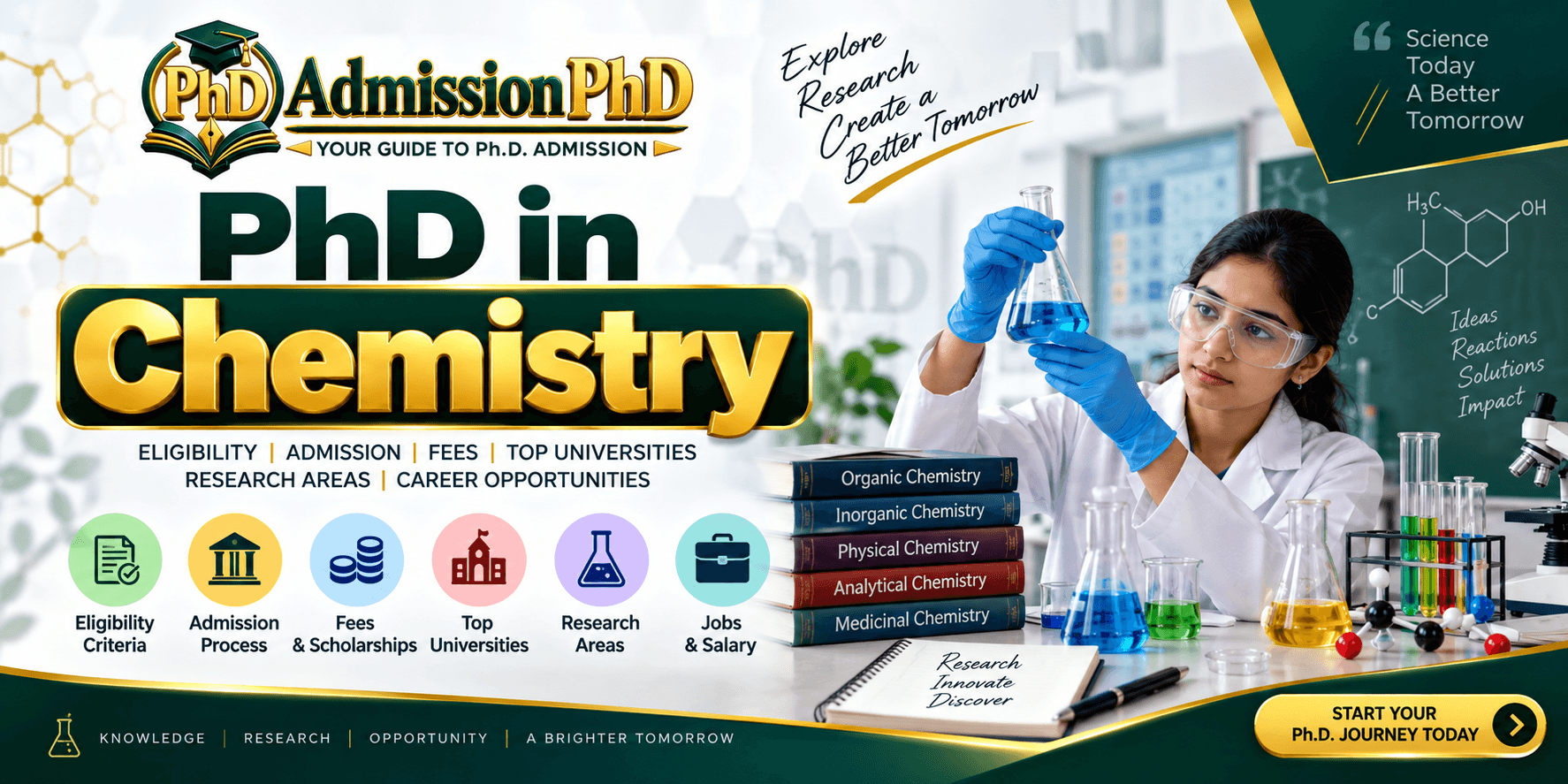
PhD in Chemistry in India 2026: Eligibility, Admission, Fees & Career Scope
PhD in Chemistry is a research-oriented doctorate programme aimed at those students who wish to learn chemistry to the highest degree and contribute to the body of knowledge through research. The programme includes but is not limited to experimental, theoretical, computational, material, chemical biology and many other specializations in the field.
As part of the programme, scholars are expected to take courses, choose the topic for their research, have a research advisor, carry out original research, make publications/presentations, if needed, and submit a dissertation.
Chemistry research is useful for pharmaceutical, health care, materials, energy, environment, agricultural, nanotech, food science and chemical industries. Thus, it offers career options in the field of teaching and research.
The key issues for Indian PhD candidates to take into account before choosing a PhD in Chemistry are eligibility criteria, entrance criteria, interests, supervisor availability, tuition fees and funding, as well as research facilities.
What is a PhD in Chemistry?
PhD in Chemistry is the highest degree awarded in chemistry for academic research. In contrast to the MSc program, the key aim is not just to learn the already established concepts but to conduct original research that adds something to knowledge, methodology, materials, explanation, and applications.
It can include lab work, spectroscopy, syntheses, modeling, theoretical work, characterization of materials and interdisciplinary research.
Common components include:
The exact coursework and research requirements depend on the university and department.
Why Choose a PhD in Chemistry?
1. Develop Advanced Chemistry Expertise
A PhD allows students to study a specialised area of Chemistry in much greater depth than undergraduate or postgraduate study.
2. Conduct Original Research
Students are given an opportunity to perform their own research and find an original solution, new material, method or application.
3. Build an Academic Career
Students interested in university teaching and research can pursue academic careers after completing a PhD, subject to the recruitment rules applicable to the position and institution.
4. Work in Research and Development
Chemistry research is relevant to pharmaceuticals, chemicals, materials, energy, biotechnology, environmental science and several other industries.
5. Develop Laboratory and Analytical Skills
Scholars can acquire expertise in various techniques such as spectroscopy, chromatography, microscopy, synthesis, computer modelling and analysis of results depending on their specialization.
PhD in Chemistry Eligibility
The PhD in Chemistry Eligibility Criteria may differ from university to university. Generally, applicants have to have a post-graduate qualification in Chemistry, Applied Chemistry, Pharmaceutical Chemistry, Materials Chemistry, or another closely related discipline. Certain universities may also consider applicants having a 4-year undergraduate degree as per the UGC norms.
- Master’s Degree: Candidates generally need to hold a relevant Master’s degree along with the requisite minimum 55% marks as per the guidelines of the university.
- Bachelor’s Degree of 4 Years Duration: The candidate holding a 4 year/8 semesters bachelor’s degree with 75% or more marks may be eligible for PhD programme admission without holding a Master’s degree. 5% relaxation would be made in case of SC/ST/OBC (non-creamy layer), Differently-Abled, EWS and other eligible categories.
- Entrance Test: As per the admission policy of the concerned university, applicants can get admitted through the University level PhD Entrance Exam or through the national level examinations/fellowship viz., UGC-NET, UGC-CSIR NET, GATE etc.
- Viva-Voce/Interview: The shortlisted applicants will need to appear for a viva-voce/interview, where their research interest, subject knowledge and research area may be evaluated.
- Categories of UGC-NET: The current categories of UGC-NET include JRF + Assistant Professor, Assistant Professor + PhD Admission and PhD Admission only. The admission route depends on the university and the category of the applicant in the NET.
- Weightage of Selection: For the applicants who are selected through the HEI conducted PhD Entrance Exam, the UGC framework provides a weightage of 70% to the entrance test and 30% to viva-voce/interview.
The specific eligibility criteria for PhD in Chemistry in India may differ from university to university. Candidates must refer.
Is UGC-NET Required for PhD in Chemistry?
UGC-NET may not be mandatory for all PhD courses in chemistry as it depends on the university and their current notification.
Some institutes require UGC-NET/CSIR-UGC NET or any other national level exam while others have their own criteria for selection. For example, the University of Hyderabad selects candidates for their 2026 Chemistry PhD program on the basis of UGC-NET/CSIR-UGC NET while IIT Bombay conducts shortlisting followed by interviews.
PhD in Chemistry Admission Process
The admission process for a PhD in Chemistry can vary between universities. However, most universities adopt a mixture of application, entrance, research proposal, and interview processes.
- Step 1: Eligibility – The first step to PhD admission is to ensure that one meets the eligibility criteria set by the university. This will include postgraduate qualification, grades, specialization, and any other requirements stated in the university prospectus.
- Step 2: Research Area Selection – The candidate should identify their area of study based on their interests and research considerations. Organic Chemistry, Inorganic Chemistry, Physical Chemistry, Analytical Chemistry, Biochemistry, Materials Chemistry, Computational Chemistry, Medicinal Chemistry, Polymer Chemistry, Environmental Chemistry are some of the areas to consider.
- Step 3: Application Form – The application form must be completed online by the official website of the university. In addition, the candidate is required to attach their documents in response to the form.
- Step 4: Entrance Exam – The university may conduct its own PhD entrance examination. The exam may focus on research methodology, research aptitude, Chemistry subject knowledge, and relevant specialised areas, depending on the university's admission pattern.
- Step 5: Research Proposal, and Interview – Short-listed candidates would be asked to submit research proposals for their ideas prior to the interview process. Possible areas of questioning by the panel may include research question, methodology, subject matter expertise, research interest, and anticipated outcome.
- Step 6: Selection Process – Finally, the university may consider their entrance examination result, academic record, research proposal, interview, and availability of supervisors during the selection process.
For students looking for more guidance, you can also explore PhD Admission in India .
Top Universities for Chemistry PhD Admissions India
The following table contains universities and institutions with either doctoral programs in chemistry. It is not a ranking; applicants need to consider various aspects before applying to any university.
| University/Institute | Approx. Fees | Programme Mode | Admission Basis |
|---|---|---|---|
| Indian Institute of Science (IISc), Bengaluru | Approx. ₹30,000 -₹41,000 | Full-time | Entrance/NET + Interview |
| IIT Bombay | Approx ₹2.2 lakh to ₹2.3 lakh | Both Full-time/Part-time | GATE/NET + Interview |
| IIT Delhi | Approx. ₹30,000 to ₹80,000 per year | Both Full-time/Part-time | GATE/NET/Entrance + Interview |
| University of Delhi | Approx ₹7,000 to ₹25,000 | Both Full time/Part-time | UGC-NET/entrance and interview as applicable |
| University of Hyderabad | Approx ₹65,000 to ₹85,000 | Both Full time/Part-time | UGC-NET/CSIR-UGC NET route |
| Panjab University, Chandigarh | Approx ₹6,000 to ₹65,000 | Both Full time/Part-time | NET/JRF/GATE/other accepted qualification or entrance route |
Fee note: These are indicative figures and should not be treated as fixed total programme costs. Registration, examination, hostel, laboratory, thesis and other institutional charges may apply. Always verify the latest official fee notification.
Government vs Private Universities for PhD in Chemistry
Both government and private/deemed universities can offer doctoral research opportunities in Chemistry. However, students should compare the research environment rather than looking only at tuition fees.
| Factor | Government/Public Universities | Private/Deemed Universities |
|---|---|---|
| Fees | Usually lower and more affordable | Often higher, depending on institution |
| Research Funding | Government grants and institutional projects may be available | Depends on institutional and external funding |
| Research Facilities | Varies; major research institutes may have extensive facilities | Depends on university and department |
| Faculty | Depends on department and research specialisations | Varies by institution |
| Competition | Can be high because of limited seats | Varies by university |
| Scholarships | JRF and institutional funding may be available | University and external fellowships may be available |
| Research Areas | Often broad in established departments | Depends on faculty and facilities |
| Supervisor Availability | Depends on available seats and faculty | Depends on department and faculty |
PhD in Chemistry Duration
A PhD generally requires at least three years, including coursework, under the applicable UGC framework. The maximum duration and provisions for extension or re-registration are subject to the applicable regulations and university rules.
The programme usually involves:
| Stage | Approximate Time |
|---|---|
| Coursework | 6–12 months |
| Literature Review | 3–6 months |
| Research Proposal | 2–4 months |
| Data Collection & Research | 1–3 years |
| Data Analysis | 6–12 months |
| Thesis Writing | 4–12 months |
| Evaluation & Viva | 2–4 months |
The timeline may vary depending on the university, research area, a chosen method of supervision, data availability, and many other factors.
PhD in Chemistry Fees in India
The fee structure of PhD in Chemistry varies depending on which Indian university students study in. Even though most government-run universities offer the course with heavily subsidized fees, private universities usually have high fees.
Approximate Fee Pattern
| University Type | Approx. Academic Fee |
|---|---|
| Central/Government Universities | ₹5,000–₹50,000+ per year |
| State Universities | ₹10,000–₹60,000+ per year |
| Deemed Universities | ₹40,000–₹1.5 lakh+ per year |
| Private Universities | ₹50,000–₹2 lakh+ per year |
This is just a range and not an absolute fee. Students might also be required to pay for registration fees, exam fees, laboratory fees, library fees, thesis evaluation fees, and other institutional fees.
PhD in Chemistry Syllabus
The PhD in Chemistry curriculum depends on the university and research specialization.
Coursework subjects can be in the following areas:
- Research Methodology – Research methods, literature search and research design.
- Research and Publication Ethics – Research ethics, academic writing and publications.
- Advanced Organic Chemistry – Reaction mechanisms and organic methods.
- Advanced Inorganic Chemistry – Coordination chemistry and organometallic chemistry.
- Advanced Physical Chemistry – Thermodynamics, reaction kinetics, quantum chemistry and molecular processes.
- Analytical Chemistry – Instrumental analysis and chemical analysis.
- Spectroscopy – NMR, IR, UV-Visible spectroscopy and mass spectrometry.
- Materials Chemistry – Materials synthesis and characterization.
- Computational Chemistry – Computational and modeling methods.
- Nanochemistry – Nano materials and nanoscience.
- Chemical Biology – Chemistry applied for biological systems.
- Thesis Research – Original research for the PhD thesis.
For instance, some of the subject areas covered by the PhD in Chemistry of the University of Delhi are analytical techniques in material science, advanced chemical kinetics, advanced materials chemistry, molecular symmetry and group theory, chemoinformatics and computer programming in chemistry.
Major Research Areas in PhD in Chemistry
Organic Chemistry
Research can be done in organic synthesis, reaction mechanism, natural products, catalysis and medicinal chemistry.
Inorganic Chemistry
The scope of research covers coordination chemistry, organometallic compounds, catalysis, metal complexes and bioinorganic chemistry.
Physical Chemistry
Thermodynamics, kinetics, spectroscopy, quantum chemistry, molecular dynamics and reaction mechanisms are some of the research areas.
Analytical Chemistry
This is concerned with developing and using methods to detect and quantify chemical substances.
Materials Chemistry
Materials with applications in the field of energy, electronics, catalysis, sensors and other technologies are studied.
Computational Chemistry
Computational methods are applied to study molecules, reactions, materials and their chemical properties.
Medicinal Chemistry
This branch links chemistry to the fields of drug discovery and development.
Environmental Chemistry
Pollutants, chemical reactions, water quality, atmospheric chemistry and environmental monitoring are some of the research topics.
Nanochemistry
This involves the synthesis, characterization and application of nanomaterials.
Skills Developed During a PhD in Chemistry
A doctoral programme can help students develop:
Based on the specialization in research, students can learn other skills, such as NMR, mass spectrometry, chromatography, spectroscopy, microscopy, and computer simulation.
Scholarships and Fellowships for PhD in Chemistry
PhD scholars may receive financial support through fellowships, university scholarships, research assistantships or funded research projects. Availability depends on eligibility, selection and the rules of the institution or fellowship scheme.
- UGC-JRF: Candidates who qualify for the applicable UGC-JRF fellowship may receive financial support subject to the fellowship's eligibility conditions and terms. The current UGC information lists ₹37,000 per month for the first two years and ₹42,000 per month for the remaining period.
- University Scholarships: Some universities provide their own scholarships, fee concessions or research support.
- Research Project Funding: Students engaged in funded research projects might be entitled to financial support depending on the project and institution.
Candidates are advised to consult the latest fellowship notification prior to applying as the amount of financial support, eligibility and duration might be subject to changes.
Career Opportunities and Salary After PhD in Chemistry
A PhD in Chemistry can open doors to a career in research, academia, pharmaceuticals, chemical industries, materials science, government research organisations, and analytical laboratories.
| Career Option | Main Work | Indicative Salary in India |
|---|---|---|
| Research Scientist | Conduct research, design experiments, develop new compounds and analyse results. | ₹6–12 LPA |
| R&D Scientist | Work on product development, formulations, materials and chemical processes. | ₹6–15 LPA |
| Analytical Chemist | Perform chemical testing, analysis and quality assessment. | ₹3–10 LPA |
| Industrial Chemist | Develop and improve chemical processes and products in industries. | ₹5–12 LPA |
| Medicinal Chemist | Work on drug discovery, chemical synthesis and pharmaceutical research. | ₹6–15 LPA |
| Materials Scientist | Research advanced materials, polymers, nanomaterials and related technologies. | ₹6–15 LPA |
| Quality Control/Research Analyst | Test products and analyse chemical data to maintain quality standards. | ₹4–10 LPA |
| Scientific Consultant | Provide specialised scientific and technical advice to organisations. | ₹6–15 LPA+ |
The salaries listed above are indicative and not guaranteed figures.
Is PhD in Chemistry Worth It?
The PhD in Chemistry can be advantageous for those who are interested in establishing their career through advanced research.
In case candidates want to be in the following areas:
- University researcher/faculty
- Advanced R&D
- Specialised knowledge in Chemistry
- Postdoctoral Research
- Pharmaceutical/Materials Research
- Independent Scientific Research
- Specialised Scientific & Technical jobs
then the PhD in Chemistry would be worth taking.
Nevertheless, a PhD is not necessary for all Chemistry-based professions. In case your target is laboratory positions, quality control or industry level positions then perhaps an MSc degree and related practical experience will do just fine.
It is thus dependent on a number of factors like career aspiration, field of research, financial capacity, work environment and so forth.
Part-Time PhD in Chemistry
Part-time doctoral study can be useful for working professionals where the university offers the option and the candidate satisfies the applicable conditions.
UGC's PhD framework permits part-time PhD programmes subject to the prescribed requirements. An employed candidate may need an NOC from the employer confirming permission to pursue the programme.
However, candidates should distinguish between a part-time PhD and an online or distance PhD. The mode and attendance requirements must be checked with the specific university.
All Rights Resvered
Frequently Asked Questions
Related Articles

PhD in Applied Science in India 2026: Eligibility, Admission & Fees
Explore PhD in Applied Science in India, including eligibility, admission process, fees, universities, duration, research areas, scholarships, jobs and salary.

PhD in Finance: Eligibility, Admission, Fees & Career
Explore PhD in Finance in India, including eligibility, admission process, entrance exams, fees, syllabus, scholarships.

PhD in Zoology: Admission, Eligibility, Fees, Universities & Career 2026
Explore PhD in Zoology in India, including eligibility, admission process, duration, fees, top universities, research areas, salary, careers and FAQs.