
Get Free Admission Guidance
Share your details and our counselors will call you.
PhD in Disaster Management: Eligibility, Admission & Career
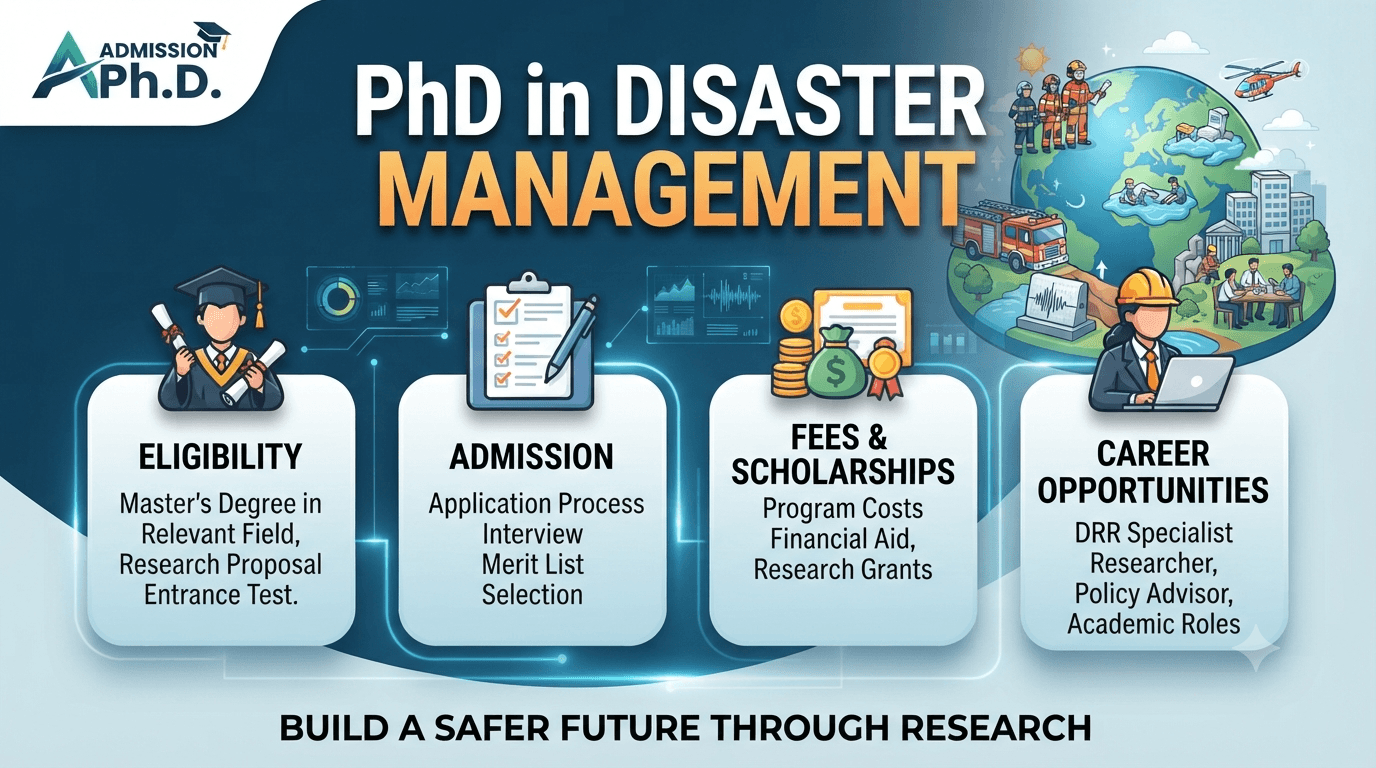
PhD in Disaster Management
Introduction
Disasters affect societies, infrastructures, economies, public health, and eco-systems simultaneously. Earthquake, flood, cyclone, landslide, drought, industrial accidents, fires, epidemic and hazards caused by climatic changes increased the demand for evidence-based disaster risk reduction and sustainable development.
A PhD in Disaster Management is a research based doctorate degree which focuses on disasters forecasting, avoidance, mitigation, management and recovery operations. Depending upon universities, this degree can be referred to as Disaster Management and Risk Reduction, Disaster Studies or Disaster Management and Mitigation.
This is a multi-disciplinary subject and may require knowledge in environmental science, engineering, geography, social sciences, public policy, economics, public health, GIS, remote sensing, artificial intelligence and community studies.
For instance, IIT Guwahati offers PhD in Disaster Management and Risk Reduction while IIT Roorkee offers research work at their Centre of Excellence in Disaster Mitigation and Management. TISS offers PhD in Disaster Studies as well as JNU also offers PhD in Disaster Studies.
PhD in Disaster Management: Course Highlights at a Glance
| Particular | Details |
|---|---|
| Degree | Doctor of Philosophy (PhD) |
| Field | Disaster Management / Disaster Studies / Disaster Risk Reduction |
| Level | Doctoral |
| Typical Duration | Minimum 3 years |
| Maximum Duration | Generally up to 6 years under UGC 2022 regulations, subject to applicable extensions |
| Eligibility | Master's degree or qualifying 4-year bachelor's degree, depending on university rules |
| Minimum Marks | Commonly 55% at Master's level; university-specific rules apply |
| Admission Routes | UGC-NET/JRF, national-level qualifications and/or university entrance test + interview |
| Study Mode | Full-time; part-time availability depends on the institution |
| Research Areas | Disaster risk, resilience, climate hazards, GIS, early warning, emergency response, governance and more |
| Coursework | Research methodology, disaster studies and discipline-specific electives |
| Final Requirement | Original doctoral research, thesis submission and viva voce |
The UGC PhD Regulations 2022 say that the shortest time to finish a degree is three years. This includes classes and other work. The longest time allowed is six years. There are ways to extend this time in some cases.
Understanding the PhD in Disaster Management
A PhD in Disaster Management goes beyond learning how disasters are handled during emergencies. The main goal is to create research that makes people understand better get ready reduce damage respond, recover or become stronger after disasters.
A doctoral student might look into questions like:
The way the research is set up depends on the teacher the school, the tools that're available and the topic that the student chooses to study.
Why Study Disaster Management at Doctoral Level?
Disaster Management is increasingly connected with climate adaptation, sustainable development, technology, infrastructure planning, public health and governance. This makes doctoral research particularly interdisciplinary.
Major Advantages
How Long Does the Doctorate Take?
Under the UGC PhD Regulations 2022, the shortest time to finish a degree is 3 years, including coursework. The l maximum period is 6 years from admission, with provisions for re-registration and certain additional extensions under applicable institutional rules. Female scholars and Persons with Disabilities may receive additional relaxation under the regulations.
In practical terms, completion may take longer than the minimum because doctoral research involves:
Who Can Apply for a PhD in Disaster Management?
Eligibility varies according to the university and the research area.
Under the UGC PhD framework, candidates with a relevant Master's degree can generally seek admission, while candidates entering after a four-year bachelor's degree may also be eligible subject to the prescribed marks and institutional requirements. The UGC framework specifies 55% as the standard Master's-level benchmark and provides specified relaxation categories.
Academic Background
Suitable academic backgrounds may include:
However, the accepted subject background is not identical at every university.
Which Entrance Exams Matter?
There is no single examination that universally governs admission to every PhD in Disaster Management programme.
Depending on the university, admission may be through:
The UGC PhD Regulations allow higher educational institutions to admit candidates who qualify for fellowship/scholarship through recognised national-level tests based on interview and/or through an institution-level entrance test. For an institutional entrance test, the UGC framework specifies 50% research methodology and 50% subject-specific content, followed by an interview process.
An important recent development is that the National Institute of Disaster Management reports that Disaster Management has been included as a UGC-NET subject from December 2024.
From Application to Doctoral Registration: Admission Process
The admission process normally follows a sequence similar to this:
Check Eligibility
↓
Select University and Research Area
↓
Check Current PhD Notification
↓
Appear for UGC-NET/JRF or University Entrance, if applicable
↓
Submit Research Proposal / Concept Note, where required
↓
Shortlisting
↓
Interview / Viva Voce
↓
Supervisor / Research Area Allocation
↓
Coursework
↓
Research Proposal Approval
↓
Doctoral Research & Thesis
↓
Thesis Evaluation + Viva Voce
↓
Award of PhD
The exact selection formula differs by institution. For example, the current TISS Disaster Studies admission information uses UGC-NET categories and an interview, with specified weightage for NET and interview for certain candidates. TISS also requires a research proposal/concept note for the programme.
Understanding the Cost of a Disaster Management PhD
PhD fees vary significantly according to the institution, student category, mode of study, hostel requirements and other charges.
The following table provides broad indicative annual ranges, not fixed fee schedules:
| Institution Type | Approx. Annual Academic Fee | Typical Mode |
|---|---|---|
| Central Universities | ₹10,000 – ₹40,000 | Mainly Full-time; institution-specific options |
| IITs / Technical Institutes | ₹20,000 – ₹1,00,000+ | Full-time / Part-time depending on institute |
| Government / Public Universities | ₹15,000 – ₹75,000 | Full-time / Part-time where permitted |
| Deemed Universities | ₹50,000 – ₹2,00,000+ | Full-time / Part-time depending on programme |
| Private Universities | ₹80,000 – ₹2,50,000+ | Full-time / Part-time depending on university |
Scholarships and Financial Support for Doctoral Researchers
Funding can make a difference in lowering the money stress of doing a full-time PhD. When you have funding you don't have to worry as much, about tuition, living costs or loans. It helps you focus more on your research and studies. Many students rely on funding to keep going through their PhD. Without it the financial pressure can be much. So having funding really helps ease the burden.
UGC-NET JRF
Candidates qualifying for JRF may receive fellowship support according to applicable UGC norms, subject to the fellowship's conditions and tenure.
NIDM Doctoral Fellowship
The National Institute of Disaster Management which belongs to the Ministry of Home Affairs has set up a Doctoral Fellowship Programme in Disaster Studies. The Doctoral Fellowship Programme is meant for scholars who are studying full‑time PhD programmes at institutions that are recognised by the UGC. Only those students whose research focuses on Disaster Studies are eligible to receive support, from the Doctoral Fellowship Programme. NIDM states that selected fellows are eligible for JRF/SRF support according to UGC norms, subject to the programme conditions.
Institute Assistantship
Institutes such as IITs may provide assistantship/fellowship opportunities to eligible full-time doctoral scholars.
Other Research Fellowships
Depending on the research area, scholars may explore:
Funding must always be checked. It should be compared to the admission notification and fellowship guidelines.
What Will You Study During the PhD?
A Disaster Management PhD does not have one nationally identical syllabus. Coursework depends on the university and research area.
Typical doctoral coursework can include:
| Coursework Area | Possible Topics |
|---|---|
| Disaster Studies | Disaster concepts, risk, hazards and vulnerability |
| Research Methodology | Research design, sampling, qualitative and quantitative methods |
| Disaster Risk Reduction | Prevention, mitigation and preparedness |
| Risk & Resilience | Vulnerability, resilience and adaptive capacity |
| Geospatial Techniques | GIS, remote sensing and spatial analysis |
| Emergency Management | Response, relief and recovery |
| Disaster Governance | Institutions, policies, law and crisis leadership |
| Climate & Disaster Risk | Climate change, adaptation and resilience |
| Data Analysis | Statistical methods, modelling and data interpretation |
| Research Ethics | Academic integrity, publication ethics and responsible research |
Research Directions Worth Exploring
Research is central in the PhD programme. Some possible themes are:
Skills That Strengthen Disaster Management Research
A successful doctoral researcher requires a lot more than just the theoretical knowledge.
Key skills include:
For technology-oriented research, additional knowledge of Python, R, machine learning, GIS software, satellite data processing or spatial modelling can be useful.
How to Select the Right University for Disaster Research
Instead of selecting a university only for its name or fee structure, applicants should look at the research environment.
Universities and Institutes for Disaster Management Research
Availability, intake, mode and admission rules can change between admission cycles. The following institutions have documented doctoral-level disaster-related research programmes:
| University / Institute | Approx. Total Academic Fee* | Program Modes Available | Admission Basis |
|---|---|---|---|
| Indian Institute of Technology Roorkee | ₹3,07,000 - ₹3,09,000 | Full-time / Part-time categories subject to institute rules | Institute PhD selection process; eligibility and category-specific requirements |
| Tata Institute of Social Sciences, Mumbai | ₹3,81,000 - ₹3,83,000 | Regular Full-time | UGC-NET categories + interview; research proposal/concept note |
| Jawaharlal Nehru University, New Delhi | ₹1,019 - ₹1,031 | Institution-specific | University admission rules / applicable PhD selection process |
| Indian Institute of Technology Guwahati | ₹3,65,000 - ₹3,70,000 | Regular, Sponsored, Employed Part-time, External, Self-Financed and other categories subject to rules | Written test/interview or applicable national qualification, depending on category/programme |
| Rashtriya Raksha University | ₹1,50,000 - ₹4,55,000 | Programme-specific | University admission process |
*Fees are indicative and should not be treated as permanent fee schedules.
IIT Roorkee currently lists doctoral research in Disaster Management and Mitigation through its Centre of Excellence in Disaster Mitigation and Management.
TISS currently lists its PhD in Disaster Studies under the Jamsetji Tata School of Disaster Studies. Its programme is regular full-time and currently has a stated intake of three in the programme information.
JNU's Special Centre for Disaster Research documents its PhD programme in Disaster Studies and describes interdisciplinary research involving social sciences, ICT and geospatial sciences.
IIT Guwahati currently identifies a PhD in Disaster Management and Risk Reduction, with regular and several non-regular admission categories.
Rashtriya Raksha University also documents a PhD in Disaster Management offered from the 2024–25 academic session.
Career Opportunities After a PhD in Disaster Management
A doctorate can lead to many opportunities in different areas, such as academia, research, government, development organizations, consulting and disaster-specific projects.
Potential roles include:
| Career Area | Possible Job Roles |
|---|---|
| Higher Education | Assistant Professor, Research Faculty |
| Research | Research Scientist, Research Associate, Project Researcher |
| Government | Disaster Management Specialist, Risk Reduction Expert, Policy Researcher |
| NGOs / INGOs | Disaster Programme Specialist, Resilience Specialist, Humanitarian Researcher |
| Consulting | Disaster Risk Consultant, Climate Risk Consultant, Resilience Consultant |
| Geospatial Sector | GIS Specialist, Remote Sensing Researcher, Hazard Mapping Specialist |
| Climate Sector | Climate Adaptation Researcher, Climate Risk Analyst |
| Emergency Management | Emergency Planning Specialist, Preparedness Coordinator |
| Development Sector | Disaster and Development Specialist, Community Resilience Researcher |
| International Organisations | Disaster Risk Reduction / Resilience Research and Programme Roles |
PhD can be relevant, for research- positions but a PhD alone does not guarantee a specific designation or salary. Recruitment depends on the employer, the discipline, the amount of experience the number of publications the technical skills and the eligibility criteria that apply.
Salary After PhD in Disaster Management
There is no fixed salary for PhD in Disaster Management. The pay varies a lot depending on the organisation, the job role, the level of experience, the location and the funding source.
An Estimated range, for India may look like this:
| Career Stage / Role | Indicative Annual Salary |
|---|---|
| Entry-level research / project roles | ₹3–6 lakh |
| Disaster / resilience programme roles | ₹5–10 lakh |
| Experienced specialist / consultant | ₹8–18 lakh |
| Senior research / programme management | ₹12–25 lakh+ |
| Academic positions | Depends on institution and applicable pay scale |
For example, latest government job advertisements continue to display UGC Academic Level 10 for Assistant Professor posts with a starting basic pay scale of ₹57,700, subject to respective recruitment policies and allowances.
Therefore, salaries should be computed considering the particular position, and not assuming every PhD graduate gets the same compensation.
Where Can Disaster Management Research Go Next?
Future Scope of PhD in Disaster Management
The future scope of Disaster Management research is closely linked with environmental, technological and societal challenges.
NIDMs current research initiatives show this research environment: its Doctoral Fellowship Programme helps people who are studying disasters and its research projects also involve practical research and giving credit to doctoral work, in disaster studies.
Summary
The Doctor of Philosophy in Disaster Management is a research-focused degree program that concentrates on reducing the risks associated with disasters getting ready for them limiting their impact responding to them and helping communities recover after them. It covers subjects such as disasters caused by climate change building disaster resilience using Geographic Information Systems and remote sensing, managing emergencies handling disaster governance and making communities more ready for disasters. The requirements to join the program, how to apply how much it costs and how it is taught can be different at each university in India. Opportunities for people with this degree are growing because of climate change and new technologies that help make things more resilient, to disasters.
Frequently Asked Questions
Related Articles

PhD in Biosensors: Eligibility, Fees, Admission & Career
Explore PhD in Biosensors in India, including eligibility, entrance exams, admission process, fees, syllabus, research areas, universities, careers & salary.

PhD in Food Technology in India: Eligibility, Fees, Admission & Career
Explore PhD in Food Technology in India, including eligibility, admission, fees, entrance exams, syllabus, research areas, universities and careers.

PhD in Quality Management in India: Admission & Career
Explore PhD in Quality Management in India, including eligibility, admission process, entrance exams, fees, syllabus, research areas, career options & salary.