
Get Free Admission Guidance
Share your details and our counselors will call you.
PhD in Home Science: Admission, Eligibility, Fees, Syllabus & Scope
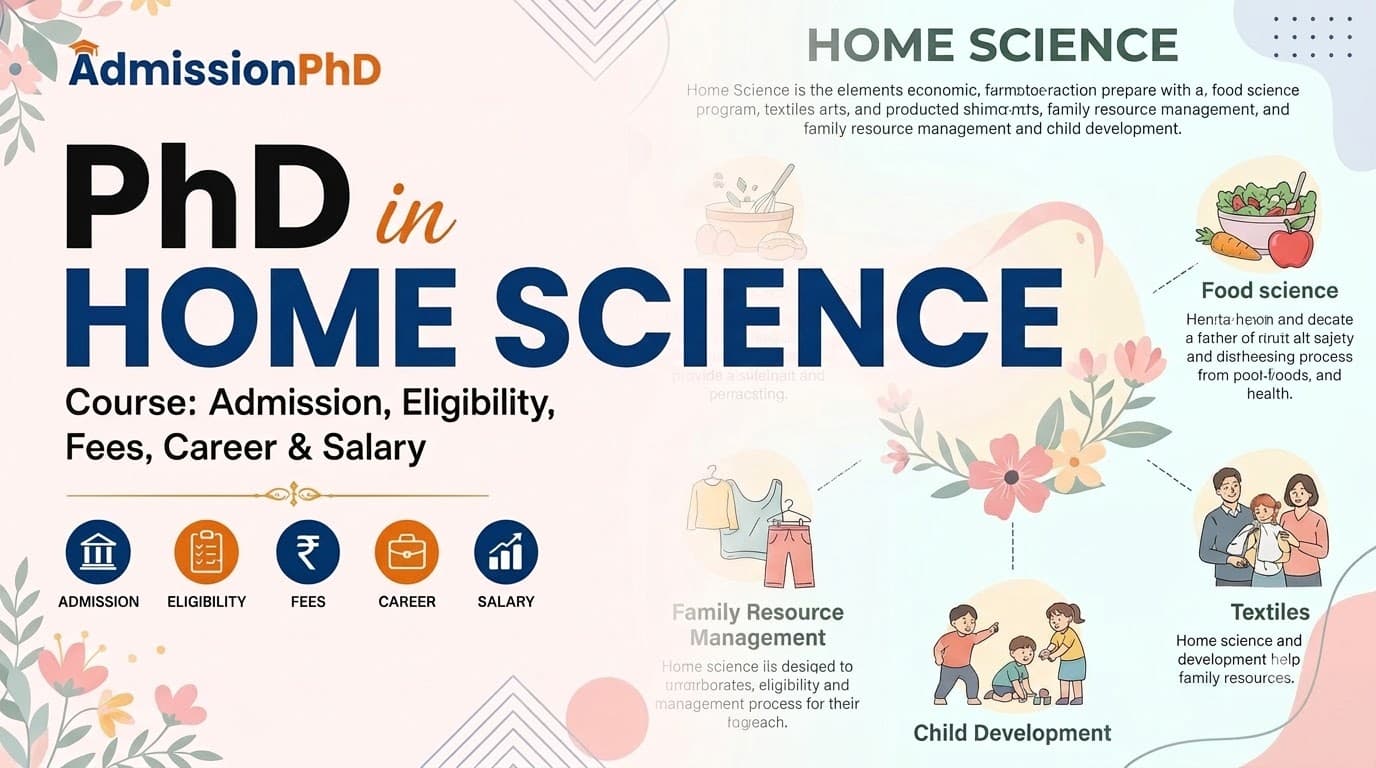
PhD in Home Science: Explore Research, Admission & Career Opportunities
Home Science is more than running a home today. Today family and consumer sciences includes food and nutrition, human development, textiles, family resource management, community development, extension education and consumer studies. This makes it a broad and interdisciplinary subject for students wishing to pursue a career in research, teaching, community development, policy or specialised professional areas.
PhD in Home Science is for students who wish to go beyond class room learning and take up real world problems through systematic research. Depending on the university and specialisation scholars may study topics related to nutrition and health, child development, sustainable textiles, family well-being, rural development, resource management or communication and extension.
The admission process, eligibility, entrance requirements, fees, syllabus, duration, universities, research areas and career opportunities are useful to know if you are planning to pursue doctoral study in this field and can help you make your decision easier.
This guide is all about the Ph.D. in Home Science Admission process. It is in simple language. We have also discussed the important things that you should know before applying.
PhD in Home Science: Course Highlights
| Particular | Details |
|---|---|
| Course Name | PhD in Home Science |
| Course Level | Doctorate |
| Course Type | Full-Time / Part-Time |
| Duration | 3 to 6 years (depending on research progress) |
| Eligibility | Master’s degree in Home Science or a relevant social science stream with a minimum of 55% aggregate marks |
| Admission Process | Entrance Exam / National-Level Qualification + Interview* |
| Entrance Exams | UGC-NET/JRF, University PhD Entrance Tests and applicable routes |
| Research Areas | Food and Nutrition, Human Development and Family Studies, Family Resource Management, Extension Education |
What Is a PhD in Home Science?
PhD in Home Science is a research based advanced degree program. Students study a particular problem or topic related to Home Science and add new knowledge to the field.
A PhD differs from an undergraduate or postgraduate course in that it is research focused. You don’t just learn about existing knowledge. You find a problem to research, look at previous studies, pick methods that suit, collect and analyze information and present your findings in a doctoral thesis.
Research in Home Science may comprise following areas depending upon the university:
- Food & Nutrition
- Human Development Family Studies Child Development
- Clothing and Textiles
- Family Resource Management Home Science and Resource Management Development Communication Extension Education Community Development
- Consumer Science
- Health & Well-being
- Development of Rural
The Institute of Home Economics, University of Delhi, for instance, provides doctoral work in five specializations of Home Science, namely Food and Nutrition, Human Development and Childhood Studies, Fabric and Apparel Science, Resource Management and Design Application and Development Communication and Extension.
This variety fits the PhD Program to students with diverse academic interests.
Why Choose a PhD in Home Science?
A doctoral degree can be a good choice if you are interested in research and want to develop specialist knowledge in a particular area.
Some reasons to consider this program:
- Chance to become a subject specialist
- Developing advanced research skills
- Teaching and careers in academia
- Research article
- Exposure to seminars and conferences
- Chance to work on social and community issues
- Opportunities within research organizations and institutions
- Scope for input into education, health and development
- Opportunity to work on emerging areas like Sustainable Textiles, Food Security
Home Science is interesting because many of the research areas are related to our day to day life. Research can help solve real world problems related to nutrition, family well-being, child development, sustainability, community development and resource use.
Advantages of Pursuing a PhD in Home Science
Pursuing a doctorate in Home Science offers a number of professional and educational benefits.
- Specialized fields of Home Science and advanced knowledge in
- Excellent research and analysis skills
- Strong academic and research writing ability
- Improved understanding of research methods and techniques
- Paper Publication Opportunities.
- Experience in data collection and analysis in research
- Higher Education Teaching and Research Opportunities
- Careers in research, education and community development
- Training in skills of critical thinking and problem solving
Duration of PhD in Home Science Program
PhD in Home Science Duration is normally 3 years including coursework. The normal maximum period is 6 years from the date of admission. Total period can be extended up to 8 years in applicable cases, through re-registration as per rules of concerned university.
The duration of the program may vary depending on the student’s research progress, university requirements and the complexity of the research topic. What a typical PhD journey may look like:
- Coursework: Completion of subjects in research methodology and the selected area of Home Science.
- Research Proposal: Identification of research problem, literature review and research planning
- Data collection: Conduct surveys, interviews, experiments, laboratory or field studies, as appropriate to the subject.
- Data Analysis The data obtained is organized and analyzed by using appropriate research methods.
- Thesis Preparation: Write-up of research findings, conclusions and recommendations in the required academic format.
- Thesis Submission: Submit completed thesis in accordance with university guidelines.
- Thesis Evaluation and Viva Voce: To undertake the required thesis evaluation and oral defense process.
For example, research in Food and Nutrition may involve laboratory or field-based data collection while research in Human Development or Family Studies may require surveys, interviews and participant-based studies. This can affect the time it takes to complete the research.
Eligibility Criteria for PhD in Home Science
The eligibility criteria for PhD in Home Science differs from university to university. Candidates should have the academic qualifications, minimum marks and other requirements laid down by the concerned university and applicable UGC regulations.
1. Educational Background
Master’s Degree:
Candidates should normally have a Master’s degree or equivalent qualification from a recognized university with the minimum marks required. Universities might prefer or require a postgraduate degree in Home Science or a relevant/related discipline for a PhD in Home Science depending on their admission rules.
Bachelor’s Degree ( 4-Year / 8-Semester ):
Candidates who have completed a 4-year/8-semester bachelor’s degree are also eligible for admission to PhD provided they fulfill the prescribed conditions. Candidates coming through this route generally need to have a minimum of 75% marks in aggregate or an equivalent grade as per the UGC PhD Regulations.
M.Phil. Specialization:
Candidates possessing M.Phil. degree with the required marks or equivalent grade may also be considered for admission to PhD as per UGC regulations and university rules.
2. Minimum Marks Required
For Master Degree:
Candidates should have normally obtained at least 55% marks or equivalent grade in Master’s degree.
For 4 Year Bachelor Degree:
Candidates applying through a four year bachelor’s degree route should generally possess at least 75% marks or an equivalent grade in aggregate, as prescribed under the applicable UGC framework.
Relaxation in Marks
Candidates belonging to the categories such as SC/ST/OBC (Non-Creamy Layer)/Differently-Abled and other categories as per the applicable government and university rules may be allowed a relaxation of 5% marks or equivalent grade.
3. PhD in Home Science Admission Process
The Admission process for PhD in Home Science can vary from university to university and also from their admission regulations. Some common routes may be :
- Admission is through a qualifying national level fellowship/ scholarship examination followed by an interview.
- University entrance examination followed by an interview.
- Any other mode of admission as provided under the relevant UGC Regulations and University Rules.
The UGC framework states that if the university conducts its own PhD entrance examination, then 50% of the entrance test should be on research methodology and 50% of the test should be on subject-specific content. Those who are selected through the entrance-test route may be called for an interview as per the admission rules of the university.
Admission Procedure for PhD in Home Science
PhD in Home Science Admission Process Steps Generally, the process comprises application, eligibility check, entrance test or exemption, interview and Final selection. The exact procedure can differ from university to university.
Step 1: Application and Register
Candidates need to apply through the official website of the university with their academic details, required documents and other details. Some universities may require a research proposal or a preferred research area.
Stage 2: Entrance Test
University checks the eligibility of the candidate. Admission is possible either through a recognized national level fellowship/qualification followed by an interview or through a university entrance test. Where a HEI conducts its own entrance test, the UGC framework has 50% weightage for Research Methodology and 50% for subject-specific content.
Stage 3: research
Shortlisted applicants may submit a research proposal, which should include research problems, objectives, literature review, methodology and expected outcomes.
Stage 4: The Interview
Candidates may be tested on their research aptitude, subject knowledge, research interests and proposed research topic.
Stage 5: Final Choice & Supervisor
The university makes the merit list according to its approved criteria for admission. The allocation of a research supervisor depends on the research area, faculty expertise and availability.
Stage 6: Admission and Academic Program
Selected candidates undergo document verification, pay fee and complete other admission formalities The doctoral course work generally includes Research Methodology, Research and Publication Ethics, and other courses as prescribed by the university.
Fees Structure for PhD in Education
The PhD in Home Science Fees can differ from institution to institution and is based on the nature of the university, the course structure, and the facilities that the university offers. The fees levied by public universities differ from that of private and deemed universities. Furthermore, the application, registration, course, examination, and thesis fees are levied separately by the universities.
| Fee Particulars | Central Public Universities (e.g., DU, BHU, AMU) |
State Public Universities (e.g., MLSU, SPPU, Calcutta University) |
Top Private & Deemed Universities (e.g., Amity, LPU, SGRR University) |
|---|---|---|---|
| Application & RET Fee | ₹600 – ₹1,200 | ₹1,000 – ₹2,500 | ₹2,000 – ₹3,500 |
| One-Time Admission / Registration | ₹1,000 – ₹5,000 | ₹4,000 – ₹10,000 | ₹10,000 – ₹25,000 |
| Annual Tuition / Academic Fee | ₹2,400 – ₹9,000 per year | ₹12,000 – ₹40,000 per year | ₹80,000 – ₹1,50,000 per year |
| Coursework & Exam Fee | ₹1,000 – ₹3,000 | ₹2,000 – ₹6,000 | ₹6,000 – ₹15,000 |
| Thesis Submission / Evaluation | ₹2,000 – ₹5,000 | ₹5,000 – ₹12,000 | ₹10,000 – ₹25,000 |
| Total Estimated Expense (3–5 Years) | ₹8,000 – ₹35,000 | ₹45,000 – ₹1,50,000 | ₹2,40,000 – ₹5,00,000 |
PhD in Home Science Scholarships and Funding Opportunities
Pursuing a PhD in Home Science may involve tuition fees, research expenses, travel and other academic costs. Eligible scholars can search for fellowships offered by UGC, ICSSR, universities and other funding agencies. The amount, duration and eligibility requirements vary depending upon the particular fellowship or institution.
1. Government Scholarships & Fellowships:
JRF (UGC Junior Research Fellowship)
The candidates qualifying for UGC-NET-JRF shall be eligible for a fellowship of Rs. 37000/- (Rupees Thirty Seven Thousand Only) per month for the first two years and Rs. 42000/- (Rupees Forty Two Thousand Only) per month for the remaining period of SRF as per the applicable rules of the fellowship. UGC also provides contingency support of ₹10,000 per year during JRF and ₹20,500 per year during SRF for Humanities and Social Sciences .
ICSSR Doctoral Fellowship
Home Science research under the relevant social-science disciplines may be considered for ICSSR Doctoral Fellowship, subject to the eligibility and selection criteria of the scheme. The Full Term Doctoral Fellowship offers a monthly fellowship of ₹20,000 and an annual contingency grant of ₹20,000 for two years.
Category-Specific UGC Fellowships:
Eligible scholars can also look into UGC fellowships for particular categories. For instance, the Savitribai Jyotirao Phule Fellowship for Single Girl Child supports the eligible single girl child pursuing PhD research by providing ₹37,000 per month for JRF and ₹42,000 per month for SRF, and applicable contingency support.
2. University Scholarships and Research Funding
University Scholarships / Assistantships:
Some universities may provide scholarships, fellowships, teaching assistance or research assistance to PhD scholars. The availability, amount and eligibility depend on the individual university, so candidates should check the latest PhD admission notification.
Funded Research Projects:
PhD scholars may also find opportunities to work on funded research projects as research assistants, project fellows or in similar roles, depending on the project's requirements, research area and available positions.
Important Note
Not all the PhD scholars automatically become eligible for fellowships. Candidates must fulfil the eligibility conditions and selection criteria of the respective scheme. Students are advised to check the latest official notification before applying as the fellowship amount and rules may also be revised.
PhD in Home Science Syllabus
The PhD in Home Science syllabus generally includes research methodology, advanced Home Science studies, and research ethics. As per UGC PhD Regulations, 2022, doctoral coursework shall be mandatory with minimum credits of 12 including Research Methodology and Research and Publication Ethics (RPE). The syllabus and detailed coursework may vary from one university to another.
Module 1: Research Methods
This module can include:
- Research methods and approaches
- Qualitative, quantitative and mixed methods research
- Research design and research questions
- Data collection and sampling
- Analysis and interpretation of data
- Literature Review and Identification of Gaps
- Academic and dissertation writing
Module 2: Advanced Studies in Home Science
The syllabus of the PhD in Home Science may include advanced topics related to the following, depending on the university and research specialization:
- Food & Nutritional
- Human Development and Family Studies
- Textile and Apparel Studies
- Family and Resource Management
- Extension and Community Development
- Food Science and related fields
The courses are different depending on the scholar’s research subject and the approved courses at the university.
Module 3: Ethics in Research and Publication
This module covers responsible research practices, including:
- Academic integrity and research ethics
- Plagiarism and authorship responsibilities .
- References and Citations 1.
- Ethics of publication
- The peer review practices
- Research data collection and management: Ethical issues
Module 4: Research Work and Position
They then proceed to do their research within the doctoral framework of the university after they have completed their coursework. The scholar's research proposal, methodology and progress are reviewed by a Research Advisory Committee.
Top Universities for PhD in Home Science in India
The table below outlines the top Indian universities for a PhD in Home Science, including their program modes, approximate total fee structures, and current selection criteria:
Here is the shortened summary of the Ph.D. in Home Science details presented in a scannable table format:
| University Name | Mode | Total Fee Range | Admission & Selection Process |
|---|---|---|---|
| University of Delhi (DU) / Lady Irwin College | Full-Time | ₹25,000 – ₹35,000 | 70% UGC-NET score + 30% Interview & Research Proposal Defense. |
| Banaras Hindu University (BHU) | Full-Time | ₹18,000 – ₹28,000 | UGC-NET score + Faculty Research Viva-Voce & Document Verification. |
| Aligarh Muslim University (AMU) | Full-Time | ₹90,000 – ₹95,000 | AMU Entrance Test (50% min.) + Interview. JRF holders skip the written test. |
| Avinashilingam Institute for Home Science | Full & Part-Time | ₹66,000 – ₹1,07,000 | 55% in PG + valid UGC-NET score + Doctoral Committee evaluation. |
| SNDT Women's University | Full & Part-Time | ₹50,000 – ₹85,000 | SNDT PET exam + Committee interview. UGC-NET/SET holders skip the written test. |
| Lovely Professional University (LPU) | Full & Part-Time | ₹3,00,000 – ₹4,50,000 | LPUNEST or UGC-NET/JRF score + Panel Defense of Research Plan. |
| Amity University | Full & Part-Time | ₹2,50,000 – ₹4,00,000 | Amity Selection Test or UGC-NET + Faculty Research Committee Interview. |
What Can You Research During a PhD in Home Science?
Do not choose your research topic just because it sounds interesting. It should be academically relevant, have a clear research problem, available data or participants, appropriate research methods and be supported by faculty or a research supervisor.
1. Food & Nutrition
Research can be directed toward:
- Community nutrition
- Functional food products
- Nutrition of mother and child
- Food processing
- Eating behavior
- Nutrition and public health
2. Human Development and Family Studies
This area may comprise:
- Development of the child
- Development of adolescents
- Parenting Aging
- Family Relationship
- Early childhood learning
- Mental and Social Health
3. Textile and Garment
Potential research topics include:
- Textiles, green
- Traditional textiles
- Clothing design
- Technology of Textiles
- Consumer behavior.
- Sustainable fabrics
- Clothing and culture studies
4. Family Resource Management
Research might explore:
- Household resource management
- Consumer research
- Housing
- Indoor environments
- Managing finances
- Time Management Ergonomics
5. Community development and extension education
This area might include:
- Rural development
- Women’s empowerment
- Community Learning
- Extension communications
- Skills development
- Development projects.
- Social consciousness
- Livelihood development
Careers Opportunities for PhD in Home Science
A PhD in Home Science is the gateway to career opportunities in education, research, health, community development and industry.
- Teaching & Academia: Be a professor, lecturer or academic professional.
- Research Connect universities, research institutes and research projects.
- Nutrition & Health: Work on nutrition research, health programs and community projects.
- Human Development: Develop programs for child, family and social development.
- Education & Policy: Assistance with education planning, policy research and development programs.
- Consulting: Give specialist knowledge to companies and institutions.
- EdTech: Explore research and content jobs in education technology.
All rights reserved
Frequently Asked Questions
Related Articles
PhD in Community Medicine: Eligibility, Admission & Career
Explore PhD in Community Medicine in India, including eligibility, admission process, research areas, top universities, career opportunities and salary.

PhD in Industrial Engineering in India: Eligibility, Fees & Career
Explore PhD in Industrial Engineering in India, including eligibility, admission, entrance exams, fees, syllabus, research topics, universities, scholarships, salary and career scope.

PhD in Business Administration : Eligibility, Fees & Career
Explore PhD in Business Administration in India, including eligibility, admission process, exams, research areas, scholarships, universities, careers & salary.