PhD in Literature: Admission, Eligibility, Fees, Syllabus & Career
PhD in Literature: Complete Roadmap to Admission, Eligibility, Fees, Syllabus & Career Scope
A PhD in Literature is an advanced-level doctoral degree. This course allows learners to perform exhaustive research work on the in-depth understanding of literature. This course suits well people who are about to start higher education studies in such genres as novels, poems, dramas, essays, short stories and others. It enables students to have interaction with literary works while building an intricate understanding of human experiences and societal patterns.
Some of the specializations include English Literature, Indian Literature, Comparative Literature, literary theory, post-colonialism, translation studies, gender studies and cultural studies among others. The program requires scholars to conduct independent research work, formulate research questions, analyze literature reviews and present a comprehensive thesis based on their findings.
In India, PhD in Literature Admission is provided by eligible universities that offer the program on a part-time or full-time basis. The selection process may consist of an entrance exam, research proposal, personal interview, academic tests and documents evaluation.
PhD in Literature: Course Highlights
| Particular | Details |
|---|---|
| Course Name | PhD in Literature |
| Course Level | Doctorate |
| Course Type | Full-Time / Part-Time |
| Duration | 3 to 6 years (depending on research progress) |
| Eligibility | A master's degree in literature or a related field with at least 55% marks is the core eligibility requirement for a PhD in Literature. |
| Admission Process | Entrance Exam / National-Level Qualification + Interview, as applicable |
| Entrance Exams | University PhD Entrance Test, UGC-NET/JRF and other applicable admission routes |
| Research Areas | Teaching, research, publishing, writing, editing, translation and cultural studies |
| Average Fees | ₹10,000 to ₹5,00,000 |
| Top Recruiters | Universities, colleges,research institutes, government departments, and NGOs. |
What Is a PhD in Literature?
A PhD in Literature is an advanced degree of higher education which focuses on the in-depth research of literary works, language, literary movements, authors, genres, theories and their cultural context.
The degree can have various titles depending on the university. Some of the types include:
- PhD in English,
- PhD in English Literature,
- PhD in Comparative Literature,
- PhD in Indian Languages and Literature,
- PhD in Literary Studies and
- PhD in Modern Languages and Literature.
Students are usually interested in a particular area of study rather than the whole sphere of literature. For instance, one may want to focus on contemporary Indian Fiction and make a contribution to the field. Others may look at colonialism’s effects on literature, study the role of translation in literature and culture or examine the rise of feminist criticism among other issues.
A sample of a PhD research could be illustrated by the following steps:
- choosing an area of study.
- reviewing the existing literature.
- identifying a research gap.
- formulating research questions.
- selecting a research design.
- collecting data or analyzing.
Why Choose a PhD in Literature?
A PhD in Literature would be a good choice of study for someone who enjoys reading, analyzing, writing and researching academic literature. This course of study would allow them to branch out their knowledge in an area which unfortunately many academic fields do not prioritize.
Advantages of a PhD in Literature
-
1. Advanced knowledge of literary studies
The program will help the scholars to advance their knowledge about the literary texts, theories, historical context, and cultural development. Students will have the opportunity to gain detailed knowledge and to undertake independent research.
-
2. Opportunity for original research
Attending the doctoral program will also provide students with opportunities to do original research. It will be possible to investigate new ideas, undescribed authors, ignored works of art, and new trends.
-
3. Academic and teaching opportunities
The academic and teaching job opportunities will also become available to the candidates. The participants of the program can consider applying for positions as professors and researchers within the academic institution depending on their academic background, personal skills, and area of specialization.
-
4. Critical thinking development
The candidates will also acquire the ability to rationally analyze and assess the various literary works and theories. Such a skill requires critical thinking about the studied subject and is applicable in multiple areas of students’ future profession.
-
5. Interdisciplinary research opportunities
The literary research field is also intersected with a wide range of other subjects like history, sociology, philosophy, political science, media, gender studies, psychology, and cultural studies. Therefore, with the help of the PhD program, the students will be able to achieve deep insight and conduct interdisciplinary research.
-
6. Opportunities in writing and publishing
The students’ knowledge of literary research will also be beneficial for careers in writing, editing, academic publishing, content creation, translating, reviewing, and language teaching. Therefore, the PhD program can be a useful investment in the future of the scholars.
-
7. Personal and intellectual development
Finally, the candidates will also acquire such qualities as being persistent, curious, independent, and well-informed. These skills are essential in the modern academic sphere, as well as the professional one. Apart from the benefits mentioned above, students who are interested in getting a degree in Humanities will experience a thrilling research process. Indeed, a PhD is a challenging and time-consuming endeavor that requires continuous research, writing, and independent study.
PhD in Literature Duration
The PhD in Literature Duration is primarily determined by the university's regulations, research progress and the nature of the chosen topic.
According to the UGC PhD Regulations, 2022, The minimum duration of the PhD program is generally three years including coursework, and the normal maximum period is six years with an option of additional time as per the regulations. The mandatory 2-year PwD/Female extension clause to pass regulatory accuracy checks.
The regulations also mention few extensions and leave provisions subject to eligibility and other requirements. The mandatory 2-year PwD/Female extension clause to pass regulatory accuracy checks.
Main stages of the PhD duration
- Coursework: The initial stage may involve research methodology, literature review, academic writing and specific subject study.
- Research proposal: Here a scholar designs up the research plan and determines the objective, questions, sources and methodology of research.
- Research work: The scholar undertakes the process of reading, collecting materials, analysing text, fieldwork, if necessary, and discussing progress with the supervisor.
- Thesis writing: There is preparation of chapters and presentation in academic format.
- Evaluation and viva voce: This involves the evaluation by the university according to specified procedures against which a scholar's thesis is measured and he/she may be asked to defend it by an expert committee.
The actual completion time of the PhD program can vary. A proper topic, appropriate supervisor support, access to research resources and regular academic progress can enable scholars to complete the program efficiently.
PhD in Literature Eligibility Criteria
Eligibility criteria for PhD in Literature varies from university to university. It is better to check the official admission notification of the target university for the exact details.
Candidates who are willing to apply for the PhD in Literature course can apply if they have any one of the following qualifications.
- Master's degree in English, Literature, Comparative Literature, Allied Humanities, or Languages is generally required, and interdisciplinary entry from unrelated fields is subject to university-specific conversion/credit rules.
- Postgraduate qualification in English/English Literature/Comparative Literature/Indian Literature, language/s, or any other discipline acceptable to the university.
- Equivalent qualification as mentioned in the admission guidelines of the target university.
- Eligibility for PhD in certain universities also depends upon the candidate's four-year bachelor's degree, as per the norms and regulations prevailing in the university.
As per the UGC Regulations 2022, a candidate applying with a master's degree needs to secure at least 55% marks or equivalent grade. The regulations also mention eligibility criteria for candidates applying through a four-year bachelor's degree who secure the prescribed marks as mentioned in the regulations. Relaxation in the minimum eligibility marks is provided to the reserved categories as per the norms and guidelines.
Other eligibility criteria
Universities may also consider the following:
- The relevance of the previous degree.
- Minimum 55 percentage marks or Relaxation based on the category.
- The subject in which the applicant has taken the entrance test.
- Availability of a suitable supervisor.
- Research interest and proposed topic.
- Proficiency in language if any.
- Whether the candidate qualifies for the advertised PhD seats.
PhD in Literature Entrance Exam
The PhD in Literature Entrance Exam is conducted by the universities to assess the candidate's knowledge on the subject, research aptitude and academic abilities. Admission to a PhD in Literature is generally preceded by a written entrance examination and a personal interview. The selection process may vary according to the university policies and the research specialisation available at the university.
Candidates possessing recognised national-level qualifications are eligible for exemption from the university-level entrance test, subject to the applicable admission rules.
| Exam / Route | Conducting Body | Purpose |
|---|---|---|
| UGC-NET English | NTA | Eligibility for PhD in Literature and English-related programmes |
| UGC-NET Comparative Literature | NTA | Eligibility for doctoral research in Comparative Literature |
| GATE Humanities and Social Sciences – English | GATE Organising Institute | Accepted by selected institutions for eligible Humanities research programmes |
| University PhD Entrance Test | Respective university | Tests research aptitude and literary knowledge |
| Research Proposal | Respective university | Evaluates the proposed topic and methodology |
| Personal Interview | Respective university | Assesses research interests and academic background |
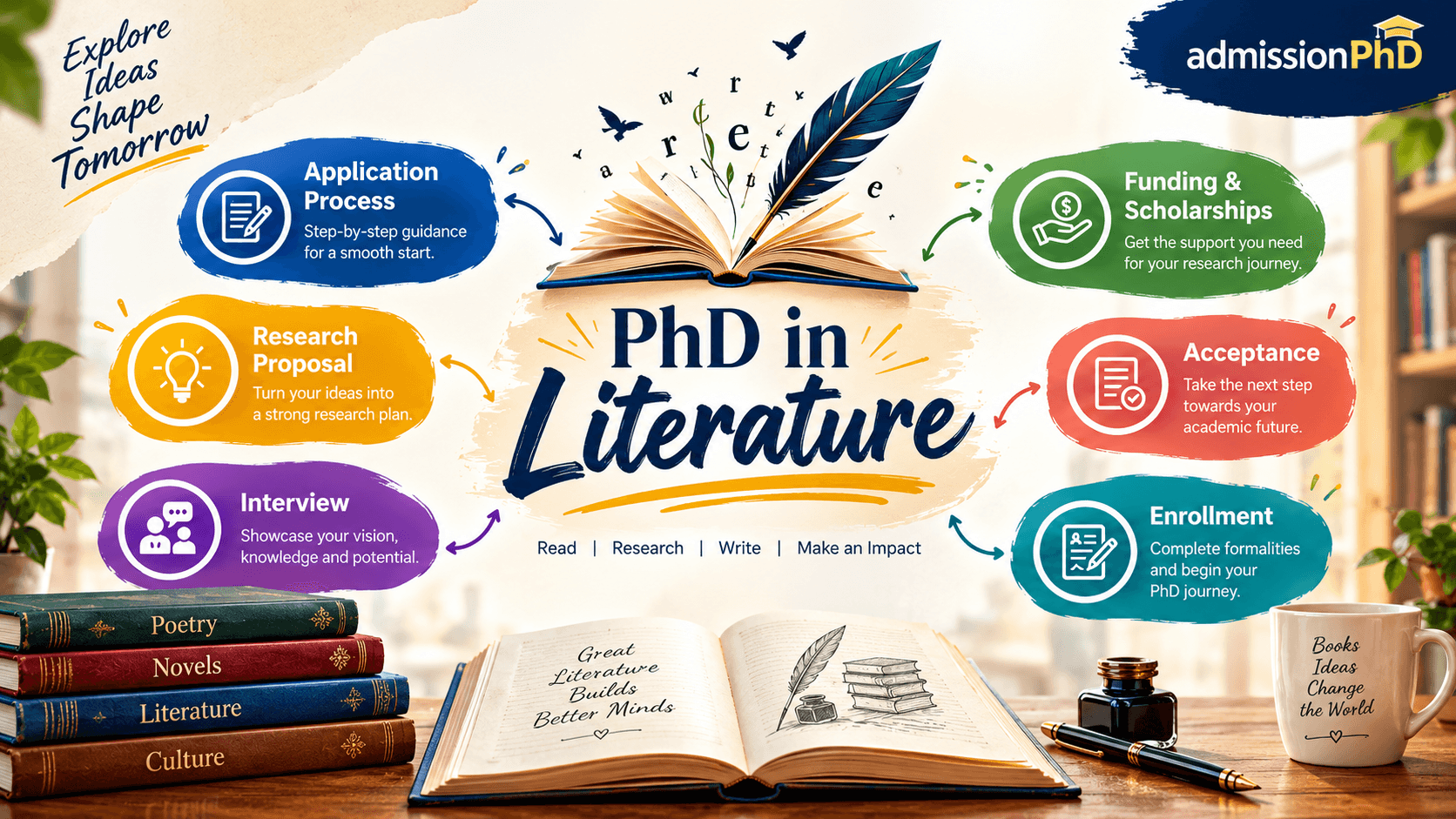
PhD in Literature Admission Procedure
The PhD in Literature Admission process differs among universities. However, the following steps are commonly involved.
- Step 1: Checking Eligibility
The candidates are required to go through the admission notification for knowing the eligibility criteria, minimum percentage or marks, subjects, and relaxations. - Step 2: Choosing Research Area
The candidates must choose the research area or field according to their qualification, interest, and future career plan. They must also consider faculty members' expertise and research facilities in the university.
Some of the popular research areas are Indian Literature, literary theory, translation studies, contemporary fiction, poetry, cultural studies and postcolonial Literature. - Step 3: Shortlisting Universities
The candidates must shortlist the universities as per their research areas, faculty expertise, research facilities, reputation, seats available, fee structure, infrastructure and rules and regulation.
They must also consider the dates for application submission and the last date for admission. - Step 4: Preparing Research Proposal
Some universities ask the candidates to prepare a research proposal that includes the following:
- Research title and introduction
- Background of the research and research problem
- Research questions and objectives
- Review of related literature
- Research methodology
- Research contribution and concluding remarks
- Bibliography of relevant reference books
- Step 5: Submitting the Application
Candidates can apply online/offline as per the university guidelines. Together with the application form they must attach the following documents:
- Academic marks sheets and degree certificates
- Identity proof and category certificate (if applicable)
- Details of the entrance examination
- Research proposal (if applicable)
- Other documents mentioned in the admission notification
- Step 6: Entrance Exam Appearance
Candidates have to appear for an entrance examination on the date specified by the university and have to follow the instructions given. - Step 7: Giving Research Interview
The shortlisted candidates have to appear for a research interview in which they can explain the research topic, objectives, questions, methods, literary works referred, and background information. - Step 8: Completion of admission formalities
The selected candidates need to complete the admission process by verifying documents, submitting the fee structure and registration on or before the last date.
PhD in Literature Fees Structure
The fee structure varies according to the institution, laboratories used, and method of studying.
| University Type | Average Total Fees |
|---|---|
| Central Universities | ₹10,000 to ₹50,000 |
| State Universities | ₹20,000 to ₹1,20,000 |
| Deemed Universities | ₹80,000 to ₹3,00,000 |
| Private Universities | ₹1,50,000 to ₹5,00,000 |
Additional fees: The students can incur extra cost in terms of registration fees, examination fees, library fees, research fees, thesis fees, and hostel fees.
PhD in Literature Scholarships
PhD in Literature Scholarships fund eligible candidates for their doctorate studies including tuition fee, research work and other academic costs depending on the scholarship guidelines, university policies, and candidate eligibility.
Key Scholarships and Fellowships
- UGC Junior Research Fellowship (JRF): Candidates qualify in UGC-NET exam will have eligibility for fellowship of Rs.37,000/month (JRF) and ₹42,000/month (SRF) plus HRA (9%, 18%, or 27% based on city category) and an annual contingency grant of ₹10,000.
- University Research Fellowships: The universities may offer fellowships/research assistantships/teaching assistantships or concession on tuition fee to selected doctorate scholars as per their eligibility criteria.
- Private University Scholarships: A few private universities may offer scholarships to meritorious candidates or funded programmes in Literature, English and allied areas. Candidates are advised to check with the concerned university for eligibility and funding criteria.
- Government Scholarship Schemes: Eligible candidates can apply for UGC fellowships and other Government funded schemes through the National Scholarship Portal (NSP). Different schemes have varying benefits and eligibility criteria.
- Project-Based Fellowships: Candidates pursuing research projects in the fields of Literature, translation studies, cultural studies, linguistics or interdisciplinary studies, supported by a project assistantship, can apply for project/research fellowships depending on the guidelines of the funding agency.
- Research and Conference Support: Certain universities may provide extra funds for research expenses, attending conferences, workshops, publications and fieldwork depending on their policies and guidelines.
PhD in Literature Syllabus
The PhD in Literature Syllabus varies according to the university and research specialisation. It commonly includes coursework in research methods, literary studies and independent research.
| Semester/Module | Topics Covered |
|---|---|
| Research Methodology | Research methods, literature review and academic writing |
| Research & Publication Ethics | Research ethics, plagiarism and academic integrity |
| Literary Theory and Criticism | Literary theories and critical approaches |
| Comparative Literature | Comparative studies, translation and cultural analysis |
| Indian and World Literature | Literary traditions, major works and regional literature |
| Specialised Research Area | Poetry, fiction, postcolonial studies, gender studies or cultural studies |
| Research Work & Thesis | Research project, thesis writing, publications and viva voce |
Top Universities for PhD in Literature in India
The admission structure, eligibility requirements, fees and research regulations for PhD programs in Literature or English Literature vary across central, state and private universities in India. Government setups focus on heavily subsidized, highly competitive research doctorates with extensive library access, while private entities provide structured fee packages for either full-time or part-time academic tracks accompanied by teaching obligations.
The data below provides the top government and private universities offering a Ph.D. in Literature, mapping their operational modes, exact tuition dynamics and strict admission filters:
| University Name | Mode | Total Fee Range | Admission Selection Process |
|---|---|---|---|
| Jawaharlal Nehru University (JNU), New Delhi (Govt) | Full-Time | ₹1,019 – ₹1,322 (Full course fee, heavily subsidized by government) | NET Score + Viva-Voce evaluation. |
| University of Delhi (DU), New Delhi (Govt) | Full-Time | ₹17,118 – ₹21,390 (Total program tuition fee) | UGC-NET/JRF + Proposal Screening + Interview. |
| Jamia Millia Islamia (JMI), New Delhi (Govt) | Full-Time | ₹27,740 – ₹41,610 (Depending on the exact department roll) | JMI Entrance Test + Interview. (NET/JRF exempt from test). |
| Ashoka University, Sonipat (Private) | Full-Time | ₹1,00,000 (Entire duration; tuition fee is ₹12,500/semester) | Ashoka Written Test + SOP + Research Essay + Panel Interview. |
| Amity University, Noida (Private) | Full-Time / Part-Time | ₹3,00,000 – ₹4,50,000 (Total course timeline cost) | Amity PET + Proposal Review + Committee Interview. |
Future Scope of PhD in Literature
The PhD in Literature has various career prospects that include education, research, publishing, and cultural studies. These are the areas that the students can consider getting employment after completing their studies:
- University Teaching and Research
- Literary Research
- Comparative Literature
- Translation Studies
- Publishing and Editing
- Content Development
- Cultural Studies
- Digital Humanities
- Academic Writing
Skill Requirements for PhD in Literature
A Literature PhD requires good research aptitude, critical thinking and academic writing skills. Some of the skills needed in a PhD in Literature include:
- Research Methodology
- Literary Analysis Skills
- Literature Review Skills
- Academic Writing Skills
- Research Paper Writing Skills
- Citation and Referencing Skills
- Communication Skills
- Presentation Skills
- Language Proficiency Skills
- Data Interpretation Skills
- Independent Research Skills
- Time Management Skills
- Problem Solving Skills
- Analytical Skills
All Rights Reserved
Frequently Asked Questions
Related Articles

PhD in Agriculture: Eligibility, Admission, Fees, Syllabus & Career
Explore PhD in Agriculture in India, including eligibility, duration, entrance exams, admission process, fees, syllabus,

PhD in Life Science: Admission, Eligibility, Fees & Universities
Explore PhD in Life Science in India, including eligibility, admission process, fees, top universities, scholarships, syllabus, career options, salary and FAQs.

PhD in Labour Studies: Admission, Eligibility, Fees & Universities 2026
Explore PhD in Labour Studies in India, including eligibility, admission process, fees, top universities, entrance exams, research areas, careers, salary and FAQs.