
Get Free Admission Guidance
Share your details and our counselors will call you.
Ph.D. in Physics Course: Admission, Eligibility, Fees, Career & Salary
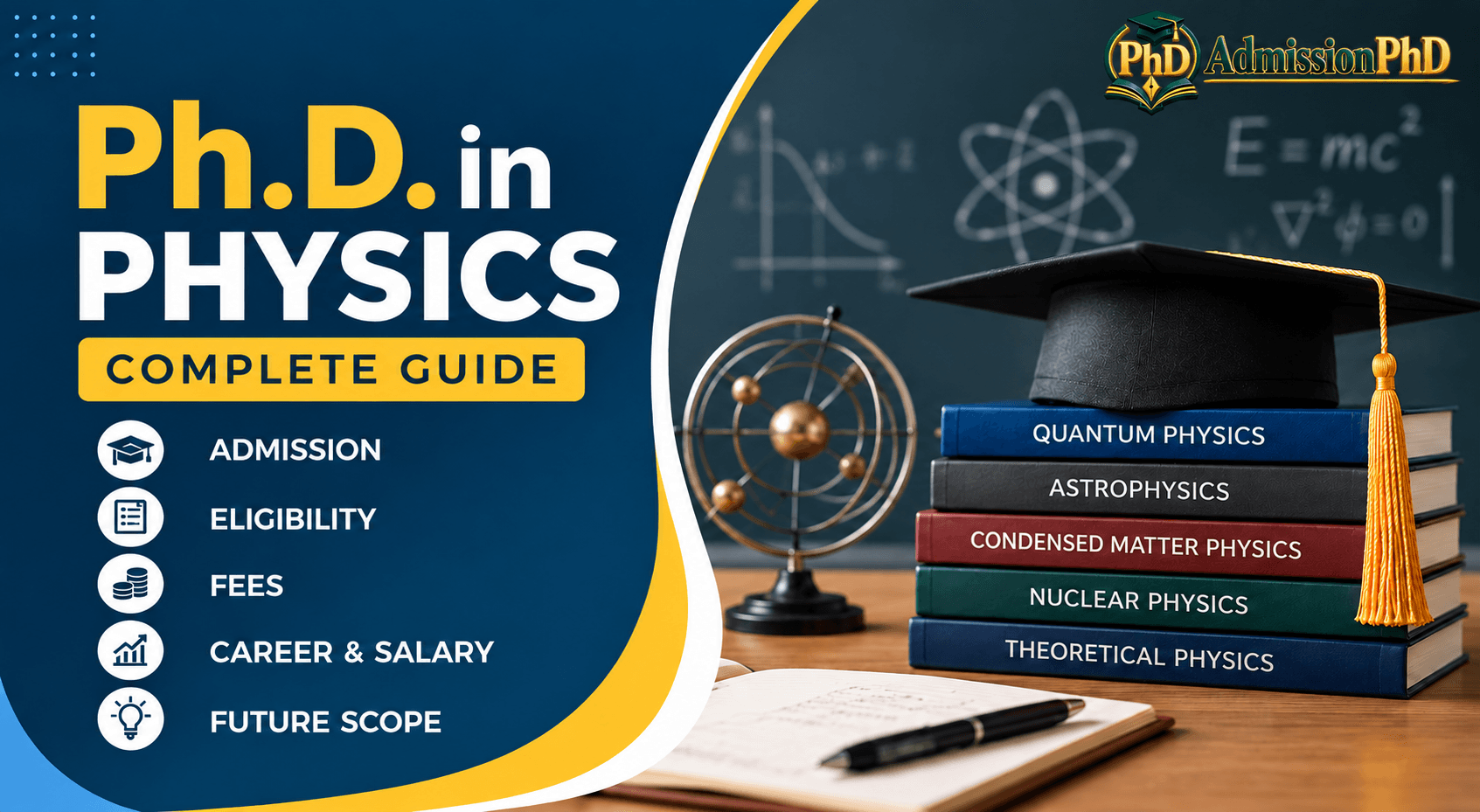
PhD in Physics is among the most advanced academic degrees for those students who wish to establish their career in scientific research, teaching, innovations, and technology. The course is designed for conducting in-depth studies and research in the subjects like theoretical physics, astrophysics, quantum mechanics, nuclear physics, condensed matter physics, particle physics, and materials science.
As compared to other educational courses, a PhD in Physics course is purely research-based. The students are mentored by faculty members or research supervisors, come up with a research question, conduct experiments or theoretical research, and make new discoveries in their respective field. The course also builds analytical and problem-solving abilities of the candidate.
In India, the admission for a PhD in Physics mostly depends upon the educational qualifications, entrance examination, research proposal, personal interview, and requirements of the university. The students can pursue their research in Physics from renowned universities, IITs, IISERs, and research institutions. In this blog post, we are going to discuss all about PhD in Physics in detail, including eligibility criteria, duration of the course, entrance exams, admission procedure, fees, syllabus, scholarships, best universities, career options, and salary packages.
A PhD in Physics is a research doctorate program tailored for students who aim at gaining expertise in the field of Physics and creating contributions through original knowledge of the discipline. This qualification is regarded as the highest level in Physics and involves much more research, investigation, experimentation and problem solving skills than any classroom-based learning. In the process of pursuing a PhD in Physics, scholars will choose a specific specialization in Physics and undertake research into a certain problem with the help of a mentor. The focus of PhD in Physics will not be on studying existing theories but investigating unknown aspects of the field.
There are several specializations for the PhD in Physics degree-
- Quantum Physics
- Theoretical Physics
- Astrophysics
- Nuclear Physics
- Particle Physics
- Chemical Physics
- Computational Physics
- Plasma Physic
- Optical Physics
- Materials Science
- Biophysics
- Solid State Physics
- Theoretical Physics
The PhD program is best suited for those who are keen on conducting scientific research, experimenting, investigations, and analysis. Prospective applicants typically require a post-graduate qualification in a relevant discipline in order to join the program, and the application criteria may differ from institution to institution.
PhD in Physics is not just about getting a PhD degree; rather, it is also an opportunity to conduct research on an advanced level and specialize in a particular area and thus make a contribution to science and technology.
Some of the major reasons that can be mentioned as follows are:
- Specialization in a particular area of Physics.
- Career in the field of teaching and academics.
- Research work and contributions to science.
- Venturing into new areas like quantum physics and astrophysics.
- Writing research papers for publication in authentic journals.
- Conducting research in research centers, laboratories and R&D organizations.
- Developing skills in solving problems.
- Participating in conferences within and outside the country.
- Making contributions to science and technology.
Even though criteria for eligibility differ according to the university, some general criteria include:
- At least 55% marks (50% for reserved categories if any).
- Passing a university or national level entrance test, where necessary.
- The conduct of interviews/viva-voce as part of the selection process.
- Presentation of research proposals in some universities.
- Compliance with the particular regulations formulated by the university concerned.
In addition, some universities may grant exemption from the entrance test to those candidates who qualify in national level eligibility tests/fellowship schemes such as CSIR-UGC NET, UGC-NET, etc., as per the admission regulations of the university.
The admission process typically includes the following:
Step 1: Application – The applicants apply for admission using the admission portal provided by the university.
Step 2: Document Verification – The documents that need to be submitted include:
- Graduation certificate
- Postgraduate certificate
- Marksheets
- Identification document
- Passport size photograph
- Category certificate, if any
- Experience certificate, if required
Step 3: Entrance Test – This test usually includes the topics such as:
- Core Physics
- Quantum Mechanics
- Classical Mechanics
- Electromagnetism
- Mathematical Physics
- Research Methodology
- Research Aptitude
Step 4: Research Proposal – Candidates have to submit a research proposal that includes:
- Research topic
- Objectives of research
- Research gap
- Methodology of research
- Expected results of research
Step 5: Interview – This involves the shortlisted candidates appearing in front of the research committee and being evaluated on the following points:
- Academic profile
- Interest in research
- Knowledge of the subject
- Understanding of the research to be done
- Viability of research
- Career goals
Step 6: Final Selection – The selection is made on the basis of the following:
- Performance in entrance examination
- Performance in interview
- Academic profile
- Criteria for reservation, if any
- Availability of research guides
If you are planning to pursue a PhD in Physics, you can also explore PhD admission opportunities in India to learn more about eligibility, entrance exams, universities, and the admission process.
| Fee Component | Government Universities | Private Universities |
|---|---|---|
| Admission Fee | ₹2,000 and ₹12,000 | ₹10,000 and ₹25,000 |
| Registration Fee (One-time) | ₹2,000 to ₹6,000 | ₹5,000 - ₹20,000 |
| Annual Tuition Fee | ₹10,000 - ₹50,000 | ₹60,000 - ₹2,00,000 |
| Research & Laboratory Fee (if applicable) | ₹2,000–₹10,000 per year | ₹10,000 – ₹50,000 per year |
| Examination Fee | ₹1,000 – ₹3,000 | ₹2,500 – ₹5,000 |
| Library Fee | ₹500–₹5,000 | ₹3,000 – ₹10,000 |
| Coursework Fee | ₹5,000 - ₹15,000 | ₹10,000 - ₹50,000 |
| Thesis Submission Fee | ₹5,000 - ₹10,000 | ₹15,000 - ₹35,000 |
Estimated Total Course Fee: Government/State Universities: ₹30,000 – ₹1,50,000+ for the entire program. Private Universities: ₹2,00,000 – ₹8,00,000+ (or more, depending on the institution and duration)
Besides tuition fees, there might be other costs associated with research and living that PhD in Physics students will have to account for, which include:
- Books and research material
- Research software and lab costs
- Traveling for research and conferences
- Publication charges of journals, if any
- Printing and binding of thesis
- Editing and proofreading
- Hostel charges, food, and travel
Other costs can vary from ₹20,000-₹1,00,000 and above depending upon the field of research.
Some of the universities have their own entrance test for PhD in Physics.
Some others take national level exams for admission and fellowship. The following are the exams conducted:
- CSIR-UGC NET (Physical Sciences) - It is a popular national level exam for candidates interested in pursuing JRF and PhD in Physics.
- UGC-NET (Physical Science/eligibility routes) – Some universities accept UGC-NET scores based on the eligibility criteria.
- GATE (Physics-PH): Some institutes like IITs and universities and other research institutes consider GATE scores for admission.
- JEST (Physics): The exam is taken by institutes for admission to their PhD and other higher-level courses in Physics.
- TIFR GS: The entrance exam is taken for admission to research programs at Tata Institute Of Fundamental Research and other institutes.
- University Specific PhD Entrance Exams: Some universities conduct their own entrance exam followed by an interview.
The eligibility criteria keep on changing every year, so it is better to check the admission notification of the university contacted.
PhD in Physics admission procedure has several steps.
- Step 1: Check Eligibility Criteria – Check the university website and see if you meet the academic and other eligibility criteria.
- Step 2: Fill Application Form – Fill the application form and upload all the necessary documents along with the processing fee.
- Step 3: Appear for the Entrance Examination – Most of the universities conduct a doctoral-level entrance examination. The entrance examination tests the research aptitude and literature knowledge of the candidate.
- Step 4: Prepare a Research Proposal – You will also have to prepare a research proposal which states your topic of research, its objective, methodology, and expected results.
- Step 5: Appear for an Interview – You will be interviewed by the Department Research Committee.
- Step 6: Final Selection – Selection of the candidates is done on the basis of marks obtained in entrance test, interview, academic record, research proposal, and availability of seats.
Students qualifying for examinations like CSIR-UGC NET JRF can get eligible for receiving fellowship for pursuing PhD in Physics. Eligible students can get monthly financial assistance in the form of fellowships as per the existing guidelines, eligibility criteria and fellowship policies.
Apart from this many universities and research institutes organize funds for attending conferences, publication of research papers, experiments and research work, accessing research material and facilities etc. Before applying students must check scholarship policies, eligibility criteria, fellowships, funding opportunities etc. offered by respective universities and research institutes.
PhD in Physics entails studying advanced level physics and research. The course syllabus includes:
- Research methodology
- Advanced mathematical physics
- Electrodynamics
- Statistical physics
- Computational physics
- Advanced studies in Physics
- Research ethics and academic writing
- Literature review
- Research proposal presentation
- Seminar and publication of research
- Research phase which involves experimental and theoretical research
- Collection and analysis of data
- Writing of thesis
- Publishing of results in research journals
- Research progress seminars
- Presentation of thesis before submission
- Thesis submission and viva-voce
Through the course, one gains in-depth knowledge of advanced level Physics and research which facilitates their doctoral thesis and completion of the course.
Students can choose to specialize in various fields of Physics according to their academic interests, research, and career objectives. Some of these fields are provided below:
- Quantum Physics – Study of Quantum-Hall effect, quantum mechanics, quantum information, quantum computing, and other allied subjects.
- Astrophysics & Cosmology – Deals with space, universe, stars, galaxies, black holes, gravitation, and other closely related topics.
- Nuclear Physics – Study of nucleus of an atom, its structure, nature of forces, and nuclear reactions.
- Particle Physics – Related to the study of smallest particles of matter and their interactions, and the forces that act between them.
- Condensed Matter Physics – Concerned with the study of solid and liquid matter. It includes superconductivity, magnetism, and other properties of condensed phases of matter.
- Materials Science – Related to advanced material design, nanotechnology, semiconductors, and their applications.
- Theoretical Physics – Concerned with the development of theory and formulation of mathematical laws that express the fundamental principles of Physics.
- Computational Physics – Uses numerical algorithms, scientific computing, and computer simulations to describe and model the behavior of physical systems.
- Plasma Physics – Involves the behaviour and properties of plasma that has applications in controlled energy research, space, and industry.
- Optics & Photonics – Includes the study of visible light, lasers, fibre optics, and other allied areas.
| Skill | Description |
|---|---|
| Knowledge of Physics | Expert knowledge of fundamental and higher-level Physics. |
| Mathematical Skills | Using advanced mathematical principles to solve problems related to Physics. |
| Research Skills | Identifying research areas and conducting independent research. |
| Analytical Skills | Solving complex problems and interpreting scientific results. |
| Experimental Skills | Creating experiments, operating lab equipment, and analysing experiment results. |
| Computational Skills | Programming, simulation, numerical analysis, and data analysis skills. |
| Critical Thinking | Objective analysing of scientific theories, evidence, and results. |
| Scientific Writing | Preparing scientific papers, research papers, and PhD theses. |
| Communication Skills | Presentation of research results through seminars and conferences. |
| Time Management | Efficient managing of coursework, research, papers, and thesis. |
There are many renowned institutes that offer PhD courses in Physics in India. It is advised that the aspirants must take into consideration many factors while choosing the institute such as the research area, expertise of faculties, research facilities, funding and admissions criteria.
| University/Institute | Type of Course | Total fees in average | Admission criteria |
|---|---|---|---|
| IIT Bombay | Both Full time & Part time | ₹73,000 -₹89,000 | GATE/NET + Interview |
| Indian Institute of Science (IISc), Bengaluru | Full-Time | ₹30,000 -₹41,000 | Entrance/NET + Interview |
| IIT Delhi | Both Full time & Part time | ₹30,000–₹80,000 | GATE/NET/Entrance + Interview |
| IIT Madras | Both Full time & Part time | ₹25,000–₹75,000 | Entrance/NET/GATE + Interview |
| IIT Kanpur | Both Full time & Part time | ₹25,000–₹70,000 | GATE/NET + Interview |
| IISER Pune | Full-time | ₹20,000–₹70,000 | GATE/NET + Interview |
| IISER Kolkata | Full-time | ₹20,000–₹70,000 | GATENET + Interview |
| TIFR, Mumbai | Full-time | ₹24,000 - ₹35,000 | TIFR GS/NET + Interview |
A doctorate degree in Physics helps open up various career options for the individual in the fields of academics, research, publishing, media, governmental and corporate bodies.
More Career options after completing PhD in Physics
One may develop his/her academic career after PhD in Physics by engaging oneself in research.
The salary after the completion of a PhD in Physics will depend upon one's experience
The scope of PhD in Physics is broadening as there are rapid advancements in science and technology. The need for qualified Physics researchers is on the rise in academia, research organizations, advanced technologies, and industrial research and development.
There are openings for Physics researchers in new fields like quantum computing, artificial intelligence, computational physics, space sciences, energy sources, nanotechnology, semiconductors, and advanced materials. There are opportunities for research collaboration, post-doctorate jobs, and teaching positions in international institutions as well.
There will be increased investment in scientific research and innovations, and thus, there will be a need for physicists who can contribute in various scientific innovations and developments.
Frequently Asked Questions
Related Articles

PhD in Biochemistry in India: Eligibility, Fees & Career
Explore PhD in Biochemistry in India, including eligibility, fees, syllabus, research areas, scholarships, top universities, career options & salary prospects.
PhD in Materials and Devices: Eligibility, Fees & Admission
Explore PhD in Materials and Devices eligibility, admission, fees, syllabus, research areas, top universities, careers, salary and future scope.

PhD in Bioinformatics in India: Eligibility, Fees & Career
Explore PhD in Bioinformatics in India, including eligibility, duration, entrance exams, admission process, fees, career opportunities & salary prospects.